DeepONet–FNO Estimation of a Road Dust Resuspension Intensity Index from Vehicle Trajectory Forcing and Particulate Sensor Data
Authors
Files
Key Information
Journal

Published in Vol. 4 No. 1 (2026) of Sustainable Energy and Environmental Engineering Journal.
The Sustainable Energy and Environmental Engineering Journal (SEEEJ) eISSN 3136-8174 is a peer-reviewed, interdisciplinary, and open-access academic journal that focuses on the development, deployment, and integration of sustainable energy technologies and environmentally responsible engineering practices.
SEEEJ serves as a forum for researchers, engineers, scientists, and policy experts to present original research and innovative solutions that address the twin challenges of global energy demand and environmental degradation. The journal emphasizes scalable technologies, real-world applications, and forward-looking strategies that support carbon neutrality and long-term ecological balance.
About the JournalAbstract
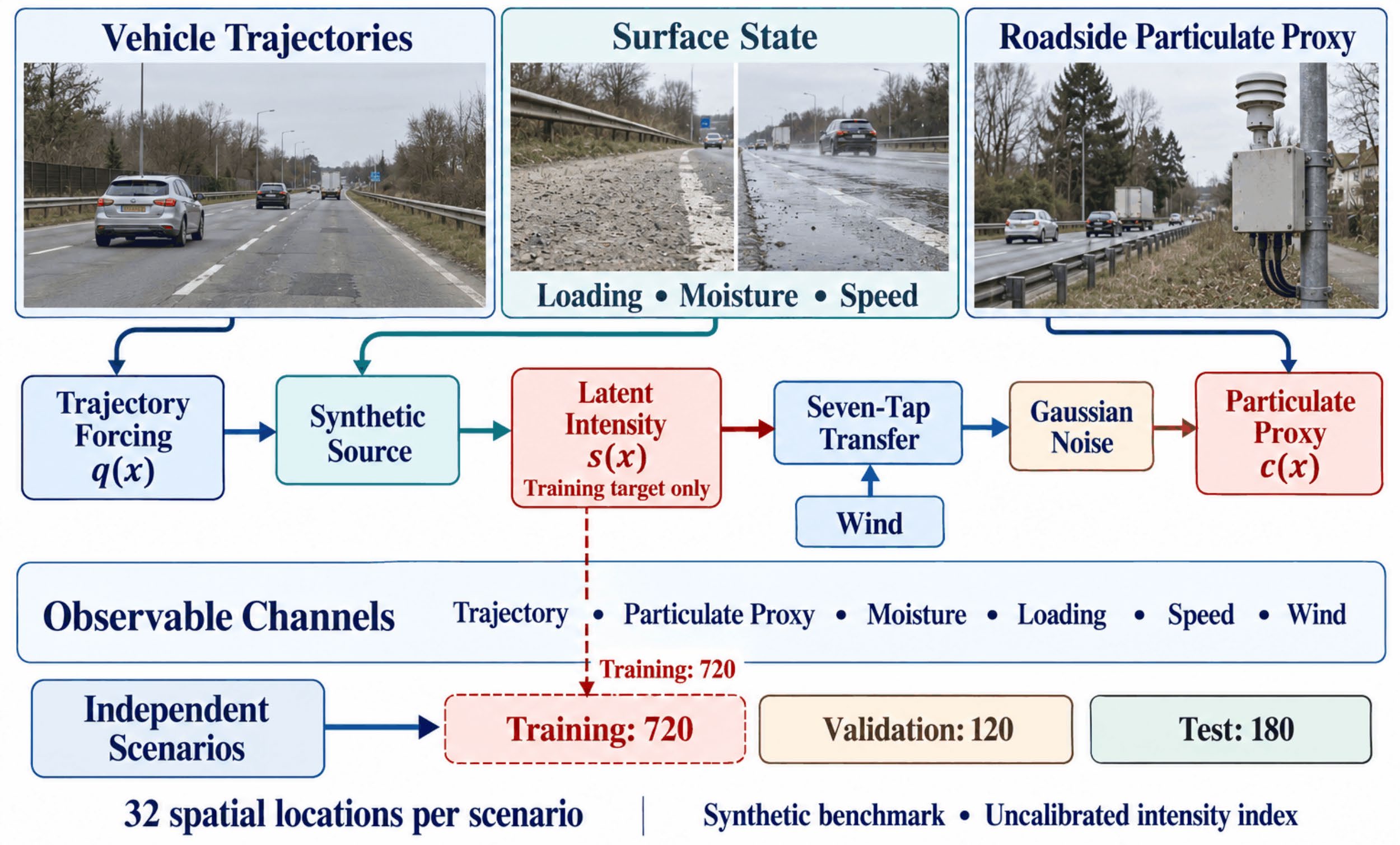
Road dust resuspension estimation requires a distinction between vehicle disturbance, road surface state, and the transported particulate signal. This study evaluates a compact DeepONet–FNO configuration that combines learned branch coefficients on a fixed coordinate basis with a trainable spectral pathway to reconstruct a dimensionless spatial intensity index. Six input channels represent trajectory-derived forcing, particulate observations, and surface and transport descriptors. The evaluation comprises 720 training, 120 validation, and 180 independent test scenarios, each sampled at 32 spatial locations. The hybrid achieves a test root mean square error of 1.066 index points and a coefficient of determination of 0.9959, compared with 1.804 points and 0.9883 for the spectral comparator. These results describe the specified implementations and information representations. Increasing particulate noise from zero to 0.12 raises hybrid error from 0.989 to 1.552 points. Random removal and interpolation of half the particulate samples yields an error of 1.169 points while the other channels remain available. A joint moisture and transport shift reverses the primary ranking, with the spectral comparator outperforming the hybrid. Empirical residual bands calibrated on validation data attain 89.46 percent pooled pointwise coverage at a nominal level of 90 percent. The findings support further development of combined global and spatial representations under explicit observation assumptions. Physical calibration, independent field evaluation, and assessment of conditional reliability are required to establish their applicability to monitored road segments.