
Topology Aware Neural ODE Transformer for Hydrogen Sulfide Risk Prediction in Urban Pipe Networks
Authors
Files
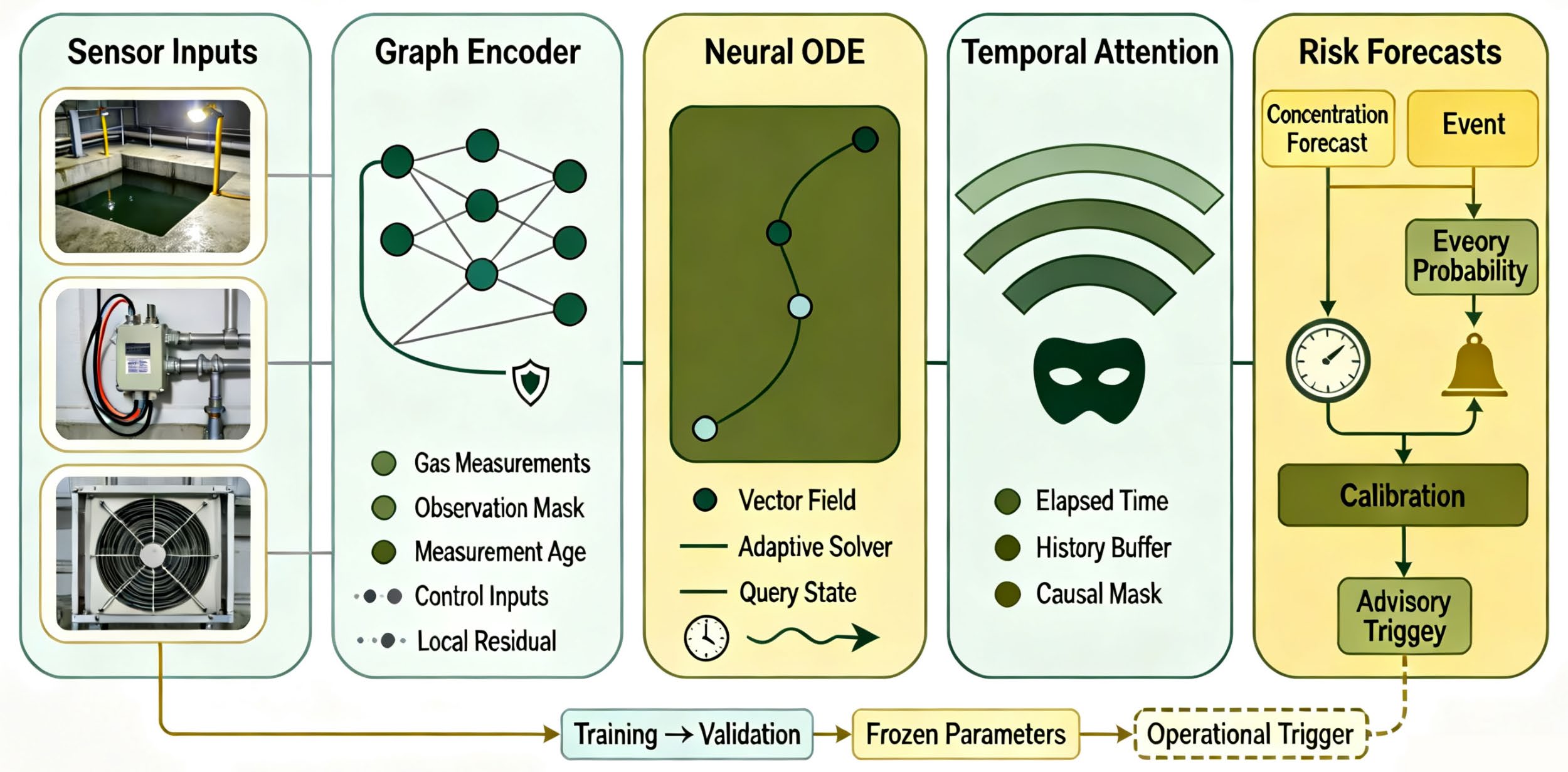
Key Information
Journal

Published in Vol. 4 No. 1 (2026) of Sustainable Energy and Environmental Engineering Journal.
The Sustainable Energy and Environmental Engineering Journal (SEEEJ) eISSN 3136-8174 is a peer-reviewed, interdisciplinary, and open-access academic journal that focuses on the development, deployment, and integration of sustainable energy technologies and environmentally responsible engineering practices.
SEEEJ serves as a forum for researchers, engineers, scientists, and policy experts to present original research and innovative solutions that address the twin challenges of global energy demand and environmental degradation. The journal emphasizes scalable technologies, real-world applications, and forward-looking strategies that support carbon neutrality and long-term ecological balance.
About the JournalAbstract
Hydrogen sulfide accumulation in urban pipe networks creates forecasting problems in which irregular observations, directional connectivity, and ventilation changes interact. This study proposes a topology aware neural ordinary differential equation and Transformer framework for concentration forecasting and exceedance risk assessment. A directed graph encoder combines verified connectivity, geometric attributes, and observation reliability. Continuous latent evolution connects measurement events, while causal temporal attention integrates operating histories available at the forecast origin. The benchmark configuration comprises 120 monitoring locations, five operating regimes, and forecast horizons of 5, 15, and 30 minutes. At the 15-minute horizon, the reported mean absolute error is 1.84 parts per million, the root mean squared error is 2.67 parts per million, and the area under the precision–recall curve is 0.914. Event recall is 0.902 at the specified advisory threshold. The separate 30-minute event head yields a median warning lead time of 18.6 minutes. Removing topology increases mean absolute error to 2.45 parts per million. Across the missing-observation sensitivity settings, error increases from 1.72 to 2.91 parts per million as missingness rises from zero to 40 percent. The reported calibration gap decreases from 0.109 to 0.019. These comparisons describe the stated benchmark conditions. The contribution lies in coordinating connectivity, continuous state evolution, and temporal context for hydrogen sulfide forecasting. Interpretation of deployment suitability requires traceable acquisition records, complete implementation settings, and prospective operational assessment.
