Topology Preserving Hyena Operator Prediction Model for Functional Annotation of Microbial Communities
Authors
Files
Key Information
Journal

Published in Vol. 4 No. 1 (2026) of Sustainable Energy and Environmental Engineering Journal.
The Sustainable Energy and Environmental Engineering Journal (SEEEJ) eISSN 3136-8174 is a peer-reviewed, interdisciplinary, and open-access academic journal that focuses on the development, deployment, and integration of sustainable energy technologies and environmentally responsible engineering practices.
SEEEJ serves as a forum for researchers, engineers, scientists, and policy experts to present original research and innovative solutions that address the twin challenges of global energy demand and environmental degradation. The journal emphasizes scalable technologies, real-world applications, and forward-looking strategies that support carbon neutrality and long-term ecological balance.
About the JournalAbstract
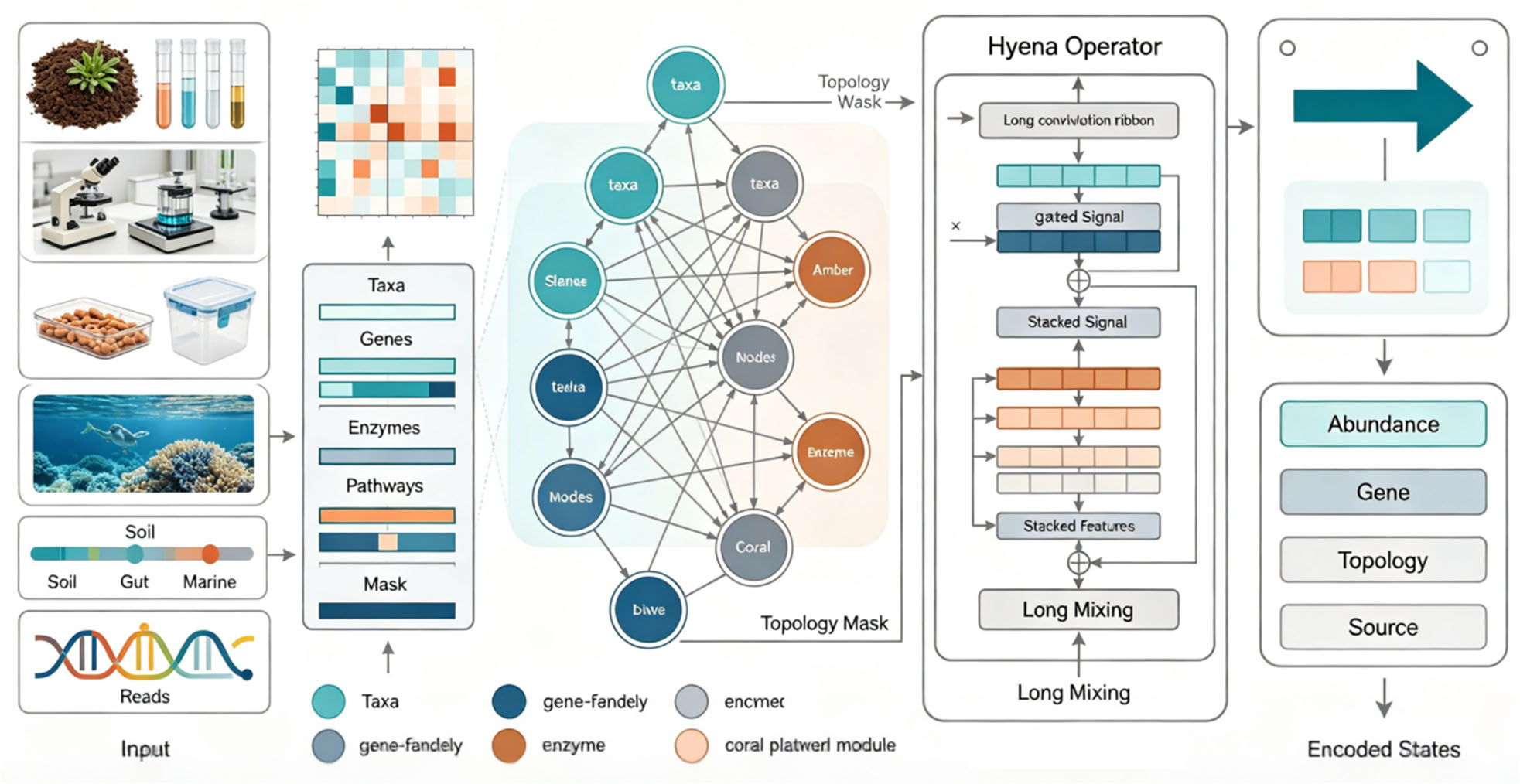
Functional annotation of the microbial community is required to interpret metagenomic data, identify changed metabolic pathways, and provide support for ecological or clinical hypotheses. Prediction is still difficult because taxonomic abundance, gene-family evidence, pathway topology, community interactions and sample environment may all affect the label. This paper proposes a topology-preserving Hyena Operator model for microbial community functional annotation. Taxon abundance, marker genes, predicted enzyme families, pathway modules, co-occurrence edges, habitat metadata, sequencing-depth indicators and uncertainty tags are aligned into abundance-function windows. The topology-preserving graph layer keeps the neighbourhood relationships and pathway dependencies of microbes, thus distinguishing between isolated gene evidence and community signals supported by pathways. The Hyena Operator then encodes long-range abundance and functional relationships with a lower computational cost than full attention, which is suitable for high- dimensional metagenomic feature spaces. Experiments are carried out on a simulated microbial community dataset from soil, gut, marine environments, fermentation, engineered sources, etc. The dataset contains various taxonomic profiles, sparse gene-family evidence, pathway-module labels, co-occurrence topology, habitat metadata, and incomplete annotation masks. Source-aware testing and unseen-community evaluation are used to determine if the model can generalise beyond random sample splits. The multi-task head predicts pathway class, enzyme profile, missing-function risk, confidence, dominant evidence and review priority. The framework proposed here aims to support interpretable microbial function screening by indicating whether a predicted function is supported by abundance, gene evidence, topology, source context or weak uncertain signals. This Design helps the researchers prioritise pathway annotations that are reliable, provisional or need further database review.