SAM2-TinyViT Model for Urban Stormwater Pollution-load Prediction Based on Pipe-network Sensors and Rainfall Radar
Authors
Files
Key Information
Journal

Published in Vol. 4 No. 1 (2026) of Sustainable Energy and Environmental Engineering Journal.
The Sustainable Energy and Environmental Engineering Journal (SEEEJ) eISSN 3136-8174 is a peer-reviewed, interdisciplinary, and open-access academic journal that focuses on the development, deployment, and integration of sustainable energy technologies and environmentally responsible engineering practices.
SEEEJ serves as a forum for researchers, engineers, scientists, and policy experts to present original research and innovative solutions that address the twin challenges of global energy demand and environmental degradation. The journal emphasizes scalable technologies, real-world applications, and forward-looking strategies that support carbon neutrality and long-term ecological balance.
About the JournalAbstract
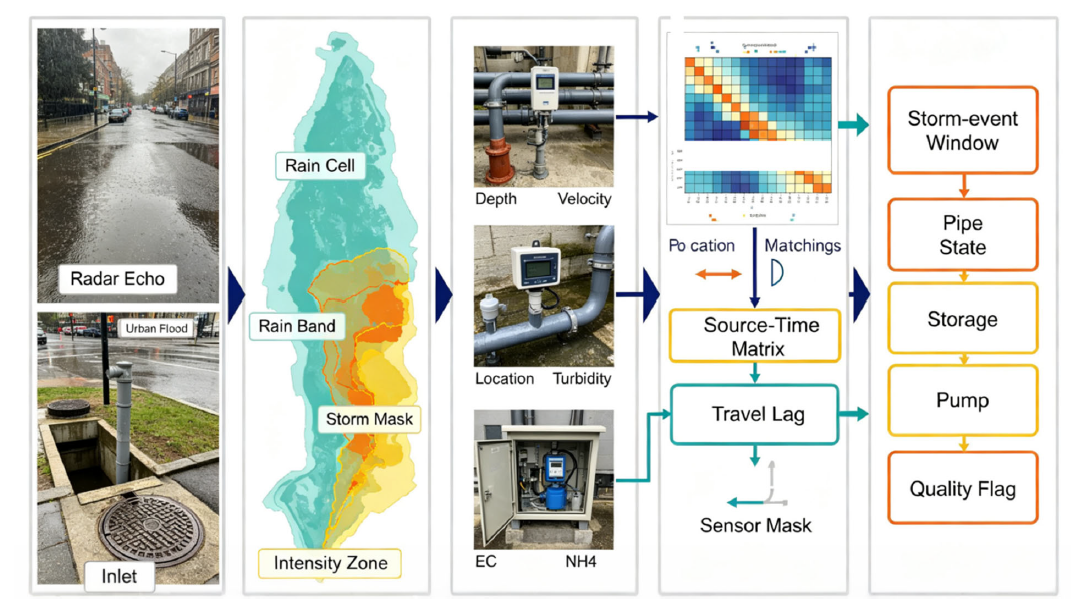
Urban stormwater pollution-load prediction is required for combined sewer overflow control, first-flush interception, pump scheduling, sampling dispatch and receiving-water protection. The task is difficult because pollutant load is controlled by rainfall intensity, rain-cell movement, antecedent dry period, impervious surface wash-off, pipe storage, hydraulic travel time, sensor drift and missing observations. This paper proposes a SAM2-TinyViT model for short-term urban stormwater pollution-load prediction based on pipe-network sensors and rainfall radar. Radar frames, rain-gauge totals, flow depth, velocity, turbidity, conductivity, temperature, dissolved oxygen, ammonium proxy, suspended-solid proxy, pump and gate state, pipe slope, drainage area, imperviousness, antecedent dry period and sensor-quality tags are aligned into event windows. SAM2 segments moving rainfall structures and high-intensity rain bands, while TinyViT compresses segmented radar evidence for repeated storm-window updating. A pipe-sensor sequence branch represents delayed hydraulic and water-quality response, and a drainage-state calibration layer adjusts pollutant interpretation under different storage, dry-period and missing-sensor conditions. The output includes estimated pollution load, peak time, confidence interval, overload warning level, dominant evidence and recommended review action. Experiments use a simulated multi-catchment dataset with storm-event diversity, uneven sensor quality, unseen-catchment transfer and extreme-rain tests. Evaluation covers load error, peak-load recall, peak-timing error, calibration, dropout robustness, radar-noise tolerance and inference cost. The framework is presented as an interpretable benchmark for municipal stormwater decision support, while real deployment still requires paired radar records, automatic samplers, laboratory load measurements and operational validation.