
Causal-Guided HyperMixer Prediction Model for Aquaponic Water-Environment Diagnosis
Authors
Files
Key Information
Journal

Published in Vol. 4 No. 1 (2026) of Sustainable Energy and Environmental Engineering Journal.
The Sustainable Energy and Environmental Engineering Journal (SEEEJ) eISSN 3136-8174 is a peer-reviewed, interdisciplinary, and open-access academic journal that focuses on the development, deployment, and integration of sustainable energy technologies and environmentally responsible engineering practices.
SEEEJ serves as a forum for researchers, engineers, scientists, and policy experts to present original research and innovative solutions that address the twin challenges of global energy demand and environmental degradation. The journal emphasizes scalable technologies, real-world applications, and forward-looking strategies that support carbon neutrality and long-term ecological balance.
About the JournalAbstract
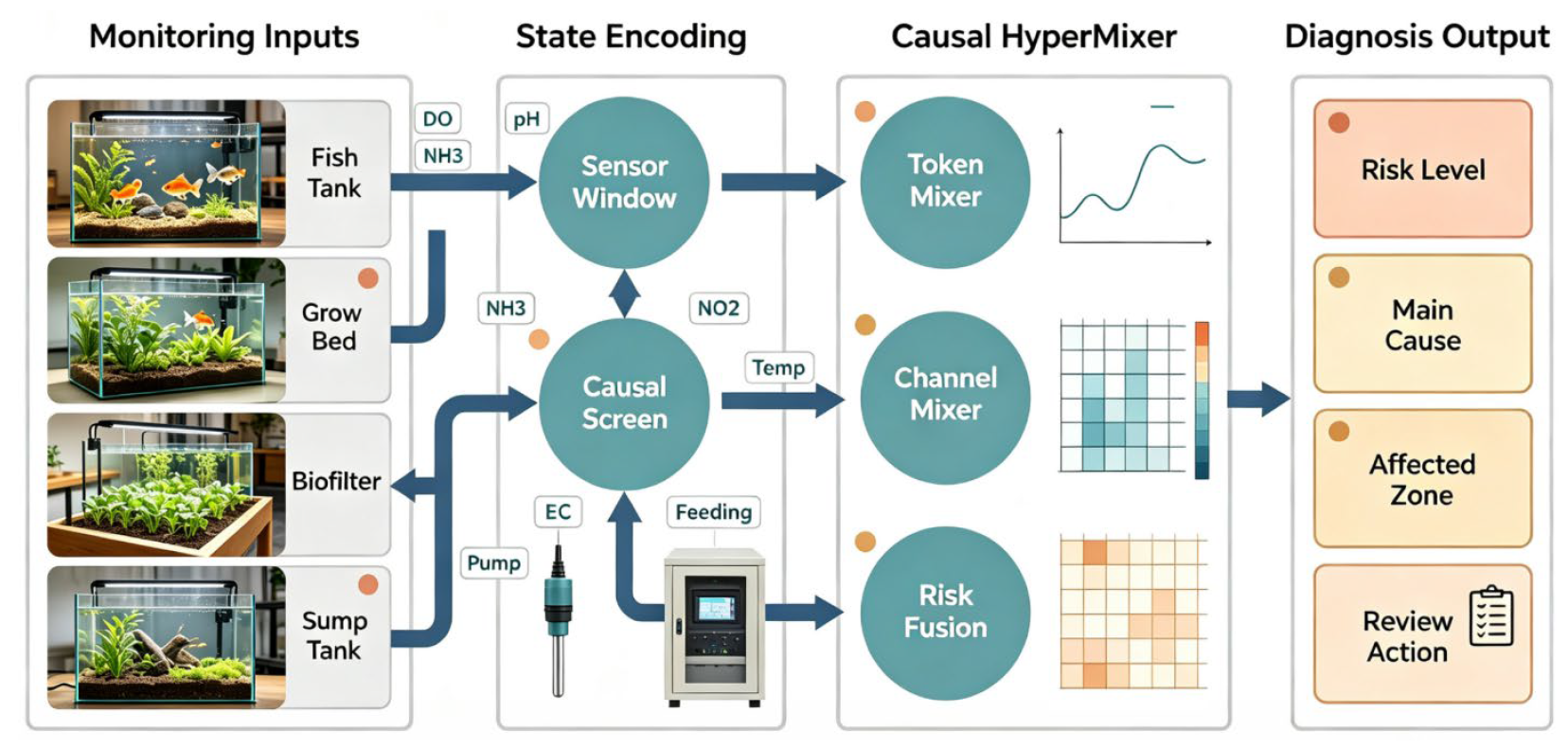
This paper presents a causal-guided HyperMixer prediction model for aquaponic water-environment diagnosis. To identify abnormal water conditions in the combined fish-plant circulation system early and prevent harm to the health of fish, nitrification stability, plant nutrient absorption, etc., disruption of regular farm operations should be avoided. The method builds multi-source observation windows by collecting dissolved oxygen, pH, ammonia nitrogen, nitrite, nitrate, temperature, electrical conductivity, turbidity, oxidation-reduction potential, feeding intensity, pump status, aeration state, water-return flow and zone metadata from fish tanks, hydroponic beds, biofilters and sump tanks. A causal screening branch reduces misleading weights caused by routine feeding, short sensor gaps, cleaning events, pump cycles, temporary tank disturbance and local root blockage. The HyperMixer branch then conducts a light-weight temporal and channel interaction of the water-quality variables to interpret oxygen decline, ammonia rise, temperature fluctuation, pH drift and circulation instability simultaneously. Conduct experiments on a simulated aquaponics monitoring dataset to perform multi-zone, cross-unit, ablation and disturbance tests. Compared with the previous machine-learning, recurrent, convolutional and mixer baselines, the proposed model has improved diagnosis accuracy, high-risk recall, warning precision and false-review control at a relatively low computational cost for edge deployment. The output is a staff review card that contains a diagnostic label, risk level, affected area, main causal factor, confidence level and suggested inspection action. Therefore, the model is to be used as an aquaponics decision-support tool for warning prioritisation and cause analysis, not as an autonomous water-control command.
