GraphCast-Lite Cross-Domain Forecasting Model for Construction Dust Emission Prediction
Authors
Files
Key Information
Journal

Published in Vol. 1 No. 1 (2022) of Sustainable Energy and Environmental Engineering Journal.
The Sustainable Energy and Environmental Engineering Journal (SEEEJ) eISSN 3136-8174 is a peer-reviewed, interdisciplinary, and open-access academic journal that focuses on the development, deployment, and integration of sustainable energy technologies and environmentally responsible engineering practices.
SEEEJ serves as a forum for researchers, engineers, scientists, and policy experts to present original research and innovative solutions that address the twin challenges of global energy demand and environmental degradation. The journal emphasizes scalable technologies, real-world applications, and forward-looking strategies that support carbon neutrality and long-term ecological balance.
About the JournalAbstract
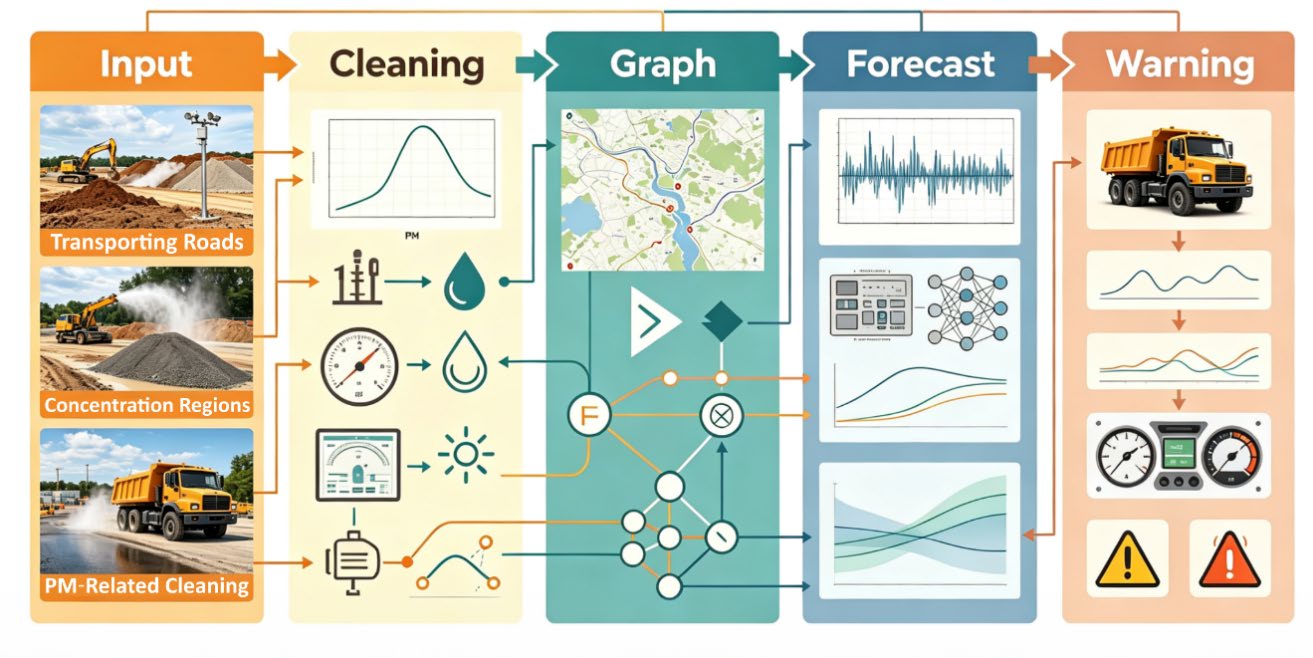
For every project, a model of construction dust emissions should be created that takes into account site activities, particle sensors, weather disturbances, and spatial mobility. A single monitoring value should not be employed. This research develops a cross-domain GraphCast-Lite forecasting model for short-term PM10 and PM2.5 emission prediction at construction sites. The objective is to improve the accuracy of emission alerts for new target projects that share some operational and environmental features with earlier projects but have few tagged high-emission occurrences. Initially, a site-level graph is created that includes monitoring nodes, building phases, working areas, humidity, wind direction, material-operation data, and the state of the nearby roads. Next, source-project information is transferred while maintaining site-specific variants using a lightweight graph forecasting backbone with domain alignment and edge- deployable alert scoring. Ten construction sites, 56 monitoring sites, 21,600 hourly recordings, five construction phases, and four weather-disturbance groups make up the study's simulated dataset. The suggested model improved high- emission event recall from 0.781 to 0.873, reduced cross-site error growth by 22.6%, and decreased PM10 mean absolute error from 18.7 micrograms per cubic metre to 12.4 micrograms per cubic metre when compared to the long short-term memory baseline, temporal convolution, graph convolution, and transformer baselines. According to the aforementioned findings, domain-aware feature alignment and graph-based meteorological routing are more efficient than pooled training in transferring dust-emission knowledge from source projects to target projects. The model will enhance environmental monitoring and provide us with an early warning of an issue on the building site.