Pipeline Digital-Twin Leakage Inference Using Autoformer-KAN with Few-Shot Learning
Authors
Barış DumanFiles
Key Information
Journal

Published in Vol. 7 No. 3 (2026) of Mathematical Modeling in Engineering.
Mathematical Modeling in Engineering (MME) eISSN:3136-764X is an international, peer-reviewed open-access journal that publishes high-quality research focused on the formulation, analysis, simulation, and application of mathematical models to solve engineering and technological problems.
The journal provides a platform for both theoretical developments and practical applications, facilitating the dialogue between mathematics, engineering science, and industrial innovation.
About the JournalAbstract
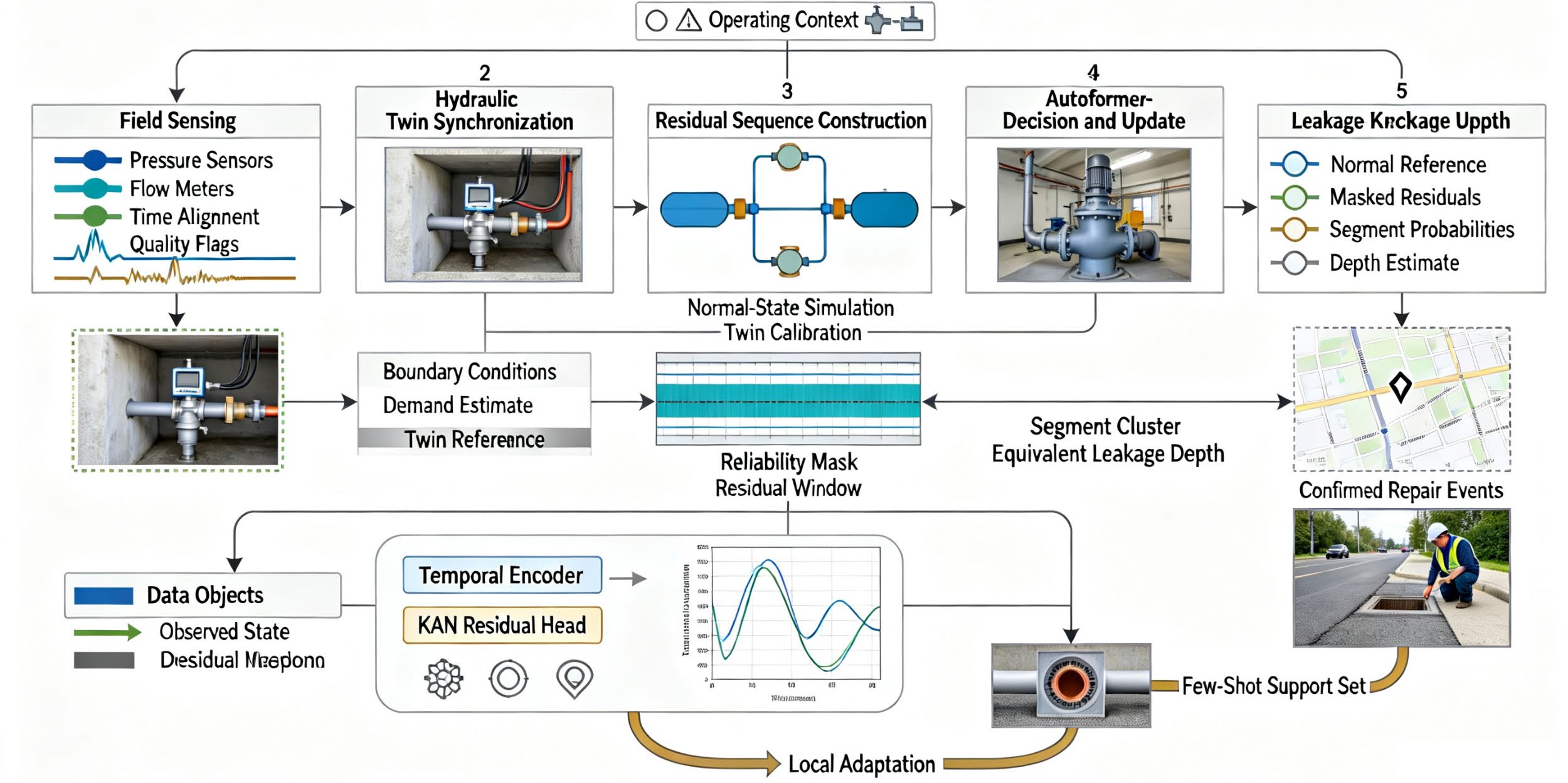
Leakage inference in water distribution networks is constrained by sparse repair-confirmed labels and differences between monitored pressure zones. This paper proposes a pipeline digital-twin framework that combines Autoformer temporal encoding, a Kolmogorov-Arnold network residual head, and episodic few-shot adaptation. The hydraulic twin supplies reference pressure and flow states; masked residual sequences are then used to infer a segment cluster and a diameter- normalized severity surrogate. The contribution is the integration of these components around a shared residual interface rather than a new underlying learning principle. An illustrative evaluation scenario describes a 126-node network with 38 pressure sensors, 12 flow meters, 312 leak events, and 480 normal disturbance windows across five demand regimes. With ten labelled support events per target zone, the example reports 94.2% localization accuracy, a mean graph-hop localization error of 0.37, and an absolute severity error of 6.8 percentage points on the normalized scale. The illustrated accuracy difference from Autoformer with a multilayer perceptron head is 4.1 percentage points, and the stated severity-error reduction is 18.1%. The example also compares component removal, false alarms, sensor dropout, and demand drift to identify questions for future evaluation. These values are not independently verified field measurements or reproduced model results. They demonstrate the intended reporting framework, not empirical superiority. The proposed architecture offers a testable rationale for connecting hydraulic reference states with limited local adaptation, while raw-data provenance, executable configurations, uncertainty analysis, and independent field validation remain necessary before its effectiveness or operational thresholds can be established.