Topology-Preserving Feature Fusion with a DINOv3 Adapter for Corrosion-Under-Insulation Prediction in Pipelines
Authors
Draginja Petković, Obrada VasićFiles
Key Information
Journal

Published in Vol. 7 No. 2 (2026) of Mathematical Modeling in Engineering.
Mathematical Modeling in Engineering (MME) eISSN:3136-764X is an international, peer-reviewed open-access journal that publishes high-quality research focused on the formulation, analysis, simulation, and application of mathematical models to solve engineering and technological problems.
The journal provides a platform for both theoretical developments and practical applications, facilitating the dialogue between mathematics, engineering science, and industrial innovation.
About the JournalAbstract
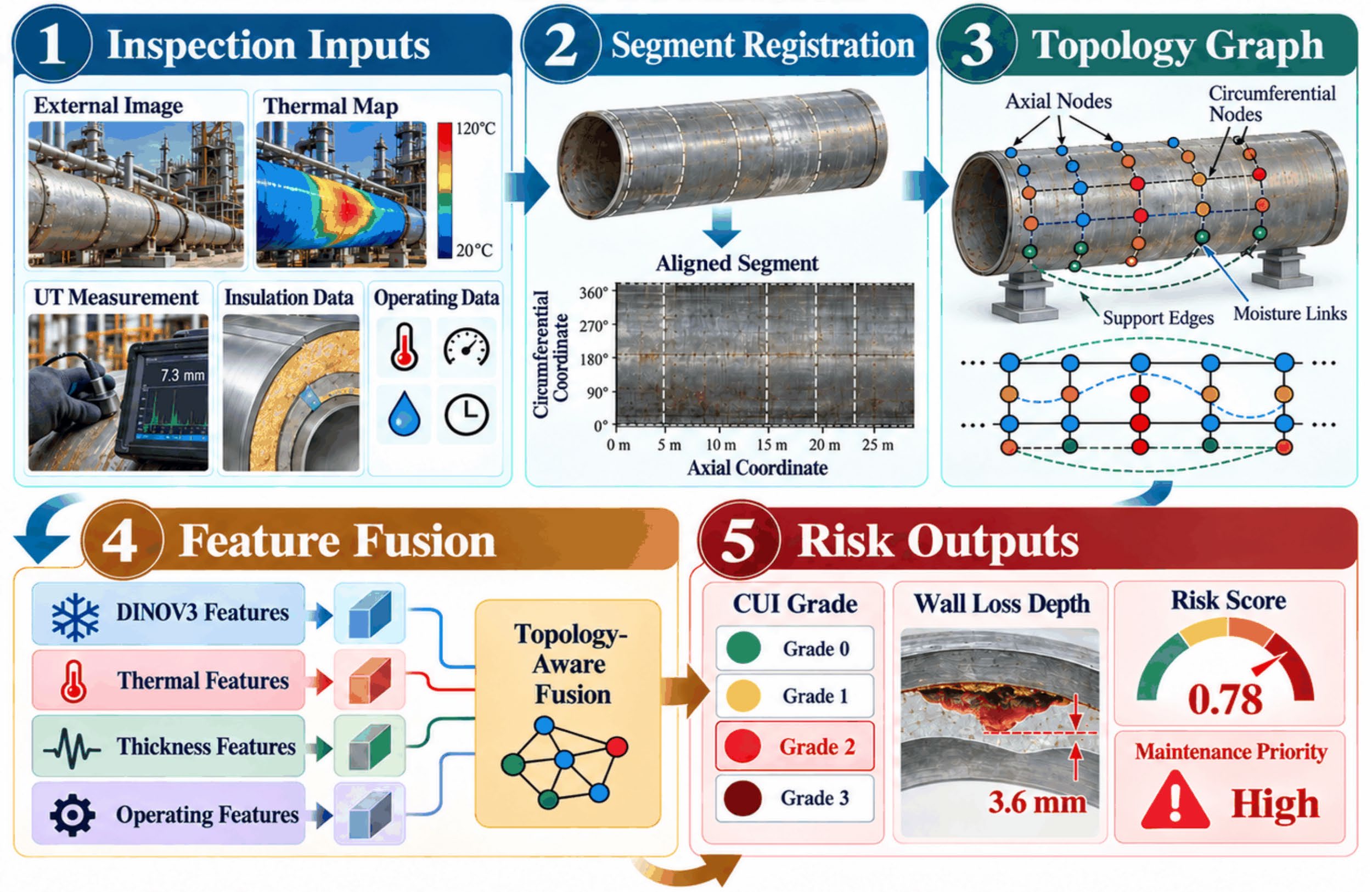
Corrosion under insulation is difficult to predict because moisture ingress, temperature cycling, coating damage, and incomplete inspection records can conceal wall loss before visible symptoms emerge. This study proposes a topology- preserving feature-fusion model that adapts a frozen DINOv3 visual backbone to pipeline CUI assessment through lightweight residual adapters. Registered image tokens are coupled with thermal, ultrasonic, insulation, and operating descriptors on a segment graph that retains axial and circumferential neighborhoods while limiting message transfer across physical discontinuities. The model jointly predicts four corrosion-severity classes and maximum wall-loss depth, and its calibrated output supports maintenance ranking rather than replacing direct inspection. Experiments used 1,248 insulated carbon-steel pipe segments with grouped separation by physical line, class-balanced training, modality masks for incomplete records, and an untouched test distribution. The proposed model achieved 0.913 grade accuracy, 0.887 macro F1, 0.872 severe-CUI recall, and 0.42 mm mean absolute error for depth prediction. Relative to the non-topological DINOv3 Adapter baseline, topology-aware fusion reduced depth error by 18.6% and improved severe-case recall by 7.1 percentage points. Ablation and subgroup analyses indicate that adapters improve domain transfer, ultrasonic evidence anchors loss magnitude, and graph neighborhoods improve recognition of spatially clustered degradation. The resulting framework provides a parameter-efficient and auditable basis for prioritizing intrusive CUI inspection under heterogeneous field evidence.