TD3-GraphMPC Model for Online Moisture Prediction in Infant Formula Powder Using Multi-Source Feature Fusion
Authors
Miodrag Đorđević, Tomislav Vujović, Damjan RistićFiles
Key Information
Journal

Published in Vol. 7 No. 1 (2026) of Mathematical Modeling in Engineering.
Mathematical Modeling in Engineering (MME) eISSN:3136-764X is an international, peer-reviewed open-access journal that publishes high-quality research focused on the formulation, analysis, simulation, and application of mathematical models to solve engineering and technological problems.
The journal provides a platform for both theoretical developments and practical applications, facilitating the dialogue between mathematics, engineering science, and industrial innovation.
About the JournalAbstract
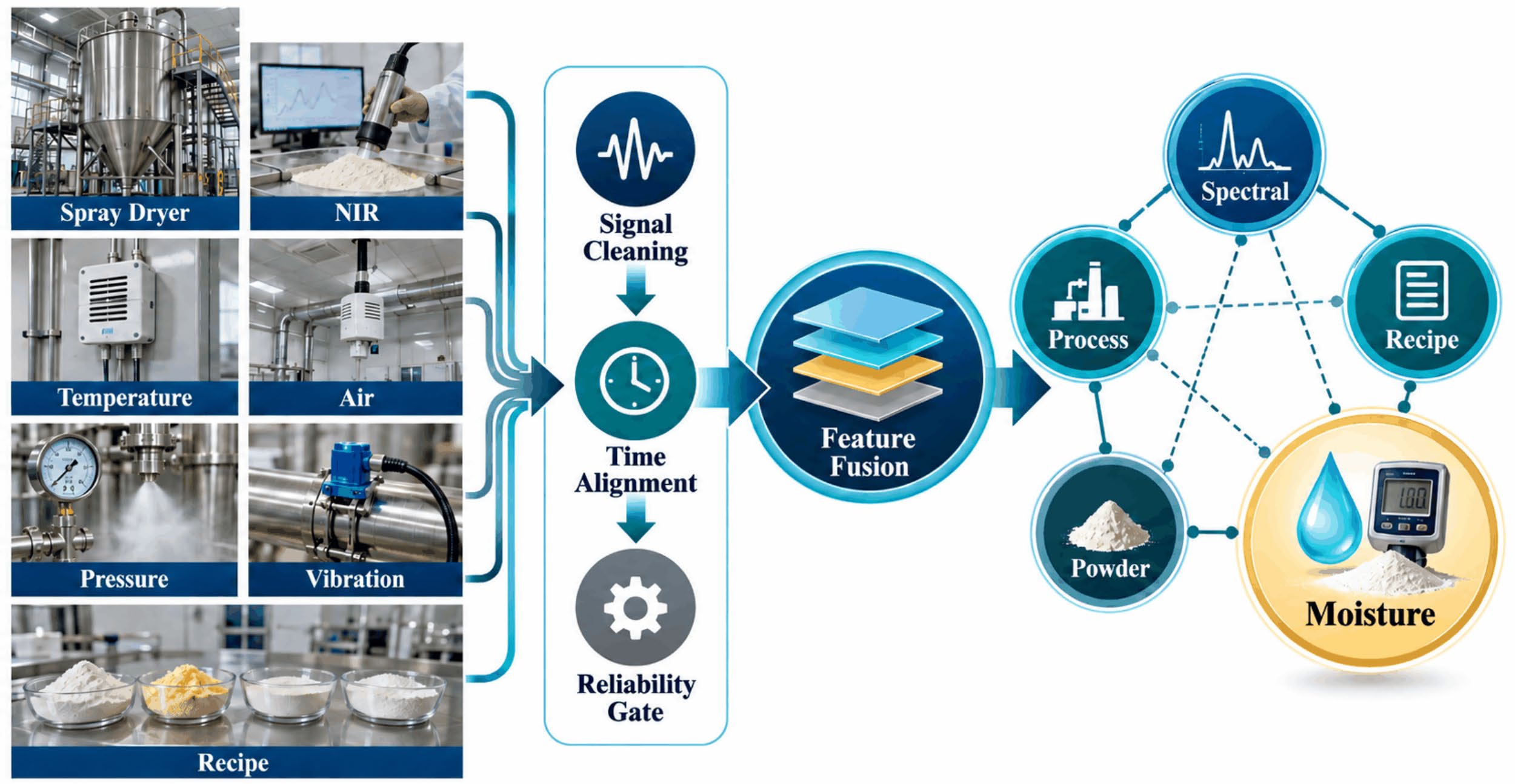
Accurate online estimation of moisture in infant formula powder is required to support drying control, powder flowability, microbial stability, and packaging performance. This study proposes a TD3-GraphMPC soft sensor that integrates multi- source feature fusion with graph-structured dynamic prediction. Near-infrared spectral descriptors, inlet and outlet air conditions, powder temperature, chamber pressure, vibration-based flow indicators, and recipe-level composition variables are synchronized through residence-time compensation, weighted by a reliability gate, and represented as a heterogeneous process graph. A twin delayed deep deterministic policy gradient module learns bounded latent-state corrections for nonlinear drying behavior, while a model predictive consistency layer constrains short-horizon moisture evolution without applying exploratory actions to the plant. The model was evaluated on 3,840 production-inspired batch segments separated by parent batch into training, validation, and test sets. It achieved a test RMSE of 0.071 percentage points, an MAE of 0.053 percentage points, and an R² of 0.962. Relative to BiLSTM and a plain graph neural network, RMSE was reduced by 25.3% and 14.5%, respectively. Coverage within the +/-0.10 percentage-point tolerance band reached 93.6%, and the mean constraint violation rate was 1.8%. Under 30% spectral missingness, RMSE remained 0.094, compared with 0.114 for GNN-MPC and 0.148 for BiLSTM. These results indicate that graph-based sensor reasoning, cautious latent correction, and prediction-consistency constraints can improve robust moisture estimation, while prospective multi-line validation remains necessary before closed-loop deployment.