Cross-Scale S4ND-UNet for Energy Consumption Optimization in Solvent Recovery
Authors
Jelena Stojanović, Ognjenka ĆukićFiles
Key Information
Journal
Published in Vol. 7 No. 2 (2026) of Mathematical Modeling in Engineering.
Mathematical Modeling in Engineering (MME) eISSN:3136-764X is an international, peer-reviewed open-access journal that publishes high-quality research focused on the formulation, analysis, simulation, and application of mathematical models to solve engineering and technological problems.
The journal provides a platform for both theoretical developments and practical applications, facilitating the dialogue between mathematics, engineering science, and industrial innovation.
About the JournalAbstract
Dynamic solvent-recovery columns are commonly operated with conservative reflux and steam margins because feed
composition, tray hydraulics, heat inventory, and product-purity requirements vary across time and column position. This
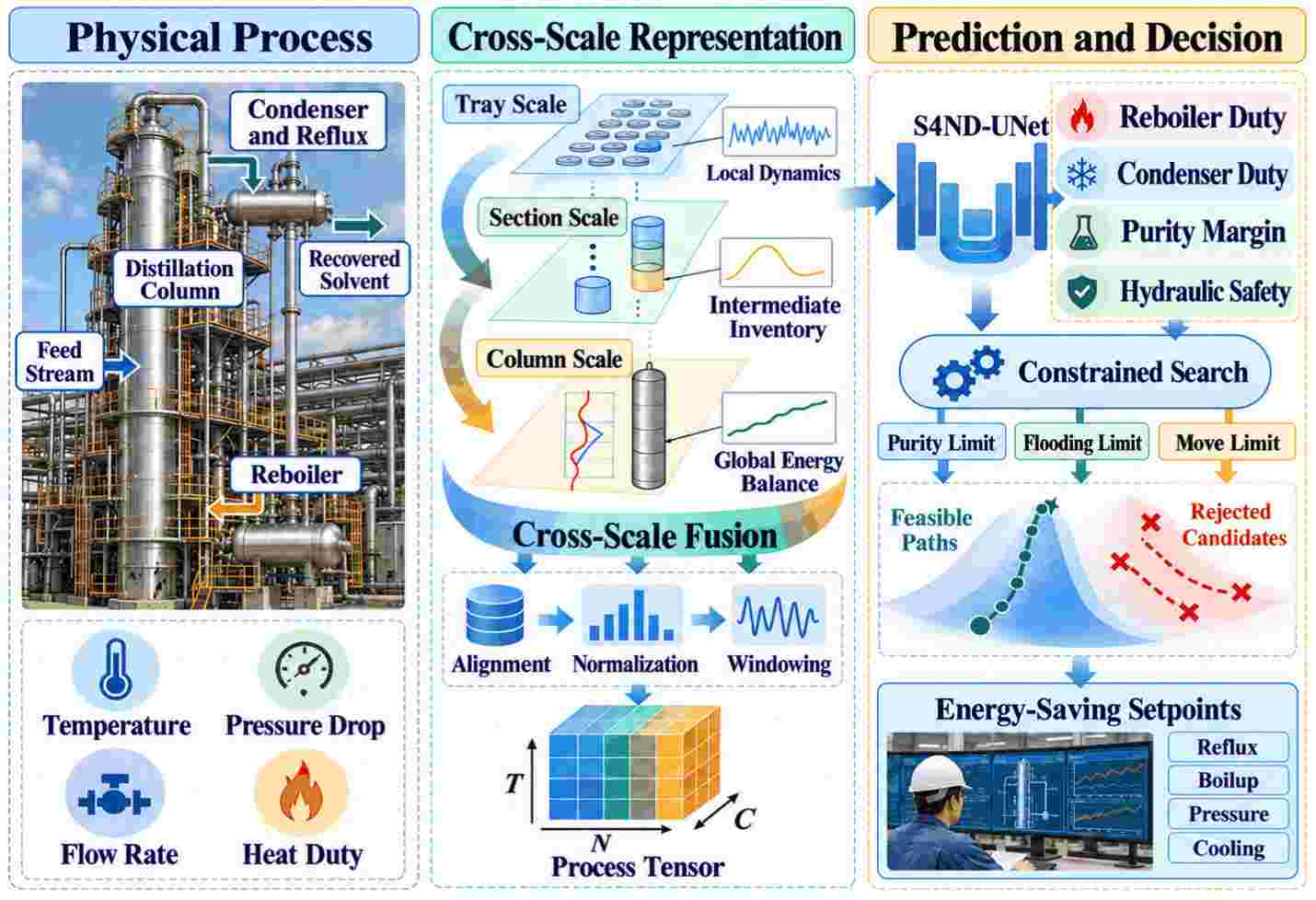
study developed a cross-scale S4ND-UNet surrogate to predict energy demand and identify feasible low-energy operating
conditions. Structured state-space blocks retained long operating memory, while the UNet hierarchy preserved tray-level
patterns and exchanged them with section- and column-level energy states through gated cross-scale bridges. A constrained
decoder jointly predicted specific reboiler duty, condenser duty, purity margin, and hydraulic feasibility, after which a
bounded search screened candidate set points. Evaluation used 18,720 one-minute operating windows from acetone-water,
ethanol-water, isopropanol-water, and dimethylformamide-water systems. The windows combined simulated tray profiles
with pilot-calibrated heat-loss, condenser-approach, and pressure-drop behavior, and the data were separated by operating
campaign to reduce temporal leakage. The proposed model achieved a heat-duty mean absolute percentage error of 2.31%,
compared with 6.42% for temporal convolution and 4.18% for a transformer surrogate. Feasible search reduced mean
reboiler duty from 4.53 to 4.12 MJ kg⁻¹, corresponding to 9.04% mean energy saving, while maintaining 98.98 wt% mean
product purity. Removing the cross-scale bridges increased error to 3.47%, and the complete model stabilized the
recommended duty within 18 min, compared with 31 min for the temporal-convolution baseline. These results indicate
that long-memory propagation, multiresolution feature exchange, and feasibility-aware decoding can support energyefficient
advisory operation within the calibrated solvent-recovery envelope.