SwinV2-KAN Multisource Fusion Model for Satellite Solar Array Degradation Estimation
Authors
Mei-wen Shao, Mei-yu Tsao, Chia-chih HsiaoFiles
Key Information
Journal
Published in Vol. 6 No. 3 (2026) of Journal of Smart Operations and Management Engineering.
Journal of Smart Operations and Management Engineering (JSOME) eISSN: 3136-7666 is an international, peer-reviewed forum dedicated to publishing cutting-edge research at the intersection of process systems engineering, advanced operations research, and intelligent management. The journal bridges the gap between technical system design and executive decision-making, focusing on how data-driven algorithms, automation frameworks, and intelligent computing transform modern industrial operations.
JSOME welcomes original research articles, rigorous reviews, and methodological contributions addressing complex industrial systems, supply chain networks, energy systems, and process industries.
About the JournalAbstract
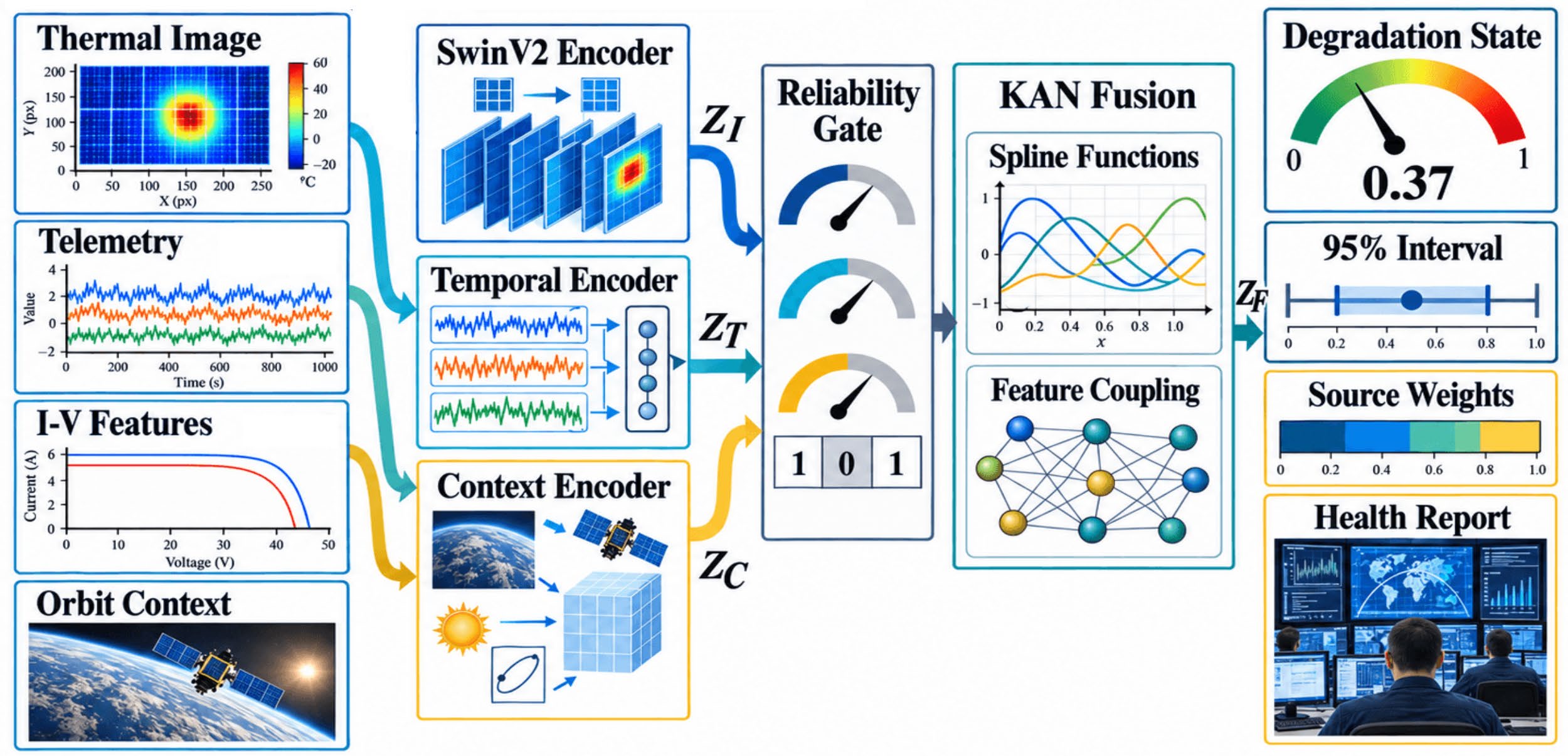
Reliable degradation estimation is required to preserve the power margin of long-life spacecraft exposed to radiation, thermal cycling, contamination, illumination changes, and interconnect ageing. This study proposes a SwinV2-KAN multisource fusion model that combines solar-wing thermal imagery, bus telemetry, I-V descriptors, orbital-environment records, and operation-mode tags to estimate normalized degradation and remaining power capability. The inputs are aligned at the orbital-cycle level, while availability masks and quality indicators prevent missing measurements from being interpreted as nominal observations. Swin Transformer V2 extracts hierarchical thermal tokens, a gated temporal encoder represents electrical and environmental sequences, and a reliability gate suppresses unavailable or low-quality sources before Kolmogorov-Arnold Network fusion. The model returns a point estimate, calibrated interval bounds, source weights, and quality flags for engineering review. Evaluation uses a simulated but engineering-constrained archive of 2,160 orbital cycles covering six representative degradation modes and five source groups. Comparisons include statistical regressors, recurrent and convolutional fusion models, a vanilla Transformer, and SwinV2-MLP fusion. SwinV2-KAN achieves an MAE of 0.018, an RMSE of 0.027, an early-warning lead time of 11.6 days, and 93.8% empirical coverage for a nominal 95% interval. Removing KAN fusion increases MAE by 28.4%, while removing thermal-image tokens reduces hot-string sensitivity by 31.7%. These results indicate that quality-aware spatial-temporal fusion can support power-budget review and maintenance-oriented analysis, although validation with independently labeled flight data remains necessary.
Details
License
Copyright (c) 2026 Mei-wen Shao, Mei-yu Tsao, Chia-chih Hsiao

This work is licensed under a Creative Commons Attribution-NonCommercial-ShareAlike 4.0 International License.
