Improved Diffusion Planner for Pore Network Reconstruction of Metal Foams from Micro CT Volume Slices
Authors
Hatice Şahin, Sevgi Öztürk, Eda ÖzcanFiles
Key Information
Journal
Published in Vol. 6 No. 3 (2026) of Journal of Smart Operations and Management Engineering.
Journal of Smart Operations and Management Engineering (JSOME) eISSN: 3136-7666 is an international, peer-reviewed forum dedicated to publishing cutting-edge research at the intersection of process systems engineering, advanced operations research, and intelligent management. The journal bridges the gap between technical system design and executive decision-making, focusing on how data-driven algorithms, automation frameworks, and intelligent computing transform modern industrial operations.
JSOME welcomes original research articles, rigorous reviews, and methodological contributions addressing complex industrial systems, supply chain networks, energy systems, and process industries.
About the JournalAbstract
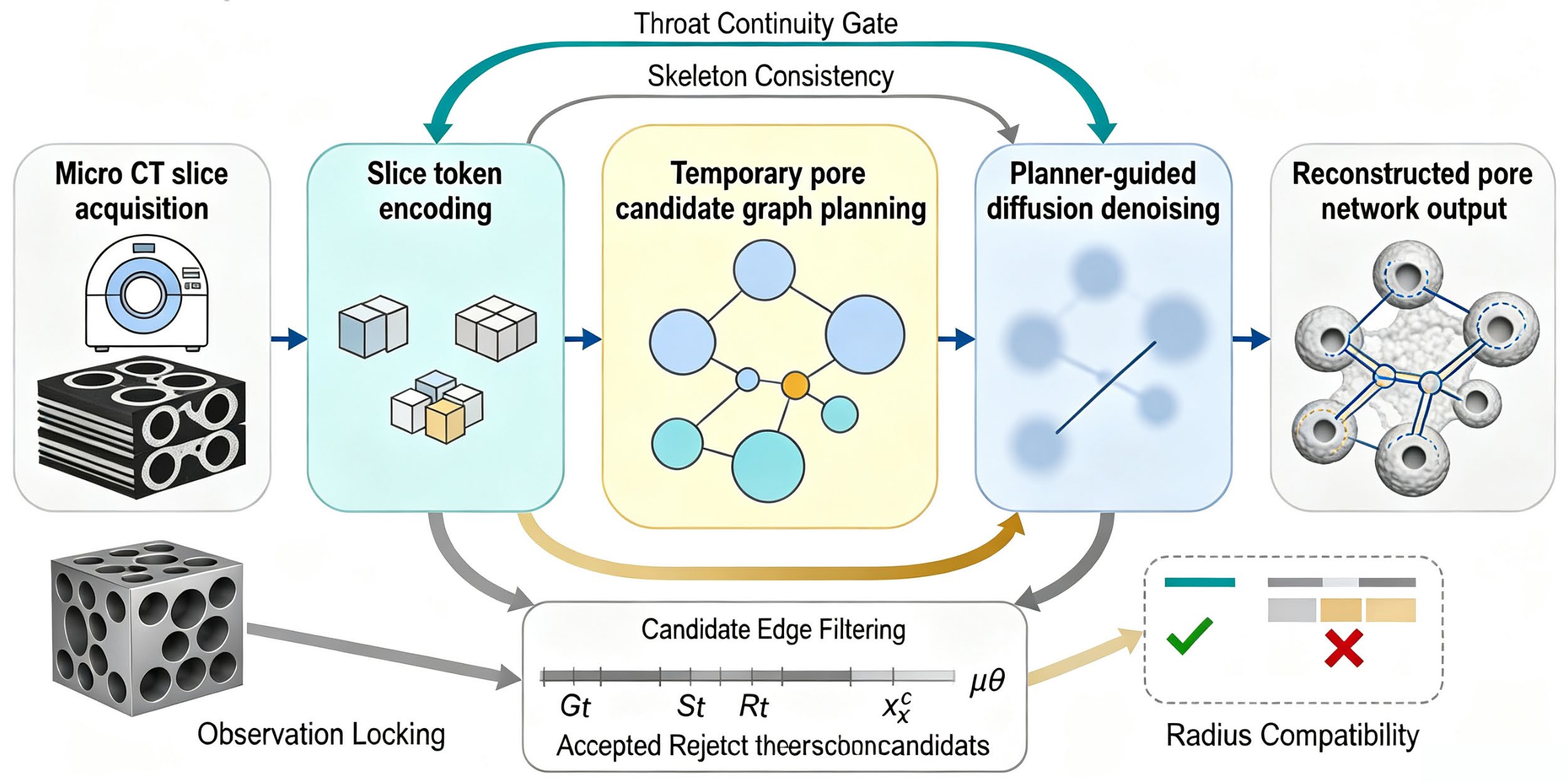
Micro-computed tomography directly shows the shape of metal foams, but practical volume slices often have anisotropic resolution, incomplete pore walls, and fragmented throats that weaken conventional segmentation networks based on network reconstruction. This paper introduces an improved Diffusion Planner for reconstructing pore networks from sliced micro-CT volumes with limited through-thickness context. A method that integrates denoising diffusion with a topology planning module, a throat continuity gate, and a skeleton-aware correction term to optimize voxel-level restoration and graph-level pore connectivity along the same reconstruction path has been developed. Six representative foam volumes with porosities of 71.8% to 89.6% and pore densities of 18.4 to 52.7 pores mm⁻³ were selected for the experiments. A 3D Swin UNETR model was used as the baseline, and compared with a standard diffusion reconstruction model, the proposed model reduced the mean porosity error to 1.84%, increased the throat F1 score to 0.873, and improved graph connectivity accuracy to 0.912. The reconstructed pore radius distribution kept the reference median within 3.1 micrometers, and the permeability ranking error dropped by 37.5% compared with the strongest baseline. Based on the above results, planner- guided diffusion can reconstruct the missing slice connections without excessive smoothing of the open-cell network and offers a compact computational path for quantitative analysis of metal foam microstructures.
Details
License
Copyright (c) 2026 Hatice Şahin, Sevgi Öztürk, Eda Özcan

This work is licensed under a Creative Commons Attribution-NonCommercial-ShareAlike 4.0 International License.