Interpretable CausalFormer Prediction Model for Abnormal Vibration Recognition in Sluice Gates
Authors
Waleed Al-Mulla, Mansour Al-SalamiFiles
Key Information
Journal
Published in Vol. 6 No. 3 (2026) of Journal of Smart Operations and Management Engineering.
Journal of Smart Operations and Management Engineering (JSOME) eISSN: 3136-7666 is an international, peer-reviewed forum dedicated to publishing cutting-edge research at the intersection of process systems engineering, advanced operations research, and intelligent management. The journal bridges the gap between technical system design and executive decision-making, focusing on how data-driven algorithms, automation frameworks, and intelligent computing transform modern industrial operations.
JSOME welcomes original research articles, rigorous reviews, and methodological contributions addressing complex industrial systems, supply chain networks, energy systems, and process industries.
About the JournalAbstract
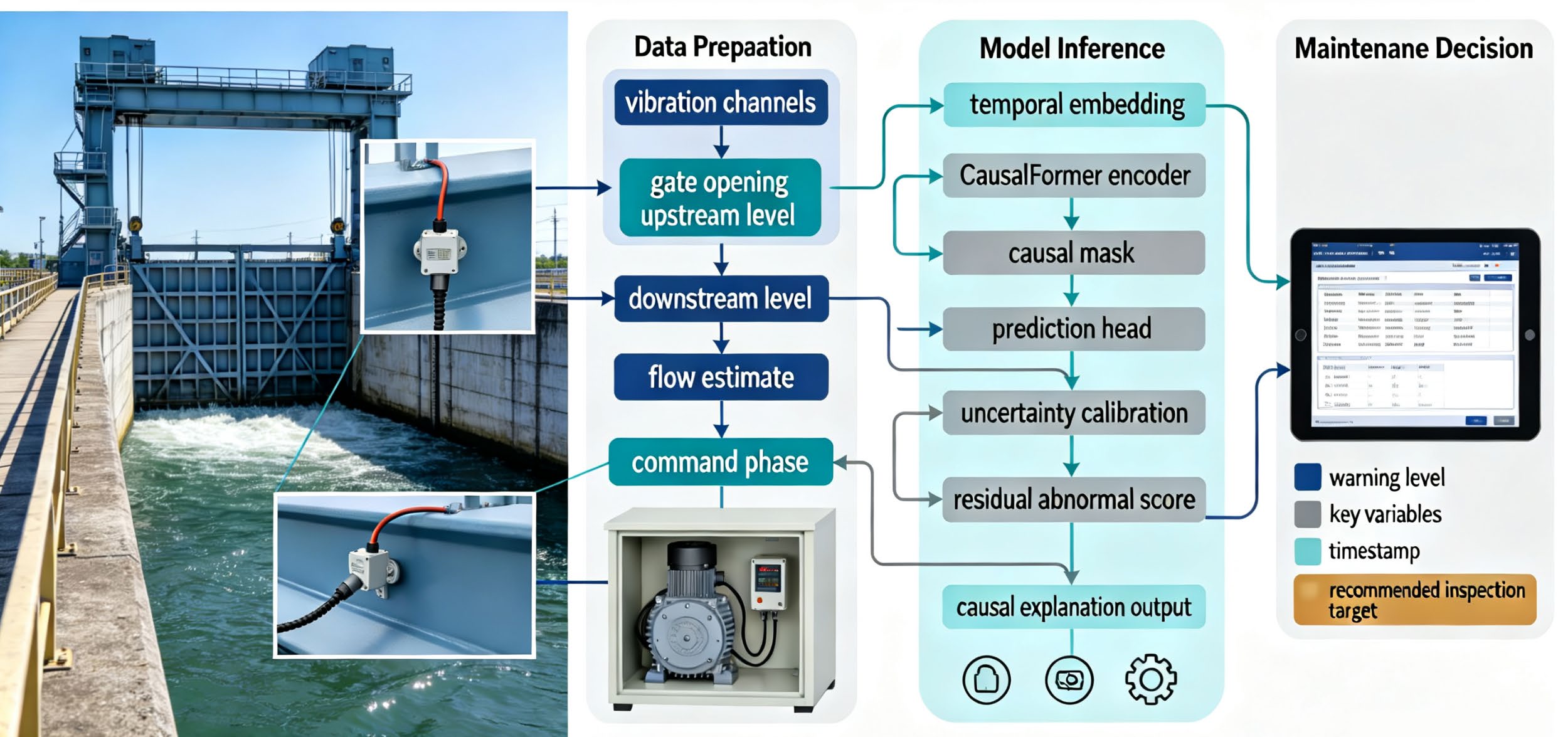
Abnormal vibration in sluice gates can precede seal wear, guide-slot impact, cavitation-related excitation, and actuator faults, yet field records are difficult to interpret because flow head, opening degree, sediment load, and operation commands change together across a 30-day monitoring period. This study develops an interpretable CausalFormer prediction model that combines regime-aware temporal attention, causal masking, residual-based abnormal recognition, and operator-readable attribution. A 30-day monitoring set containing 1,296,000 vibration samples from four accelerometers was organized with opening, upstream level, downstream level, flow estimate, motor current, and temperature. The proposed model reached a vibration forecasting MAE of 0.031 g and an RMSE of 0.047 g, reducing RMSE by 27.7 percent compared with a standard Transformer and by 35.6 percent compared with LSTM under the same monitoring split. For abnormal recognition, it achieved 96.1 percent F1-score, 95.4 percent precision, and 96.9 percent recall under mixed gate-opening conditions. Causal attention pruning reduced explanation instability by 41.3 percent and kept 88.6 percent of high-risk decisions aligned with hydraulic or electromechanical trigger variables. The results indicate that prediction residuals become more reliable when temporal dependence is separated from operating-condition causality. The model offers a practical route for sluice-gate condition monitoring where operators need both early abnormal-warning accuracy and traceable evidence for maintenance decisions.
Details
License
Copyright (c) 2026 Waleed Al-Mulla, Mansour Al-Salami

This work is licensed under a Creative Commons Attribution-NonCommercial-ShareAlike 4.0 International License.
