Causal Aware Feature Fusion DeepONet Mamba Model for eVTOL Vertiport Demand Forecasting
Authors
Matas Kazlauskas, Benas BalčiūnasFiles
Key Information
Journal

Published in Vol. 6 No. 3 (2026) of Journal of Smart Operations and Management Engineering.
Journal of Smart Operations and Management Engineering (JSOME) eISSN: 3136-7666 is an international, peer-reviewed forum dedicated to publishing cutting-edge research at the intersection of process systems engineering, advanced operations research, and intelligent management. The journal bridges the gap between technical system design and executive decision-making, focusing on how data-driven algorithms, automation frameworks, and intelligent computing transform modern industrial operations.
JSOME welcomes original research articles, rigorous reviews, and methodological contributions addressing complex industrial systems, supply chain networks, energy systems, and process industries.
About the JournalAbstract
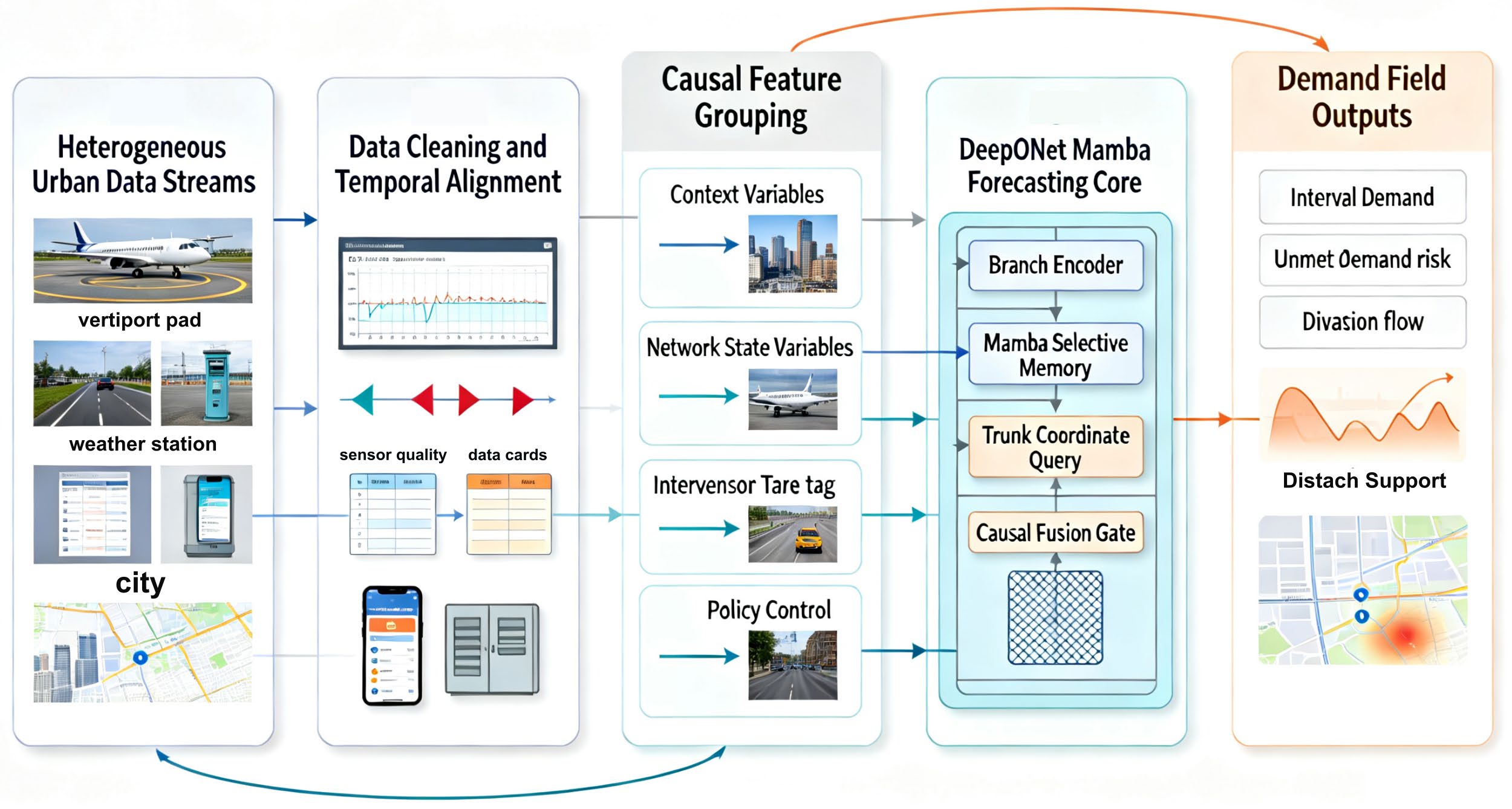
Accurate demand forecasting is a prerequisite for eVTOL vertiport dispatch, pad staffing, battery service planning, and access management, yet short-horizon demand is affected by confounded interactions among weather, road access, queue feedback, aircraft availability, and pricing interventions. This study evaluates the proposed model on a synthetic but engineering-constrained eight-vertiport network, so the reported results should be interpreted as controlled methodological evidence rather than direct commercial demand measurement. The paper proposes a Causal Aware Feature Fusion DeepONet Mamba model that learns a function-to-function mapping from urban mobility states to vertiport demand fields. Causal gates separate contextual variables, network states, and intervention-sensitive variables before a Mamba branch encoder and coordinate-aware DeepONet trunk produce interval demand forecasts. Experiments with 184 simulated operating days show that the proposed model achieves an MAE of 18.7 requests per 15-minute interval, reducing error by 15.6% relative to the strongest non-causal baseline. Peak interval error decreases to 54 requests, 0.9-quantile pinball loss decreases to 11.3, and scenario ranking error is reduced by 32.8% compared with Mamba without causal fusion. Spatial transfer tests, missing-sensor experiments, and capacity-restriction scenarios indicate that causal feature control improves robustness when operating conditions deviate from ordinary correlations. The results show that combining causal fusion, neural operator learning, and selective state-space memory provides a practical forecasting framework for early-stage vertiport network planning and tactical eVTOL operations.
Details
License
Copyright (c) 2026 Matas Kazlauskas, Benas Balčiūnas

This work is licensed under a Creative Commons Attribution-NonCommercial-ShareAlike 4.0 International License.
