Hiera-Seg Model for UAV Delivery Landing Risk Assessment with Edge Adaptive Learning
Authors
Goran Škoro, Saša Radoš, Mario GrgićFiles
Key Information
Journal
Published in Vol. 6 No. 3 (2026) of Journal of Smart Operations and Management Engineering.
Journal of Smart Operations and Management Engineering (JSOME) eISSN: 3136-7666 is an international, peer-reviewed forum dedicated to publishing cutting-edge research at the intersection of process systems engineering, advanced operations research, and intelligent management. The journal bridges the gap between technical system design and executive decision-making, focusing on how data-driven algorithms, automation frameworks, and intelligent computing transform modern industrial operations.
JSOME welcomes original research articles, rigorous reviews, and methodological contributions addressing complex industrial systems, supply chain networks, energy systems, and process industries.
About the JournalAbstract
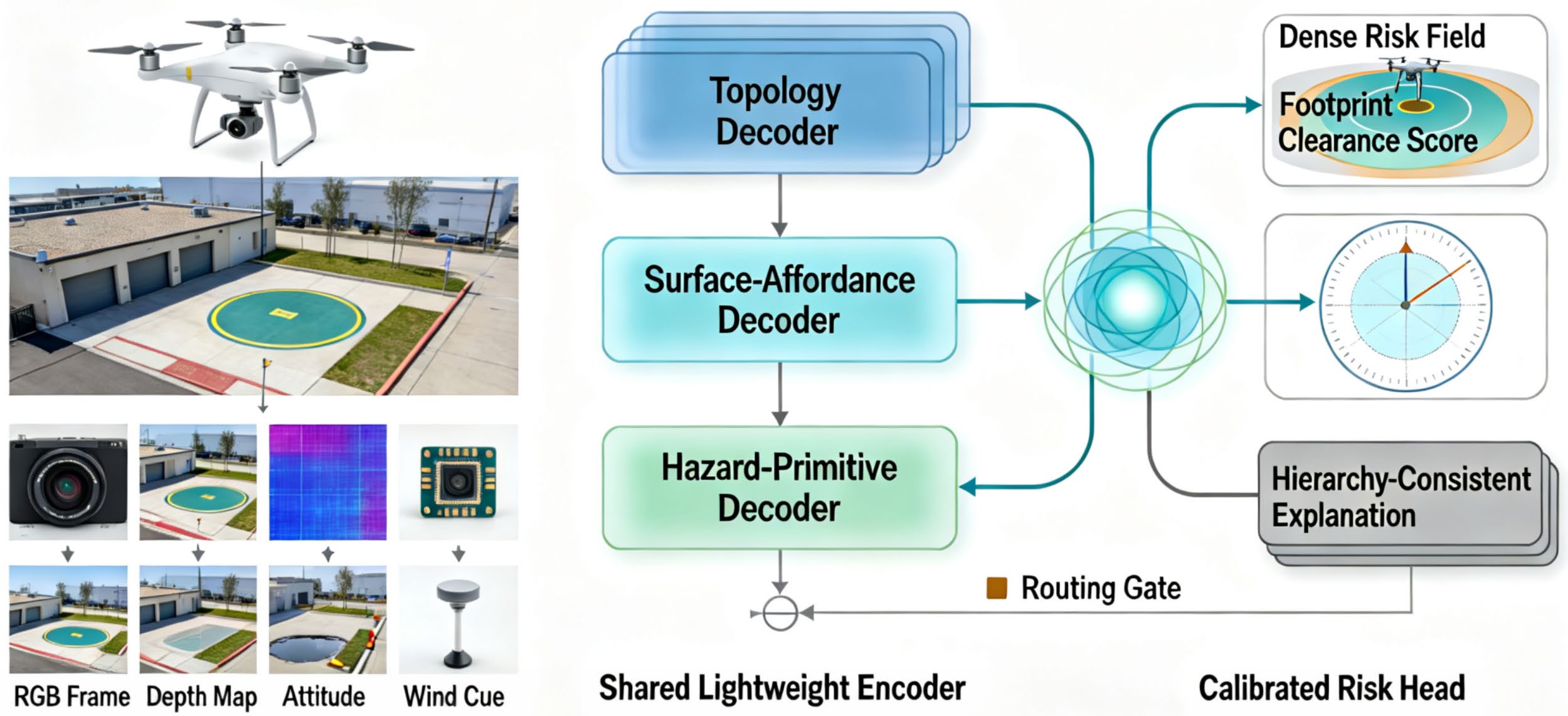
Urban drone delivery increasingly requires autonomous landing in courtyards, curbside bays and rooftop pads, where perception, communication and local micro-weather can change within a few seconds of descent. This paper presents Hiera-Seg, a hierarchical segmentation and edge-adaptive learning model for landing-risk assessment in unmanned aerial vehicle delivery. The model decomposes the landing scene into traversability, obstacle, surface-stability and exposure layers, and then fuses them through a calibrated risk head updated by lightweight edge clients. A controlled evaluation was constructed from 18,420 annotated image-depth frames, 612 descent sequences and five representative landing environments, including rooftop, sidewalk, courtyard, service-lane and campus-pad scenes. Against a non-adaptive DeepLab-style baseline, Hiera-Seg improved mean intersection over union from 78.6% to 84.9%, reduced expected calibration error from 0.116 to 0.052 and lowered high-risk false clearance from 9.8% to 4.1%. The edge adaptation module reached 27.4 ms median inference latency on an embedded GPU and retained 96.2% of centralized accuracy after communication was limited to 1.6 MB per update round. These results show that landing risk is estimated more reliably when scene hierarchy and edge-specific operating conditions are learned together rather than handled as separate perception and decision stages.
Details
License
Copyright (c) 2026 Goran Škoro, Saša Radoš, Mario Grgić

This work is licensed under a Creative Commons Attribution-NonCommercial-ShareAlike 4.0 International License.
