RetNet Informer Model with Robust Learning for Multi UAV Airspace Time Slot Allocation
Authors
Vassilis Pappas, Antonis Sotiropoulos, Leonidas XenakisFiles
Key Information
Journal
Published in Vol. 6 No. 3 (2026) of Journal of Smart Operations and Management Engineering.
Journal of Smart Operations and Management Engineering (JSOME) eISSN: 3136-7666 is an international, peer-reviewed forum dedicated to publishing cutting-edge research at the intersection of process systems engineering, advanced operations research, and intelligent management. The journal bridges the gap between technical system design and executive decision-making, focusing on how data-driven algorithms, automation frameworks, and intelligent computing transform modern industrial operations.
JSOME welcomes original research articles, rigorous reviews, and methodological contributions addressing complex industrial systems, supply chain networks, energy systems, and process industries.
About the JournalAbstract
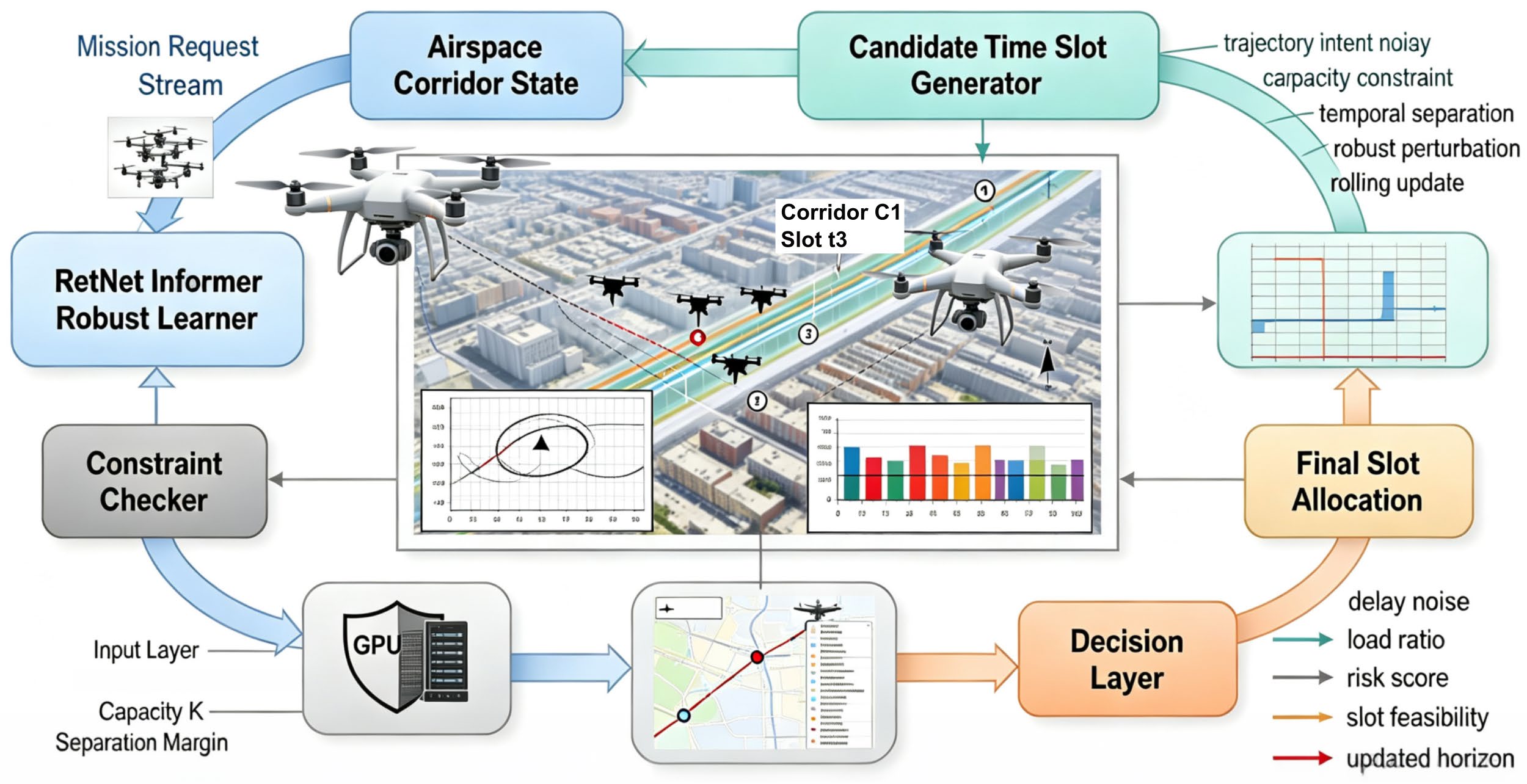
Dense low-altitude operations require slot allocation methods that can maintain conflict risk and delay within limits during rapid changes in the demand for multiple UAVs, and conventional rule-based scheduling cannot respond promptly. This paper develops a RetNet Informer model with robust learning for multi-UAV airspace time slot allocation in shared low- altitude corridors. Model each airway segment as a sequence of capacity-constrained time slots, use a recurrent network to retain long-range interaction states of UAV flows, and employ an Informer branch to estimate short-horizon demand envelopes from delayed and noisy observations. A stable objective is added to penalize slot decisions that are highly sensitive to trajectory perturbation, communication delay and non-stationary demand. Experiments are conducted on a synthetic but operationally constrained low-altitude traffic dataset of 96 corridors and 1,200 UAV missions under six disturbance settings. Compared with the earliest feasible slot assignment, genetic scheduling, LSTM attention and a plain Informer baseline, the proposed model has reduced the mean allocation delay from 42.6 s to 24.8 s, decreased the residual conflict rate from 3.7% to 1.4%, and improved slot utilization from 78.9% to 86.5%. Under 20% trajectory intent noise, the feasible allocation ratio is still 95.8%, and it exceeds the best baseline by 6.9 percentage points. The results show that retentive temporal memory and robust learning can support reliable time slot allocation for dense UAV traffic management without exceeding the engineering deployment limit of online inference cost.
Details
License
Copyright (c) 2026 Vassilis Pappas, Antonis Sotiropoulos, Leonidas Xenakis

This work is licensed under a Creative Commons Attribution-NonCommercial-ShareAlike 4.0 International License.
