Cross-Domain Reformer-XL Model for Transferable Irrigation Canal Gate Control
Authors
George Stanciu, Karol JipaFiles
Key Information
Journal
Published in Vol. 6 No. 2 (2026) of Journal of Smart Operations and Management Engineering.
Journal of Smart Operations and Management Engineering (JSOME) eISSN: 3136-7666 is an international, peer-reviewed forum dedicated to publishing cutting-edge research at the intersection of process systems engineering, advanced operations research, and intelligent management. The journal bridges the gap between technical system design and executive decision-making, focusing on how data-driven algorithms, automation frameworks, and intelligent computing transform modern industrial operations.
JSOME welcomes original research articles, rigorous reviews, and methodological contributions addressing complex industrial systems, supply chain networks, energy systems, and process industries.
About the JournalAbstract
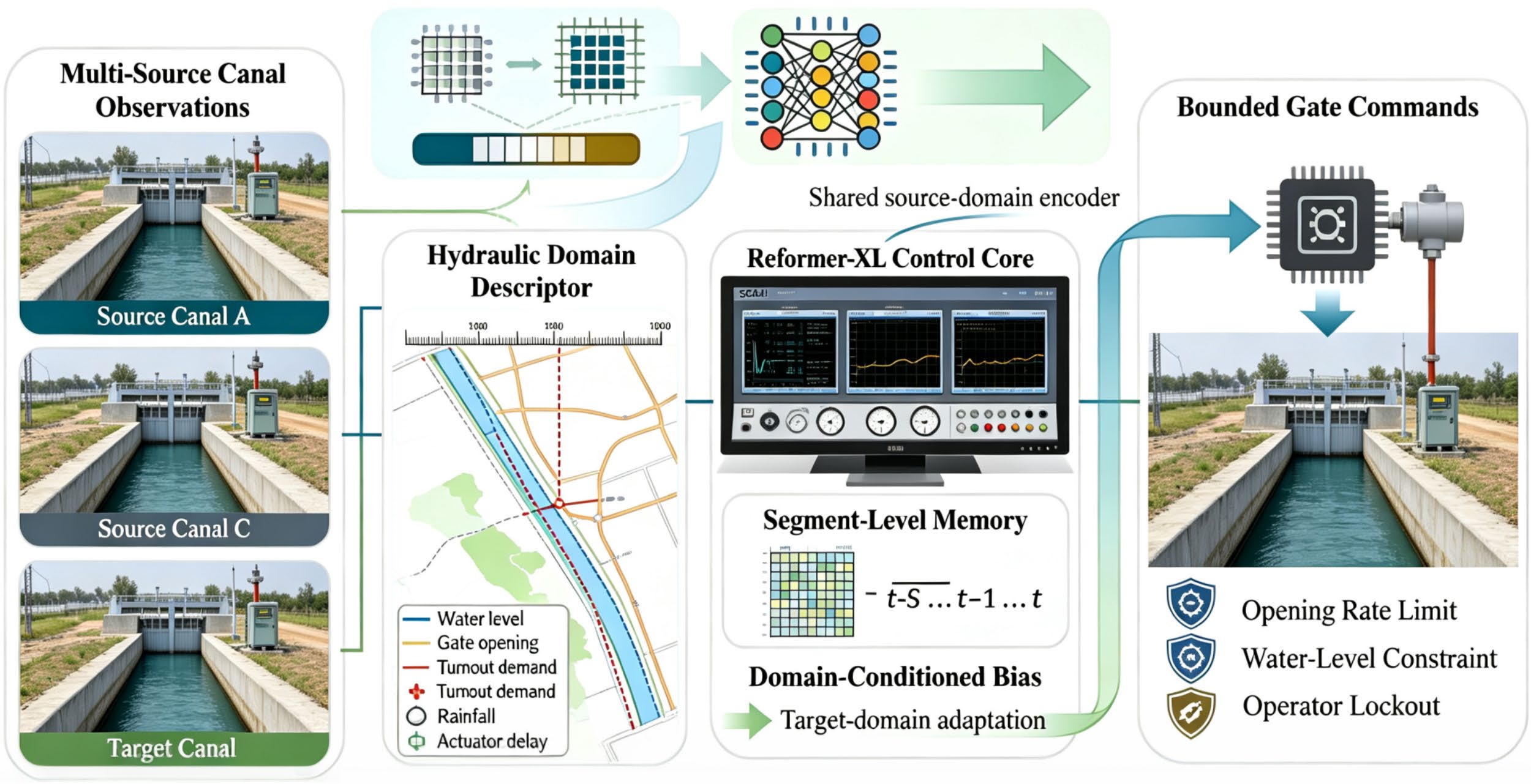
Irrigation districts increasingly require gate-control algorithms that can operate across canals with different cross sections, actuator delays, inflow disturbances, and sensor densities. This paper proposes a cross-domain Reformer-XL model for canal gate control, in which locality-sensitive hashing attention is coupled with segment-level memory, a domain- conditioned hydraulic embedding, and a constrained control head. The model was trained with digital-twin rollouts and historical operating records, then evaluated on four simulated and field-calibrated irrigation domains containing 38 reaches, 112 gate structures, and 16,800 daily operation sequences. Compared with nonlinear model predictive control, gated recurrent networks, and a standard Transformer, the proposed model reduced downstream water-level root-mean-square error from 7.8 cm to 4.9 cm in the most shifted target domain, lowered cumulative gate travel by 18.6%, and maintained a 96.4% constraint-satisfaction rate during unmeasured turnout disturbances. Ablation tests showed that segment memory contributed 1.4 cm of tracking improvement, sparse hashing kept 288-step inference below 0.7 s, and domain adversarial alignment reduced transfer degradation by 31.2%. A sensitivity test also showed that seven days of target-domain commissioning data were sufficient to reach 5.4 cm tracking error after adaptation. The results indicate that long-context attention with explicit hydraulic-domain adaptation can provide accurate, smooth, and computationally practical gate scheduling for modern irrigation canal automation while reducing the amount of target-domain commissioning data required for deployment.
Details
License
Copyright (c) 2026 George Stanciu, Karol Jipa

This work is licensed under a Creative Commons Attribution-NonCommercial-ShareAlike 4.0 International License.