Causal-Guided E(n)-Equivariant Graph Neural Network for Channel Seepage Detection
Authors
Shaheen Al-Otaibi, Zuhair Al-Buainain, Mansour Al-SalamiFiles
Key Information
Journal
Published in Vol. 6 No. 2 (2026) of Journal of Smart Operations and Management Engineering.
Journal of Smart Operations and Management Engineering (JSOME) eISSN: 3136-7666 is an international, peer-reviewed forum dedicated to publishing cutting-edge research at the intersection of process systems engineering, advanced operations research, and intelligent management. The journal bridges the gap between technical system design and executive decision-making, focusing on how data-driven algorithms, automation frameworks, and intelligent computing transform modern industrial operations.
JSOME welcomes original research articles, rigorous reviews, and methodological contributions addressing complex industrial systems, supply chain networks, energy systems, and process industries.
About the JournalAbstract
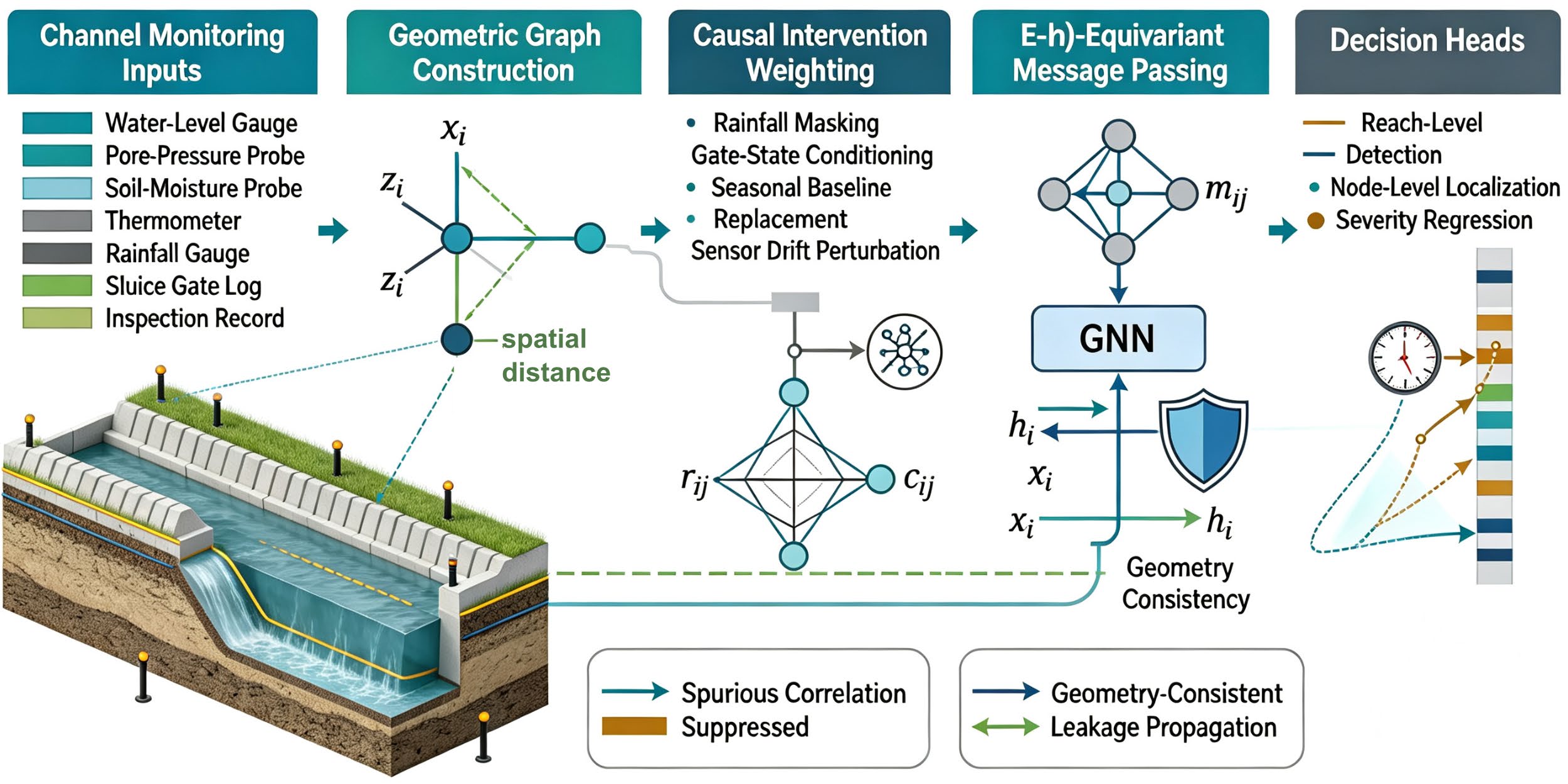
Reliable seepage detection in irrigation and conveyance channels remains difficult because leakage signatures are weak, spatially irregular, and easily confused with rainfall, gate operation, soil moisture redistribution, and sensor drift. This study develops a causal-guided E(n)-equivariant graph neural network, named Causal Leak-EGNN, for channel seepage detection from distributed pressure, water level, moisture, temperature, and operation-state observations. The evaluation is based on a synthetic-field hybrid monitoring data set rather than a fully continuous field deployment, covering 18 channel reaches, 126 monitoring nodes, 5 leakage grades, and 72-step monitoring windows. The model constructs a geometric sensor graph, performs E(n)-equivariant message passing, and uses intervention-sensitive causal weights to suppress nuisance dependencies under rainfall, gate transition, seasonal baseline shift, and sensor dropout. Compared with temporal convolutional, recurrent, graph convolutional, graph attention, and non-causal EGNN baselines, the proposed model achieved 0.941 accuracy, 0.936 F1-score, 0.973 AUC, 4.6 m mean localization error, and 0.958 top-two interval hit rate. Under 20% sensor dropout, it retained 0.903 F1-score, and under dry-to-wet seasonal transfer it reached 0.901 F1-score. These results indicate that causal guidance improves robustness to operational disturbance while equivariant propagation preserves spatial consistency for leakage localization. The proposed framework provides a technically interpretable route for early seepage warning in sensorized channel infrastructure, although broader field validation remains necessary before large-scale deployment.
Details
License
Copyright (c) 2026 Shaheen Al-Otaibi, Zuhair Al-Buainain, Mansour Al-Salami

This work is licensed under a Creative Commons Attribution-NonCommercial-ShareAlike 4.0 International License.
