KAN-Transformer Model for Glacier Terminus Change Detection in Multi-Temporal SAR Images
Authors
Nikodem Żmuda, Pola MrózFiles
Key Information
Journal
Published in Vol. 6 No. 2 (2026) of Journal of Smart Operations and Management Engineering.
Journal of Smart Operations and Management Engineering (JSOME) eISSN: 3136-7666 is an international, peer-reviewed forum dedicated to publishing cutting-edge research at the intersection of process systems engineering, advanced operations research, and intelligent management. The journal bridges the gap between technical system design and executive decision-making, focusing on how data-driven algorithms, automation frameworks, and intelligent computing transform modern industrial operations.
JSOME welcomes original research articles, rigorous reviews, and methodological contributions addressing complex industrial systems, supply chain networks, energy systems, and process industries.
About the JournalAbstract
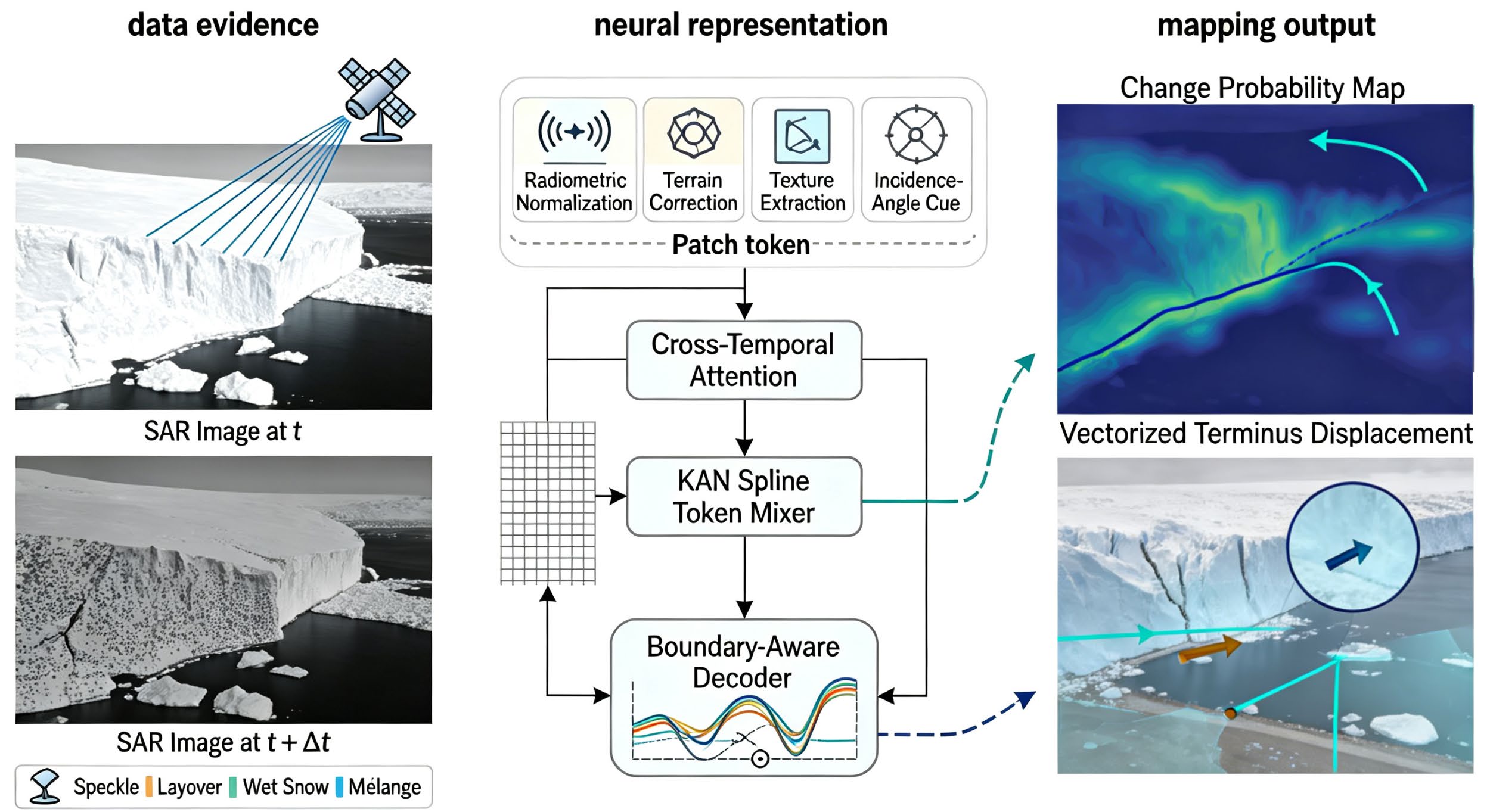
Multi-temporal synthetic aperture radar (SAR) imagery has become a practical source for monitoring glacier terminus migration where cloud cover, polar night, and terrain shadow limit optical observation. This paper proposes a physics- guided Kolmogorov-Arnold Network Transformer (KAN-Transformer) for glacier terminus change detection, with the goal of converting paired or short-sequence SAR observations into dense change probabilities and signed boundary displacement products. The method constructs temporal tokens from calibrated intensity, ratio, signed-difference, texture, and incidence-angle descriptors, and then combines cross-temporal attention with KAN-based nonlinear feature mixing and a boundary-aware decoder. A direction-aware preprocessing workflow, boundary-weighted supervision, and vectorization-based quality control are further designed to reduce false frontal fragments and to preserve physically plausible retreat or advance signals. Experiments on 1,248 SAR image pairs from Jakobshavn Isbrae, Helheim Glacier, Columbia Glacier, and Aletsch Glacier show that the proposed model achieves an F1-score of 0.893, an IoU of 0.812, a boundary error of 22.6 m, and a displacement MAE of 31.4 m on an independent test split. Compared with ChangeFormer, the model reduces boundary error by 18.7% and decreases analyst correction time from 14.8 min to 8.6 min per scene, while maintaining more stable estimates across 12-day to 72-day acquisition intervals. These results indicate that the proposed framework can improve SAR-based terminus mapping when operational products require both pixel-level change evidence and vector-ready frontal displacement estimates for regional glacier inventory maintenance and seasonal monitoring.
Details
License
Copyright (c) 2026 Nikodem Żmuda, Pola Mróz

This work is licensed under a Creative Commons Attribution-NonCommercial-ShareAlike 4.0 International License.
