Packet-Loss-Mode-Conditioned Sensor Network Topology Recovery Using an Improved MambaMixer Model
Authors
Ljiljana Lazarević, Mirjana Novaković, Radmila JovićFiles
Key Information
Journal

Published in Vol. 6 No. 2 (2026) of Journal of Smart Operations and Management Engineering.
Journal of Smart Operations and Management Engineering (JSOME) eISSN: 3136-7666 is an international, peer-reviewed forum dedicated to publishing cutting-edge research at the intersection of process systems engineering, advanced operations research, and intelligent management. The journal bridges the gap between technical system design and executive decision-making, focusing on how data-driven algorithms, automation frameworks, and intelligent computing transform modern industrial operations.
JSOME welcomes original research articles, rigorous reviews, and methodological contributions addressing complex industrial systems, supply chain networks, energy systems, and process industries.
About the JournalAbstract
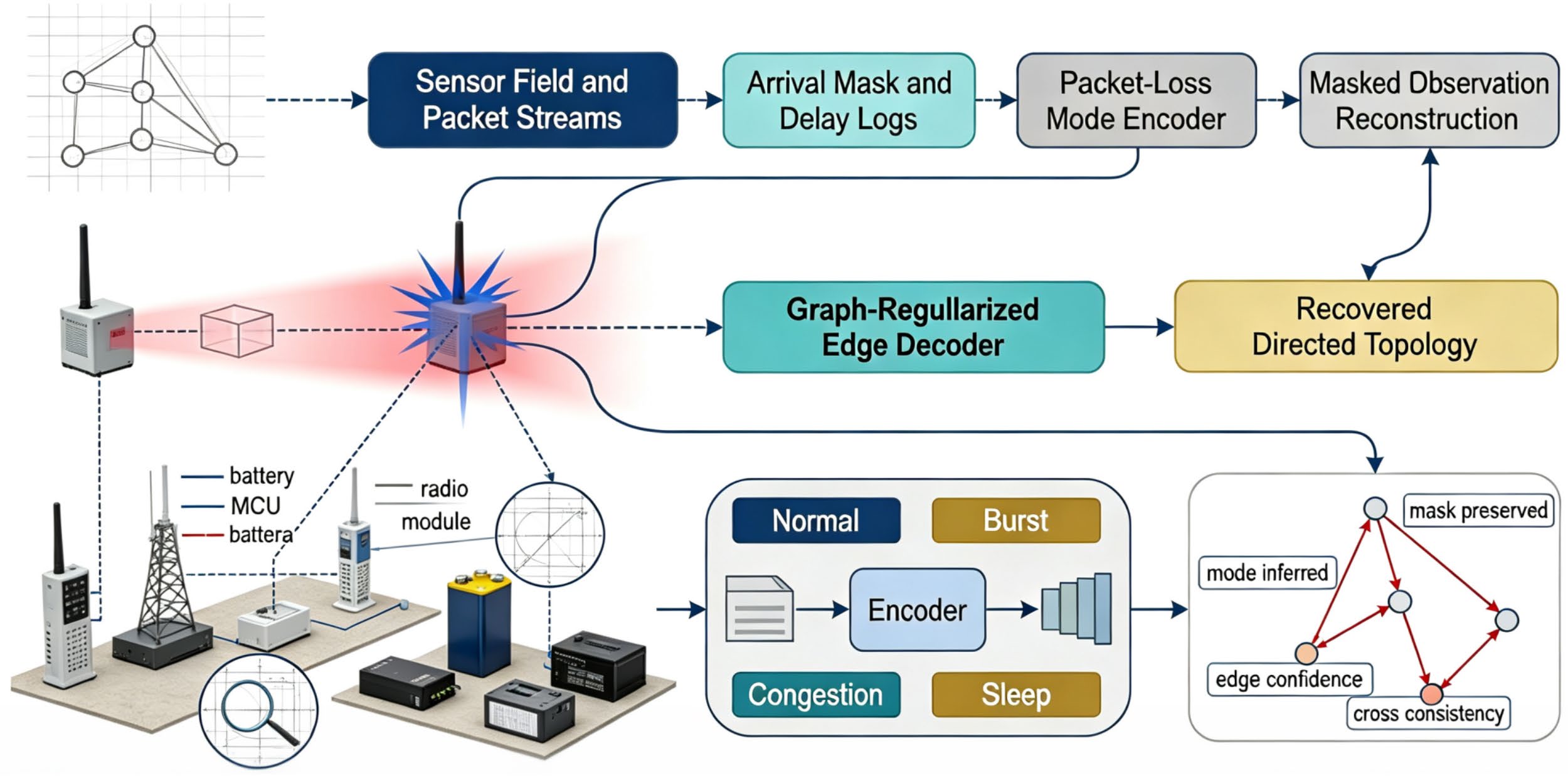
Topology recovery in wireless sensor networks is unreliable when packet loss is not random but is related to traffic load, link quality and duty-cycle mode. This paper proposes an improved MambaMixer model for recovering directed sensor- network topology under packet-loss-correlated operating modes. The method introduces mode-aware loss encoding, selectively mixes state-space sequences, and uses graph-regularized edge decoding to treat missing observations as structured information rather than noise. Experiments were carried out on synthetic and semi-realistic sensor streams with 40-160 nodes, four packet-loss regimes, and mixed temporal dynamics. Compared with a correlation threshold, Granger- style sparse regression, graph neural reconstruction and a vanilla Mamba baseline, the proposed model increased the average F1-score from 0.781 to 0.873, reduced the structural Hamming distance by 31.6%, and maintained an AUC of 0.921 at 35% burst loss. Ablation results show that the mode gate contributes 3.8 percentage points to the F1-score and the mixer-edge consistency loss contributes 2.6 percentage points. The model reduced the inference latency to 18.4ms for a 120-node window and supports a near-online topology inspection in engineering applications. According to the above results, topology recovery performs better when the loss pattern is modelled as conditional modes and observation gaps correspond to network congestion or channel fading.
Details
License
Copyright (c) 2026 Ljiljana Lazarević, Mirjana Novaković, Radmila Jović

This work is licensed under a Creative Commons Attribution-NonCommercial-ShareAlike 4.0 International License.