TabPFN-XGBoost Model for Hydraulic Data-Driven Sluice Gate Scheduling Optimization in Tidal River Reaches
Authors
Xanthos Vasilopoulos, Adonis Bouras, Stelios Paraskevopoulos, Nestoras FotiadisFiles
Key Information
Journal

Published in Vol. 6 No. 2 (2026) of Journal of Smart Operations and Management Engineering.
Journal of Smart Operations and Management Engineering (JSOME) eISSN: 3136-7666 is an international, peer-reviewed forum dedicated to publishing cutting-edge research at the intersection of process systems engineering, advanced operations research, and intelligent management. The journal bridges the gap between technical system design and executive decision-making, focusing on how data-driven algorithms, automation frameworks, and intelligent computing transform modern industrial operations.
JSOME welcomes original research articles, rigorous reviews, and methodological contributions addressing complex industrial systems, supply chain networks, energy systems, and process industries.
About the JournalAbstract
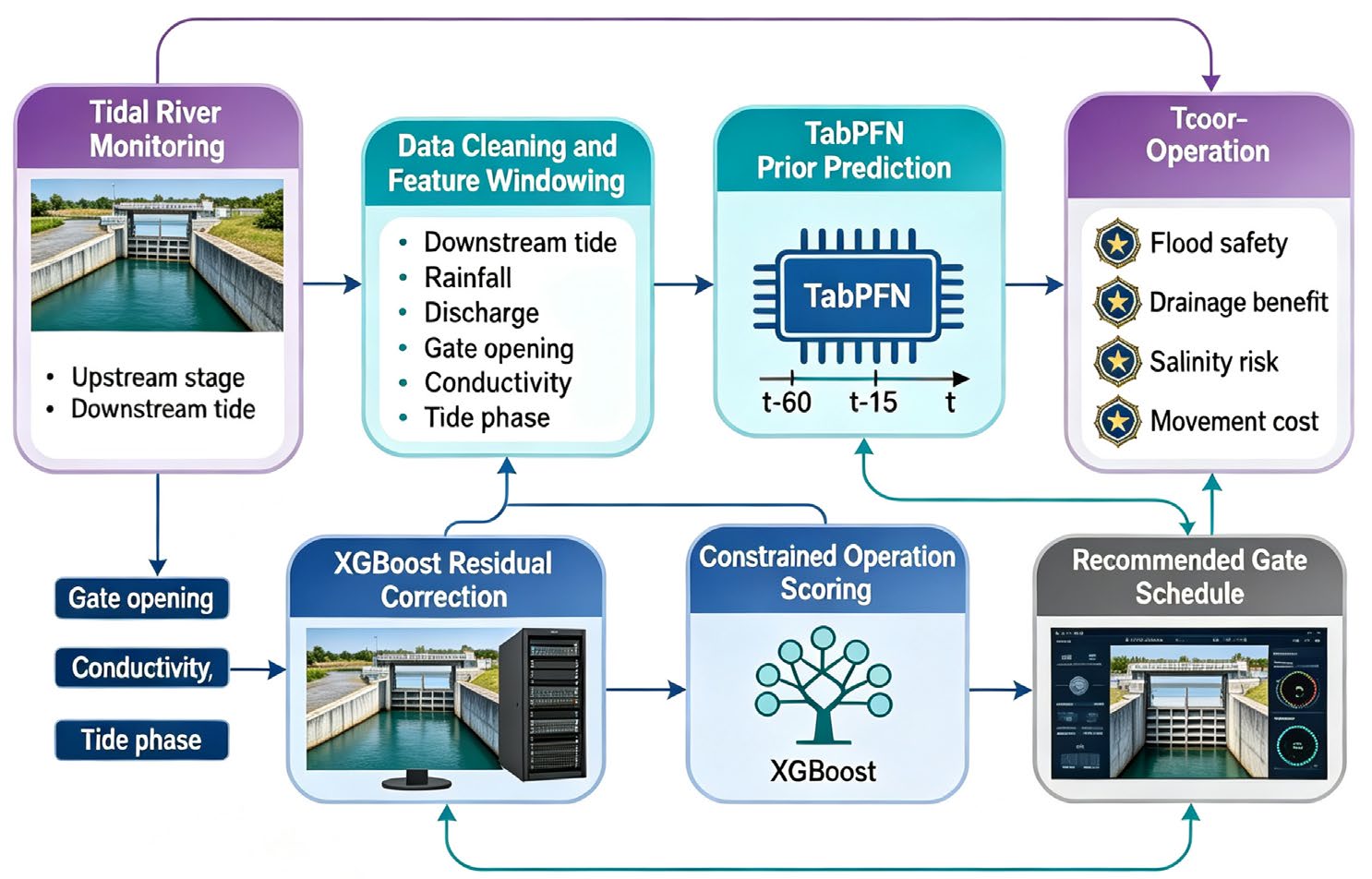
Tidal River Sluices need to regulate flood storage, ebb-tide drainage, salinity intrusion and gate movement frequency under changing hydraulic conditions over a period of hours. This paper proposes a hydraulic data-driven TabPFN-XGBoost model for sluice gate scheduling optimization in tidal river reaches. TabPFN is used as a small-sample prior learner for the short-horizon water level and discharge response, and then XGBoost is employed to correct the residual hydraulic bias and map candidate gate openings to operational scores under safety constraints. A 15-minute monitoring data set of the upstream stage, downstream tide, gate opening, discharge, rainfall and conductivity was organized into 18,432 samples across the spring, neap and spring tidal periods. Compared with standalone XGBoost, Random Forest, LSTM and Support Vector Regression, the proposed model reduced the one-hour water-level RMSE to 0.071 m, improved the discharge prediction Nash-Sutcliffe efficiency to 0.942, and decreased unnecessary gate movement by 23.6% in the scheduling simulation. The optimized schedule also increased the effective low-tide drainage volume by 8.9% and kept the maximum upstream stage at 0.18m below the warning limit. Based on the above results, a tabular foundation prior coupled with gradient-boosted residual learning can offer a relatively compact and interpretable path for real-time sluice operation in data-scarce tidal river environments. The regime contrast suggests that the hybrid model gains most during storm-tide transitions, where rainfall-driven upstream rise and downstream tidal resistance occur within the same forecast window.
Details
License
Copyright (c) 2026 Xanthos Vasilopoulos, Adonis Bouras, Stelios Paraskevopoulos, Nestoras Fotiadis

This work is licensed under a Creative Commons Attribution-NonCommercial-ShareAlike 4.0 International License.