Physics-Informed KAN-Mamba Model for Thermal Conductivity Estimation
Authors
Daniel Szczepański, Robert Tomczyk, Laura ŁapińskaFiles
Key Information
Journal
Published in Vol. 6 No. 2 (2026) of Journal of Smart Operations and Management Engineering.
Journal of Smart Operations and Management Engineering (JSOME) eISSN: 3136-7666 is an international, peer-reviewed forum dedicated to publishing cutting-edge research at the intersection of process systems engineering, advanced operations research, and intelligent management. The journal bridges the gap between technical system design and executive decision-making, focusing on how data-driven algorithms, automation frameworks, and intelligent computing transform modern industrial operations.
JSOME welcomes original research articles, rigorous reviews, and methodological contributions addressing complex industrial systems, supply chain networks, energy systems, and process industries.
About the JournalAbstract
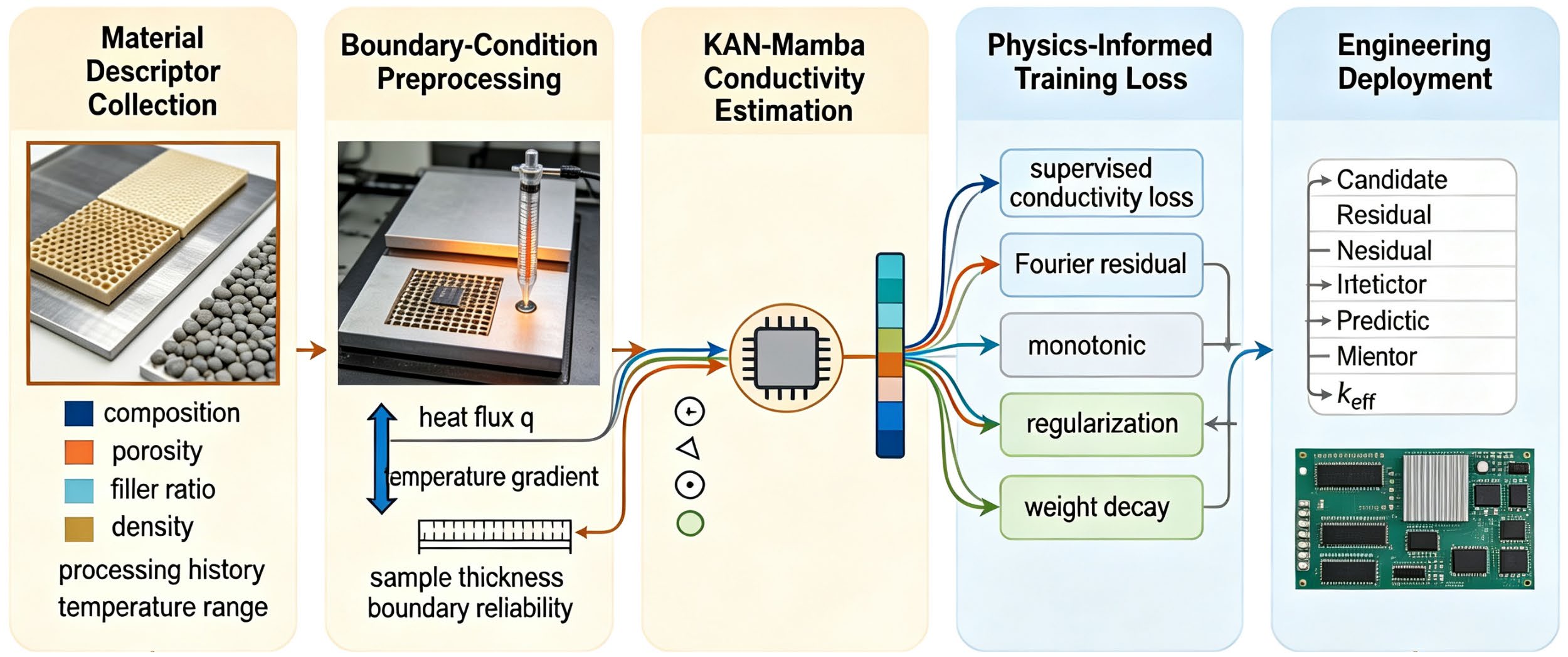
Accurate thermal conductivity estimation remains difficult when engineering materials exhibit coupled temperature dependence, porosity, anisotropic fillers, and manufacturing-induced variability. This study proposes a physics-informed KAN-Mamba model that combines Kolmogorov-Arnold network transformations with a selective state-space backbone to estimate effective thermal conductivity from composition, microstructure, and boundary-condition descriptors. The method introduces a differentiable Fourier-consistency penalty, monotonic temperature regularization, and channel-wise spline activation to improve both numerical accuracy and physical plausibility. A benchmark containing 4,860 synthetic- measured samples across polymer composites, porous ceramics, aluminum alloys, and phase-change interface materials was constructed with five descriptor groups and three operating-temperature regimes. Compared with multilayer perceptron, random forest, temporal convolution, transformer, and pure Mamba baselines, the proposed model achieved an MAE of 0.137 W m−1 K−1, an RMSE of 0.214 W m−1 K−1, and an R2 of 0.982 on the held-out test set. The mean physics residual decreased by 47.6% relative to the unconstrained Mamba model, and the extrapolation error at 420-480 K was reduced from 0.412 to 0.246 W m−1 K−1. Ablation experiments show that removing the KAN transformation increased RMSE by 18.7%, while removing the physics-informed loss increased boundary-flux inconsistency by 52.3%. The results indicate that physically guided selective sequence modeling can provide a compact and reliable estimator for thermal design workflows involving sparse measurements and heterogeneous material families.
Details
License
Copyright (c) 2026 Daniel Szczepański, Robert Tomczyk, Laura Łapińska

This work is licensed under a Creative Commons Attribution-NonCommercial-ShareAlike 4.0 International License.