Terrain- and Battery-Telemetry-Constrained Energy-Saving Route Planning for Electric Buses Using an Improved MegaCRN Model
Authors
Kosmas Papaspyrou, Rafail Logothetis, Alexandros StergiouFiles
Key Information
Journal
Published in Vol. 6 No. 2 (2026) of Journal of Smart Operations and Management Engineering.
Journal of Smart Operations and Management Engineering (JSOME) eISSN: 3136-7666 is an international, peer-reviewed forum dedicated to publishing cutting-edge research at the intersection of process systems engineering, advanced operations research, and intelligent management. The journal bridges the gap between technical system design and executive decision-making, focusing on how data-driven algorithms, automation frameworks, and intelligent computing transform modern industrial operations.
JSOME welcomes original research articles, rigorous reviews, and methodological contributions addressing complex industrial systems, supply chain networks, energy systems, and process industries.
About the JournalAbstract
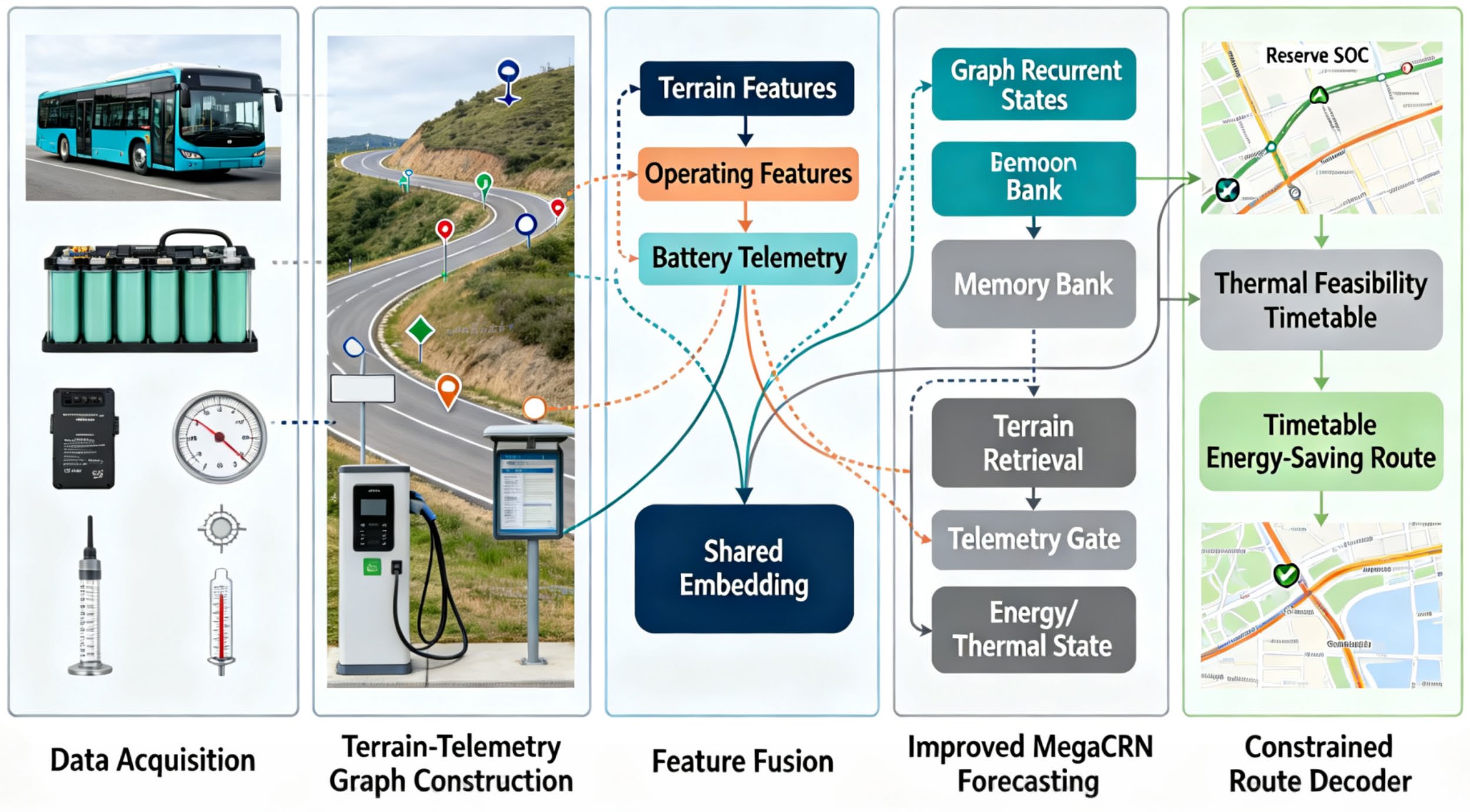
Electric buses are strongly affected by route topography and battery operating state, yet many energy-saving routing methods still treat segment cost as a static distance- or speed-based attribute. This paper emphasizes an operational extension of MegaCRN in which memory retrieval is conditioned by terrain and live battery telemetry, and the resulting prediction is passed to a feasibility-aware routing decoder. This paper proposes an improved MegaCRN model for energy- saving route planning under terrain and battery telemetry constraints. The method constructs a directed road-segment graph in which gradient, elevation change, curvature, stop density, observed speed, passenger load, state of charge, battery temperature, voltage dispersion, and regenerative braking opportunity are fused through a telemetry-conditioned memory module. A constraint-aware decoder then estimates segment energy and transfers the prediction into a multi-objective path search with timetable, reserve-energy, and thermal-feasibility constraints. Experiments are designed on a 214-segment urban bus network with 38,720 synchronized telemetry records and 1,246 candidate trips. Compared with vanilla MegaCRN, DCRNN, STGCN, ASTGCN, and an energy shortest-path baseline, the proposed model reduces mean absolute energy prediction error from 0.182 to 0.121 kWh/km, lowers route-level energy consumption by 9.8%, and improves reserve-energy violation rate from 7.4% to 1.9%. Ablation results show that terrain memory and battery gating contribute 3.1% and 4.4% energy reduction, respectively, while the complete model keeps average delay within 2.6 min. The results indicate that memory-based graph forecasting can support deployable electric-bus routing when physical terrain features and battery telemetry are treated as coupled constraints rather than auxiliary covariates.
Details
License
Copyright (c) 2026 Kosmas Papaspyrou, Rafail Logothetis, Alexandros Stergiou

This work is licensed under a Creative Commons Attribution-NonCommercial-ShareAlike 4.0 International License.