Neural Operator Transformer for Roadside Perception Blind-Zone Completion Based on Multi-Sensor Intersection Observation
Authors
Adam Musiał, Lena KubackaFiles
Key Information
Journal

Published in Vol. 3 No. 1 (2023) of Journal of Smart Operations and Management Engineering.
Journal of Smart Operations and Management Engineering (JSOME) eISSN: 3136-7666 is an international, peer-reviewed forum dedicated to publishing cutting-edge research at the intersection of process systems engineering, advanced operations research, and intelligent management. The journal bridges the gap between technical system design and executive decision-making, focusing on how data-driven algorithms, automation frameworks, and intelligent computing transform modern industrial operations.
JSOME welcomes original research articles, rigorous reviews, and methodological contributions addressing complex industrial systems, supply chain networks, energy systems, and process industries.
About the JournalAbstract
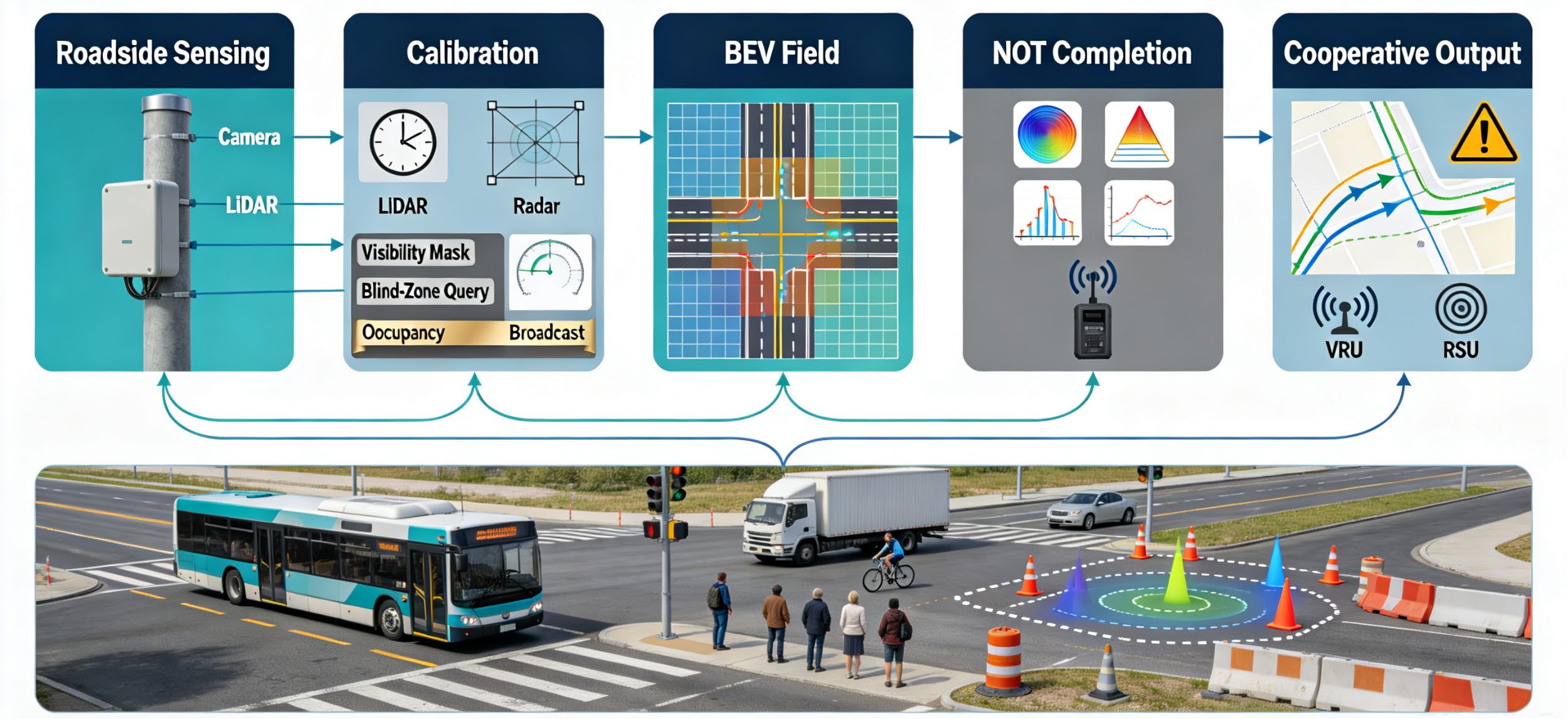
Roadside perception is now a practical foundation for cooperative automated driving, but fixed-infrastructure sensors still have blind spots behind stopped buses, turning trucks, signal poles, and dense groups of pedestrians into blind spots. This paper proposes a Neural Operator Transformer for blind-zone completion at signalized intersections based on synchronized camera, LiDAR, millimeter-wave radar and signal-phase observations. The model represents each intersection as a continuous spatio-temporal observation field, learns an operator that maps partially visible multi-sensor evidence to latent occupancy and velocity states, and injects lane topology via a lightweight cross-attention prior. A 42-hour multi-sensor intersection corpus with 18,620 annotated object tracks, five occlusion classes and 31,400 blind-zone query windows were used for the experiments. Compared with a BEV Transformer, a graph temporal network and a convolutional imputation baseline, the proposed model reduced the blind-zone occupancy error from 0.184 to 0.112, improved trajectory endpoint accuracy from 1.48 m to 0.91 m, and increased vulnerable-road-user recall under heavy occlusion from 82.6% to 90.8%. The model had an average inference latency of 28.7ms on the edge GPU and met the 10Hz roadside perception requirement. Therefore, operator learning can improve the robustness of infrastructure perception in the face of sensor occlusion without adding dense extra hardware.
Details
License
Copyright (c) 2023 Adam Musiał, Lena Kubacka

This work is licensed under a Creative Commons Attribution-NonCommercial-ShareAlike 4.0 International License.
