Spatial Interpolation of Ore Grade from Blast-Hole Assay and Geological Data Using a Bayesian Graph Neural Network
Authors
František Kubík, Václav Mareš, Robert HladíkFiles
Key Information
Journal

Published in Vol. 3 No. 1 (2023) of Journal of Smart Operations and Management Engineering.
Journal of Smart Operations and Management Engineering (JSOME) eISSN: 3136-7666 is an international, peer-reviewed forum dedicated to publishing cutting-edge research at the intersection of process systems engineering, advanced operations research, and intelligent management. The journal bridges the gap between technical system design and executive decision-making, focusing on how data-driven algorithms, automation frameworks, and intelligent computing transform modern industrial operations.
JSOME welcomes original research articles, rigorous reviews, and methodological contributions addressing complex industrial systems, supply chain networks, energy systems, and process industries.
About the JournalAbstract
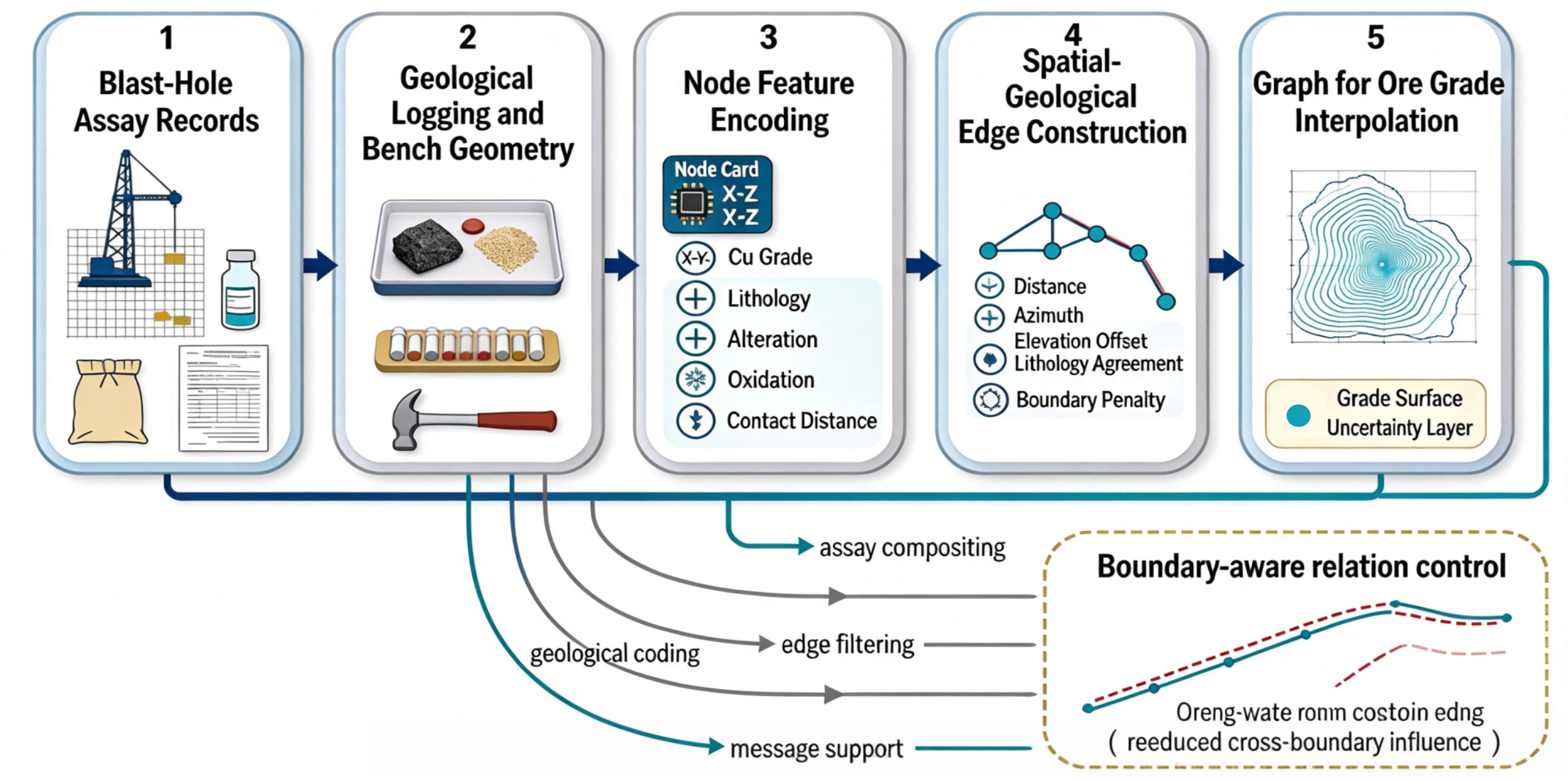
Reliable interpolation of ore grade from blast-hole assays and geological logging is still difficult when short-range grade variability, domain boundaries, and uneven sampling density occur in the same mining bench. This paper introduces a Bayesian graph neural network for bench-scale ore grade interpolation, where each blast-hole interval is modelled as a spatial-geological node and edges incorporate information such as horizontal distance, elevation offset, azimuthal continuity, lithological similarity and structural boundary penalties. The model estimates grade expectation and predictive uncertainty via stochastic message passing, variational weight sampling, and heteroscedastic likelihood learning. A synthetic but mine-realistic open-pit copper dataset with 4,862 blast-hole intervals, 11 geological attributes and 38,910 graph edges was used for controlled experiments. Compared with ordinary kriging, random forest, Gaussian process regression and a deterministic graph neural network, the proposed model reduced the Cu grade MAE to 0.087%, improved RMSE to 0.131%, increased 90% prediction interval coverage to 0.914, and maintained a mean interval width of 0.236%. Boundary-zone evaluation showed a 16.8% lower ore-waste misclassification rate than the deterministic graph baseline, and marginal-grade errors were reduced most significantly around the 0.35% Cu cut-off. The results show that Bayesian graph learning can provide an operationally feasible interpolation surface and a calibrated uncertainty layer for grade control, selective mining and follow-up assay prioritization, and retain inspectable graph relations for geological review under practical bench-scale constraints.
Details
License
Copyright (c) 2023 Hanna Ziółkowska, Alicja Tomala, Adrian Robert Frączek

This work is licensed under a Creative Commons Attribution-NonCommercial-ShareAlike 4.0 International License.