MambaOut-CA for Multimodal EBSD and SEM Phase-Microstructure Segmentation in Additively Manufactured Alloys
Authors
Hanna Ziółkowska, Alicja Tomala, Adrian Robert FrączekFiles
Key Information
Journal
Published in Vol. 3 No. 1 (2023) of Journal of Smart Operations and Management Engineering.
Journal of Smart Operations and Management Engineering (JSOME) eISSN: 3136-7666 is an international, peer-reviewed forum dedicated to publishing cutting-edge research at the intersection of process systems engineering, advanced operations research, and intelligent management. The journal bridges the gap between technical system design and executive decision-making, focusing on how data-driven algorithms, automation frameworks, and intelligent computing transform modern industrial operations.
JSOME welcomes original research articles, rigorous reviews, and methodological contributions addressing complex industrial systems, supply chain networks, energy systems, and process industries.
About the JournalAbstract
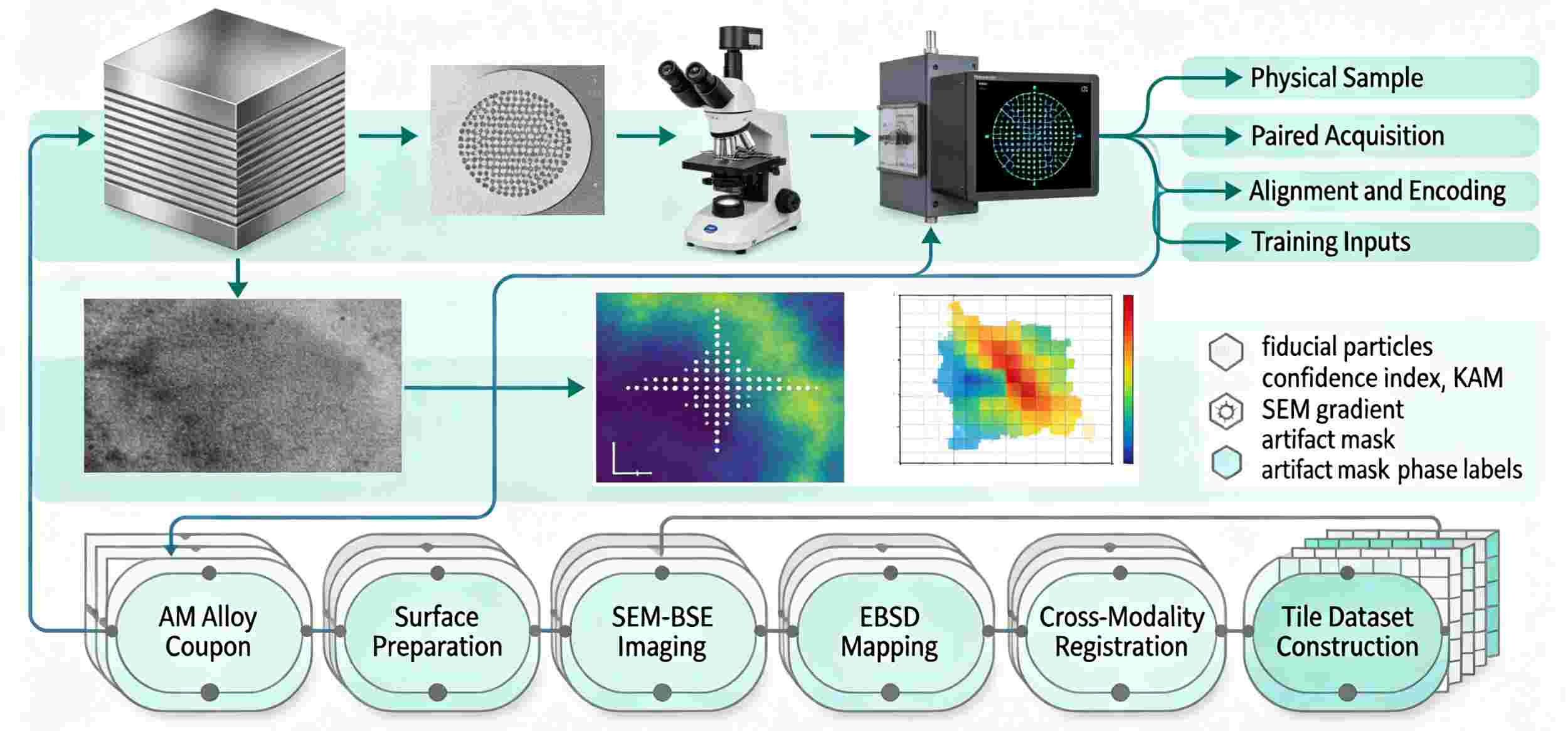
Alloy additively manufactured parts often exhibit steep thermal gradients, elongated grains, melt-pool bands, and locally ambiguous phase contrast, making separate analysis of electron backscatter diffraction and scanning electron microscopy insufficient for robust phase segmentation. This study introduces MambaOut-CA, a multimodal segmentation model that integrates EBSD orientation descriptors and SEM morphology through a registration-aware encoder, MambaOut residual mixing, and coordinate attention. A curated dataset of 4,320 paired EBSD-SEM tiles from laser powder bed fused nickel-based alloy specimens was used to evaluate four phase classes and boundary-sensitive labels. The method combines reliability-aware input encoding, modality-specific shallow feature extraction, coordinate-guided context aggregation, and a boundary-assisted decoder to reduce errors around melt-pool traces, carbide particles, and uncertain interfaces. Compared with the UNet baseline, the proposed model increased mean intersection-over-union to 88.9%, improved boundary F1 to 84.8%, and reduced phase-fraction error to 1.6% across three build heights. The model retained 87.3% mean intersection-over-union under 20% EBSD confidence dropout and required 27.8 ms per 512 x 512 tile. Additional tests show that coordinate attention improves boundary continuity, while the reliability mask limits error propagation during modality degradation. These results indicate that explicit multimodal alignment and coordinate-guided context aggregation can improve phase continuity and preserve thin precipitate networks for quantitative metallographic analysis.
Details
License
Copyright (c) 2023 Hanna Ziółkowska, Alicja Tomala, Adrian Robert Frączek

This work is licensed under a Creative Commons Attribution-NonCommercial-ShareAlike 4.0 International License.