Masked GraphTransformer Multi-Source Fusion Model for Ceramic Sintering Shrinkage Prediction
Authors
Mika Nieminen, Kalle Virtanen, Antti LaineFiles
Key Information
Journal
Published in Vol. 6 No. 1 (2026) of Journal of Smart Operations and Management Engineering.
Journal of Smart Operations and Management Engineering (JSOME) eISSN: 3136-7666 is an international, peer-reviewed forum dedicated to publishing cutting-edge research at the intersection of process systems engineering, advanced operations research, and intelligent management. The journal bridges the gap between technical system design and executive decision-making, focusing on how data-driven algorithms, automation frameworks, and intelligent computing transform modern industrial operations.
JSOME welcomes original research articles, rigorous reviews, and methodological contributions addressing complex industrial systems, supply chain networks, energy systems, and process industries.
About the JournalAbstract
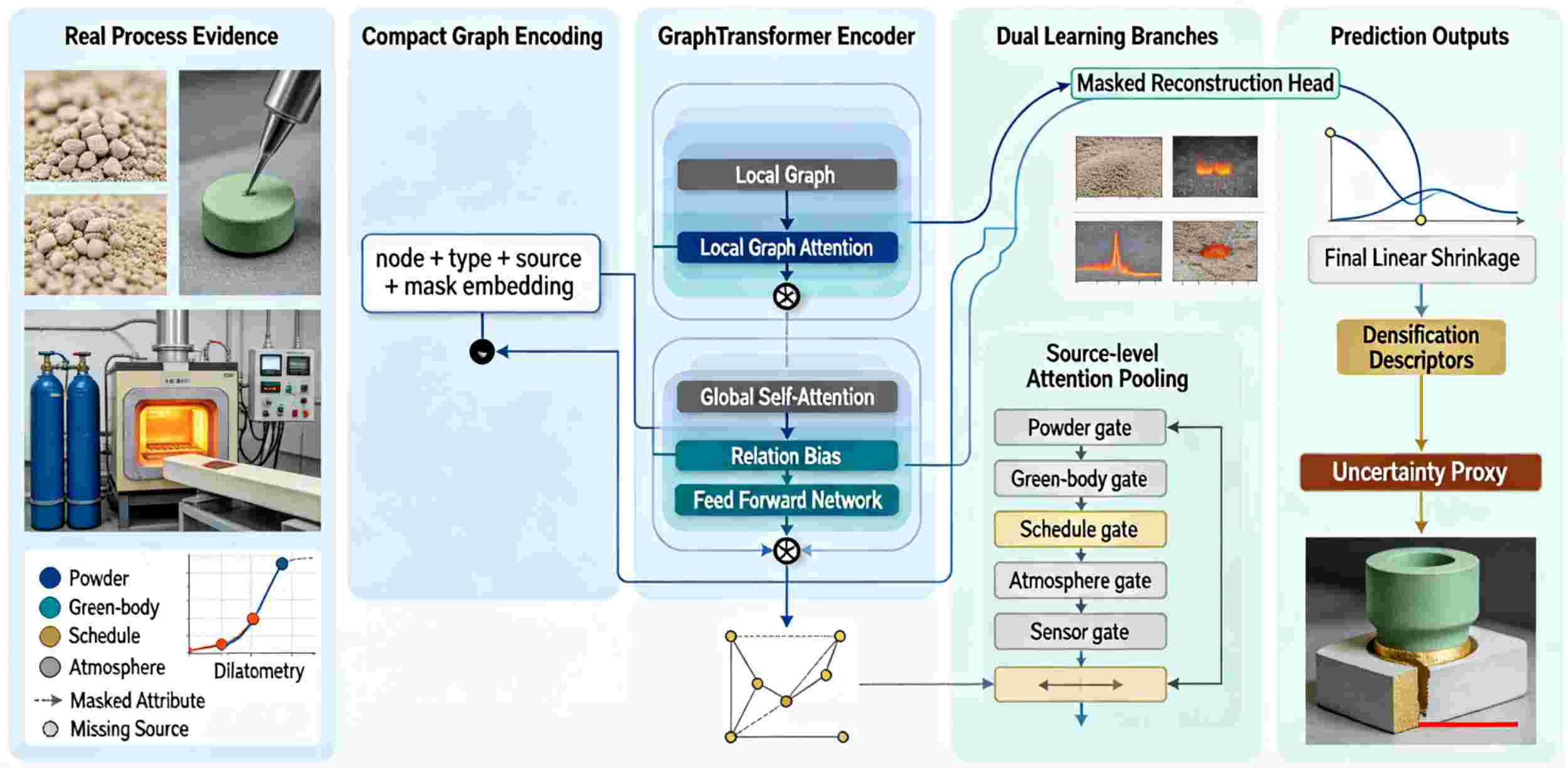
Accurate prediction of ceramic sintering shrinkage is still challenging because powder descriptors, green-body data, thermal schedules, atmosphere measurements and dilatometry traces are recorded at different resolutions and often have missing fields. Develop a Masked Graph Transformer multi-source fusion model for estimating the final linear shrinkage and intermediate densification states from heterogeneous process evidence in this paper. Each specimen is represented as a process graph whose nodes describe powder morphology, binder and additive conditions, compaction variables, furnace segments, atmosphere observations, and sensor-derived curve tokens. A masked reconstruction problem is added, and graph attention and a physics-informed shrinkage head are used to learn relational dependencies while maintaining usability in the presence of one or more missing sources. Experiments are carried out on a curated dataset of 1,284 ceramic specimens that include alumina, zirconia-toughened alumina, yttria-stabilized zirconia and silicon nitride systems. The proposed model has a final-shrinkage MAE of 0.36 %, an RMSE of 0.51 %, and an R² of 0.941, and has reduced the MAE by 31.0% compared with the best gradient boosting baseline. Under 30% random feature masking, the error increased by only 0.09 %, and the best non-masked neural baseline increased by 0.28 %. Attention and ablation analysis show that green density, peak temperature, dwell time, powder size distribution and mid-stage dilatometry slope jointly determine the prediction. Based on the above results, graph-based masked fusion can be used to achieve robust shrinkage estimation for data-fragmented ceramic manufacturing.
Details
License
Copyright (c) 2026 Mika Nieminen, Kalle Virtanen, Antti Laine

This work is licensed under a Creative Commons Attribution-NonCommercial-ShareAlike 4.0 International License.