Congestion Estimation for Expressway Service Areas Under Vehicle Entry-Exit and Dwell-Time Data Using an Improved DLinear-MoE Model
Authors
Martin Kováč, Peter Hudec, Tomáš ŠvecFiles
Key Information
Journal
Published in Vol. 6 No. 1 (2026) of Journal of Smart Operations and Management Engineering.
Journal of Smart Operations and Management Engineering (JSOME) eISSN: 3136-7666 is an international, peer-reviewed forum dedicated to publishing cutting-edge research at the intersection of process systems engineering, advanced operations research, and intelligent management. The journal bridges the gap between technical system design and executive decision-making, focusing on how data-driven algorithms, automation frameworks, and intelligent computing transform modern industrial operations.
JSOME welcomes original research articles, rigorous reviews, and methodological contributions addressing complex industrial systems, supply chain networks, energy systems, and process industries.
About the JournalAbstract
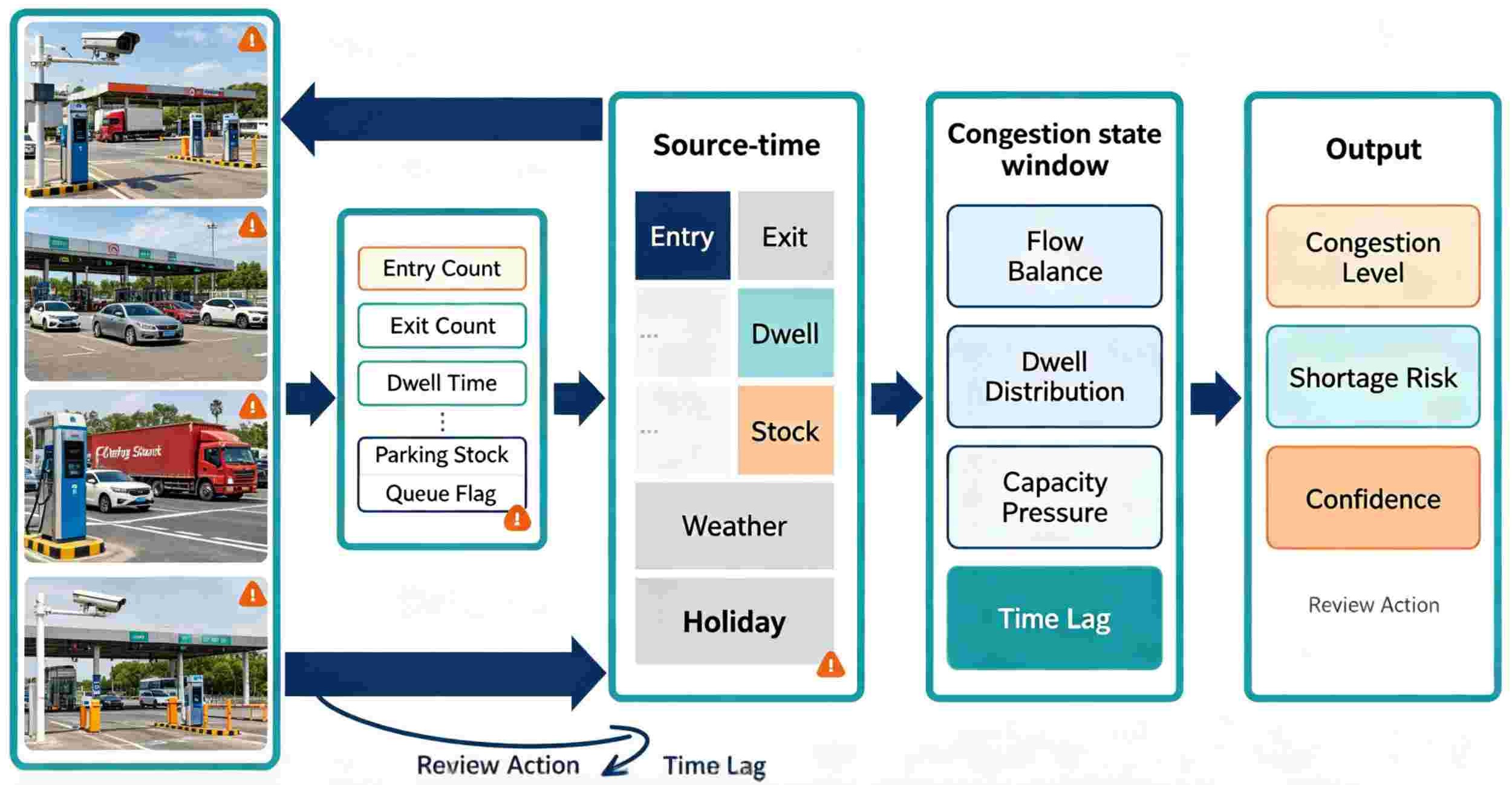
Expressway service areas are essential nodes for rest, refueling, charging, catering, emergency support and traffic regulation, but their congestion status cannot be estimated reliably from entry counts alone. Congestion emerges from the nonlinear interaction of entry-exit flow, dwell-time distribution, parking turnover, heavy-vehicle occupation, charging-space saturation, service-facility load, holiday demand, weather and management interventions. This paper proposes an improved DLinear-MoE model for congestion estimation based on vehicle entry-exit and dwell-time data. Vehicle arrivals, departures, dwell-time bins, occupancy estimates, parking turnover, vehicle type, charging-space pressure, service-facility load, upstream traffic state, weather, calendar attributes and management tags are aligned into service-area state windows. DLinear decomposes the multivariate traffic signal into trend and residual components so that stable daily demand is separated from abnormal pressure caused by peak returns, incidents or long-stay vehicles. The mixture-of-experts module routes ordinary weekdays, weekends, holidays, charging peaks, weather-sensitive demand and incident-driven waves to different scenario experts. The model outputs congestion level, parking pressure, confidence, dominant evidence and recommended management action. Experiments are conducted on a simulated expressway service-area dataset with different demand regimes, capacity settings and resource-specific pressure patterns. The framework supports interpretable warnings, parking guidance, dispatch priority, upstream information release and diversion review, rather than producing only a single traffic-flow number.
Details
License
Copyright (c) 2026 Martin Kováč, Peter Hudec, Tomáš Švec

This work is licensed under a Creative Commons Attribution-NonCommercial-ShareAlike 4.0 International License.