Koopman GRU Improved Model for Creep Life Estimation of Superalloys under Composition and Heat Treatment Descriptors
Authors
Kenta Nakamura, Takashi Yamamoto, Daichi Suzuki, Hiroshi TanakaFiles
Key Information
Journal
Published in Vol. 6 No. 1 (2026) of Journal of Smart Operations and Management Engineering.
Journal of Smart Operations and Management Engineering (JSOME) eISSN: 3136-7666 is an international, peer-reviewed forum dedicated to publishing cutting-edge research at the intersection of process systems engineering, advanced operations research, and intelligent management. The journal bridges the gap between technical system design and executive decision-making, focusing on how data-driven algorithms, automation frameworks, and intelligent computing transform modern industrial operations.
JSOME welcomes original research articles, rigorous reviews, and methodological contributions addressing complex industrial systems, supply chain networks, energy systems, and process industries.
About the JournalAbstract
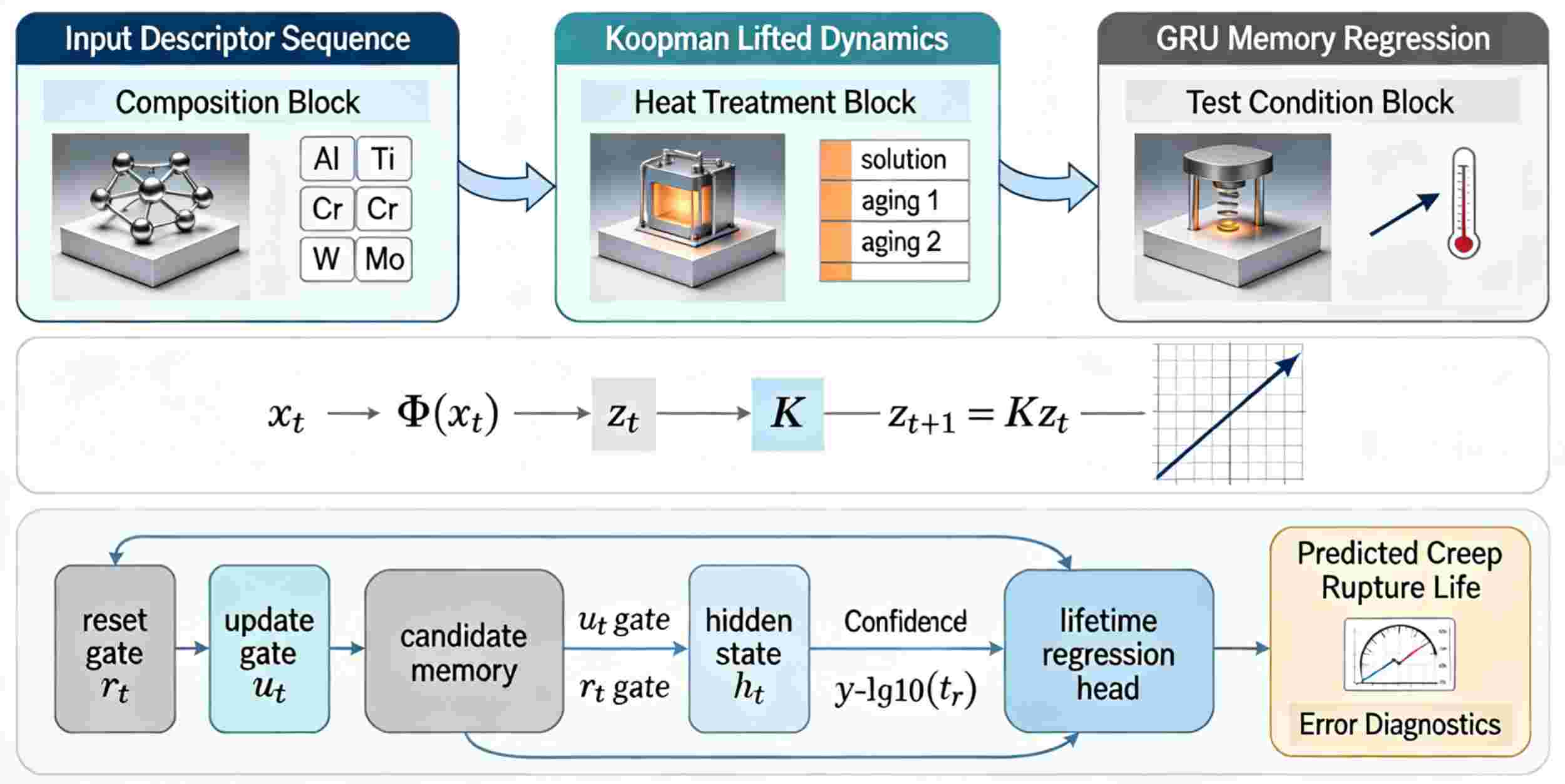
Creep rupture life estimation for high-temperature superalloys is still challenging because chemical composition, heat treatment, stress and test temperature interact in a non-linear manner that is only partially known from engineering databases. This paper introduces an improved Koopman Gated Recurrent Unit model that maps composition and heat-treatment descriptors into a lifted latent space prior to recurrent lifetime regression. The input includes the main alloying elements, refractory strengthening indicators, solution and ageing schedule descriptors, and creep test states; the output is logarithmic rupture life. A curated dataset of 684 creep records covering 37 alloy grades, 650 to 980 °C, and 120 to 760 MPa was partitioned by alloy grade to reduce optimistic leakage. Compared with random forest, multilayer perceptron, and conventional GRU baselines, the proposed model reduced the test RMSE from 0.196 to 0.143, increased R² from 0.874 to 0.931, and lowered the median absolute percentage error from 18.6% to 11.8% after inverse transformation. Ablation analysis shows that Koopman lifting reduced the RMSE by 15.4%, and heat treatment descriptors provided the largest improvement for long-life samples over 1000 hours. Based on the above results, operator-based recurrent learning can model the coupling of alloy process conditions with compact parameters and stable extrapolation.
Details
License

This work is licensed under a Creative Commons Attribution-NonCommercial-ShareAlike 4.0 International License.