TimesFM GAT Model for Industrial Recipe Anomaly Attribution with Batch Process Logs and Quality Labels
Authors
Felix Wagner, Lukas Schneider, Daniel FischerFiles
Key Information
Journal

Published in Vol. 5 No. 4 (2025) of Journal of Smart Operations and Management Engineering.
Journal of Smart Operations and Management Engineering (JSOME) eISSN: 3136-7666 is an international, peer-reviewed forum dedicated to publishing cutting-edge research at the intersection of process systems engineering, advanced operations research, and intelligent management. The journal bridges the gap between technical system design and executive decision-making, focusing on how data-driven algorithms, automation frameworks, and intelligent computing transform modern industrial operations.
JSOME welcomes original research articles, rigorous reviews, and methodological contributions addressing complex industrial systems, supply chain networks, energy systems, and process industries.
About the JournalAbstract
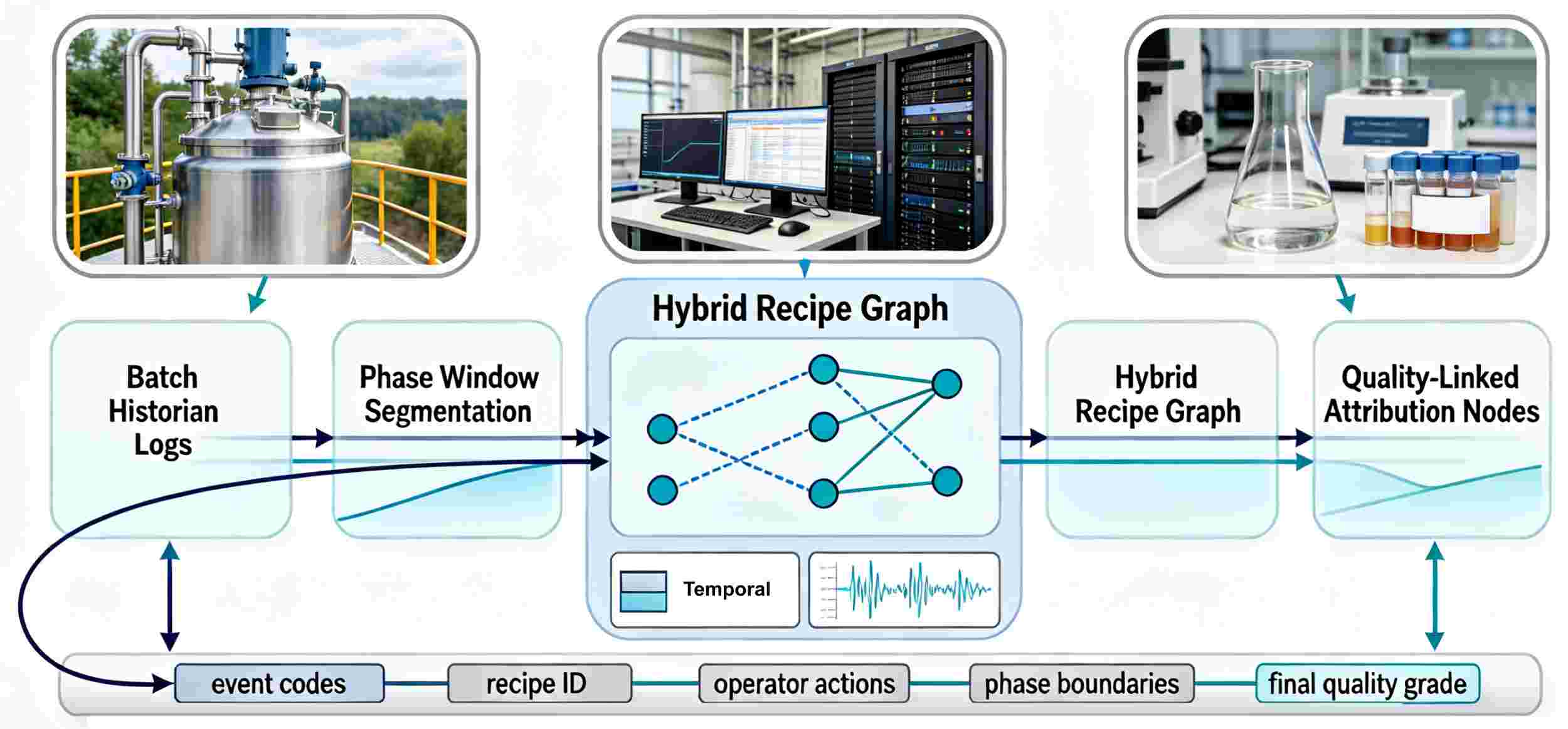
Batch manufacturing systems save detailed event logs, phase records, set-point traces and delayed quality labels, but abnormal quality changes are often only identified by isolated control charts or operator experience. This paper proposes a TimesFM-GAT model for recipe anomaly attribution in batch processes, and aligns pretrained temporal representations with a recipe graph that connects units, phases, sensors, manipulated variables, and laboratory quality results. TimesFM is used to encode multiscale log windows, a graph attention network propagates contextual evidence, and quality-supervised contrastive learning constrains attribution. A synthetic but process-faithful fermentation and specialty-chemical benchmark with 18,240 batches, 42 process variables, 11 recipe phases and four quality labels were built to evaluate detection, localization and diagnostic stability. Compared with the LSTM, TCN, TimesFM-only and GAT-only baselines, the proposed model increased the batch-level F1 score from 0.842 to 0.913, improved phase localization accuracy from 0.781 to 0.864, and reduced mean attribution drift by 27.6% under sensor missingness and recipe changeover conditions. Based on the above results, the foundation-model temporal embeddings and process-graph reasoning are complementary in identifying quality-related abnormal evidence in logged batch operations. The proposed framework offers a feasible path for recipe monitoring systems that require early warning, interpretable root-cause ranking and transferable deployment across related product grades.
Details
License

This work is licensed under a Creative Commons Attribution-NonCommercial-ShareAlike 4.0 International License.