Koopman Neural Operator Model for Ensemble Tide Level Forecasting Using Nearshore Tide Gauges and Wind Fields
Authors
Lorenzo Moretti, Alessandro RinaldiFiles
Key Information
Journal

Published in Vol. 6 No. 2 (2026) of Journal of Smart Operations and Management Engineering.
Journal of Smart Operations and Management Engineering (JSOME) eISSN: 3136-7666 is an international, peer-reviewed forum dedicated to publishing cutting-edge research at the intersection of process systems engineering, advanced operations research, and intelligent management. The journal bridges the gap between technical system design and executive decision-making, focusing on how data-driven algorithms, automation frameworks, and intelligent computing transform modern industrial operations.
JSOME welcomes original research articles, rigorous reviews, and methodological contributions addressing complex industrial systems, supply chain networks, energy systems, and process industries.
About the JournalAbstract
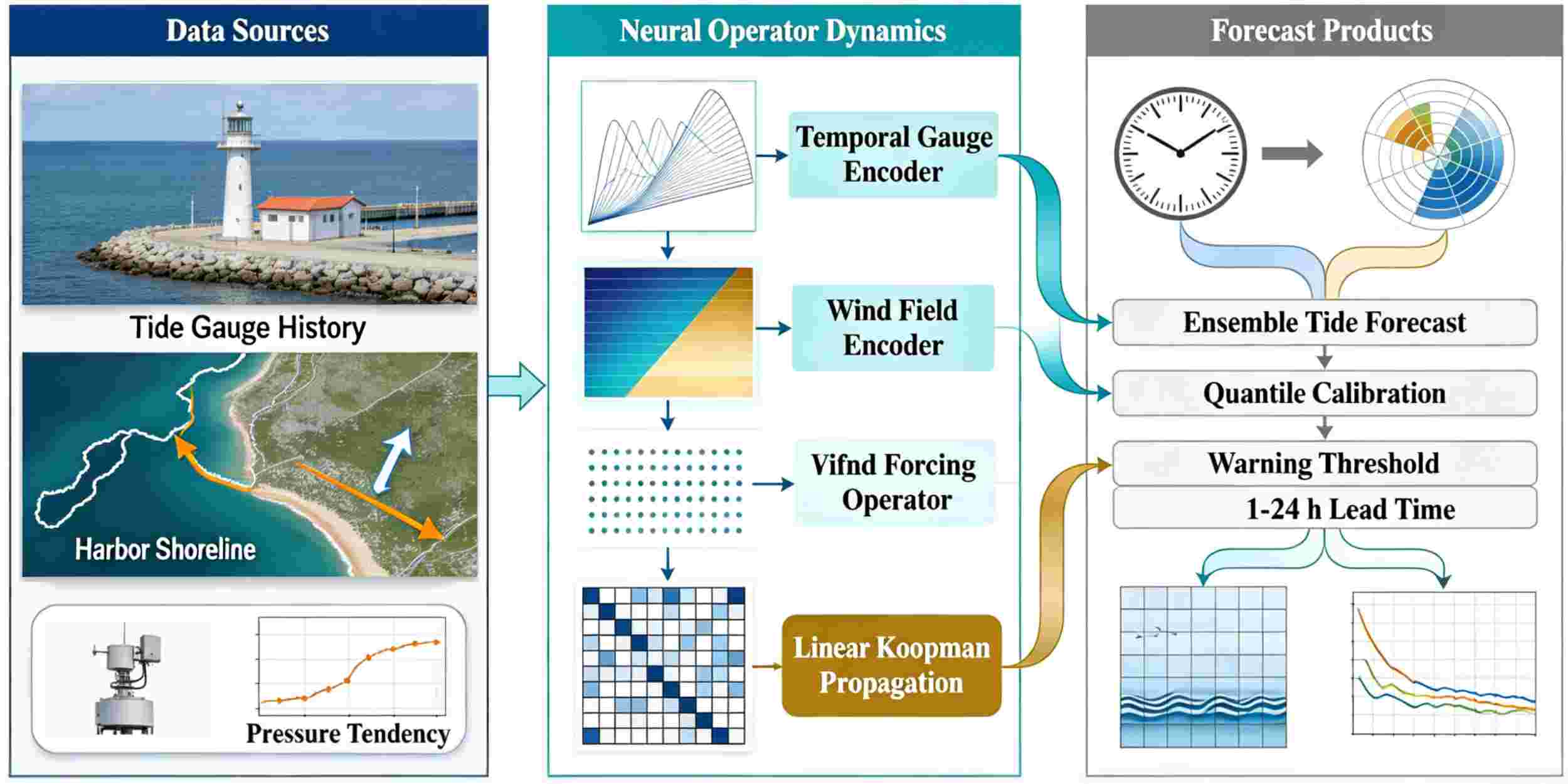
Nearshore tide level prediction remains difficult when astronomical tides, wind setup, pressure-driven residuals, and station-specific bathymetric effects interact over short warning horizons. This paper proposes a Koopman Neural Operator model for ensemble tide forecasting using coastal tide gauge records and gridded wind fields. The method maps recent gauge observations, wind speed, wind direction, and pressure tendency into a latent function space, advances the state with a learned linear Koopman operator, and decodes calibrated quantile ensembles for 1-24 h forecasts. A six-station hindcast experiment was designed with 31,680 hourly samples, four storm segments, and three seasonal validation blocks. Compared with persistence, long short-term memory, temporal convolution, and Fourier neural operator baselines, the proposed model reduced 24 h root mean square error from 18.9 cm to 12.7 cm and improved continuous ranked probability score by 22.4%. For surge events above the 95th percentile, the ensemble interval captured 91.6% of observed peaks while keeping the mean interval width below 29.4 cm. Ablation tests show that removing wind-direction embeddings increased peak error by 14.8%, and removing Koopman linear evolution weakened horizon stability after 12 h. The results indicate that operator learning with explicit wind-field coupling can provide accurate, stable, and uncertainty-aware tide forecasts for engineering warning systems. The central contribution is therefore a calibrated ensemble operator that targets wind-driven nearshore warning horizons rather than a single deterministic water-level trajectory.
Details
License
Copyright (c) 2026 Lorenzo Moretti, Alessandro Rinaldi

This work is licensed under a Creative Commons Attribution-NonCommercial-ShareAlike 4.0 International License.