Impedance Spectroscopy and Operating History Driven Solid Oxide Fuel Cell Degradation Prediction Using TD3 GraphMPC
Authors
Žan Vidmar, Matej KranjcFiles
Key Information
Journal
Published in Vol. 6 No. 1 (2026) of Journal of Smart Operations and Management Engineering.
Journal of Smart Operations and Management Engineering (JSOME) eISSN: 3136-7666 is an international, peer-reviewed forum dedicated to publishing cutting-edge research at the intersection of process systems engineering, advanced operations research, and intelligent management. The journal bridges the gap between technical system design and executive decision-making, focusing on how data-driven algorithms, automation frameworks, and intelligent computing transform modern industrial operations.
JSOME welcomes original research articles, rigorous reviews, and methodological contributions addressing complex industrial systems, supply chain networks, energy systems, and process industries.
About the JournalAbstract
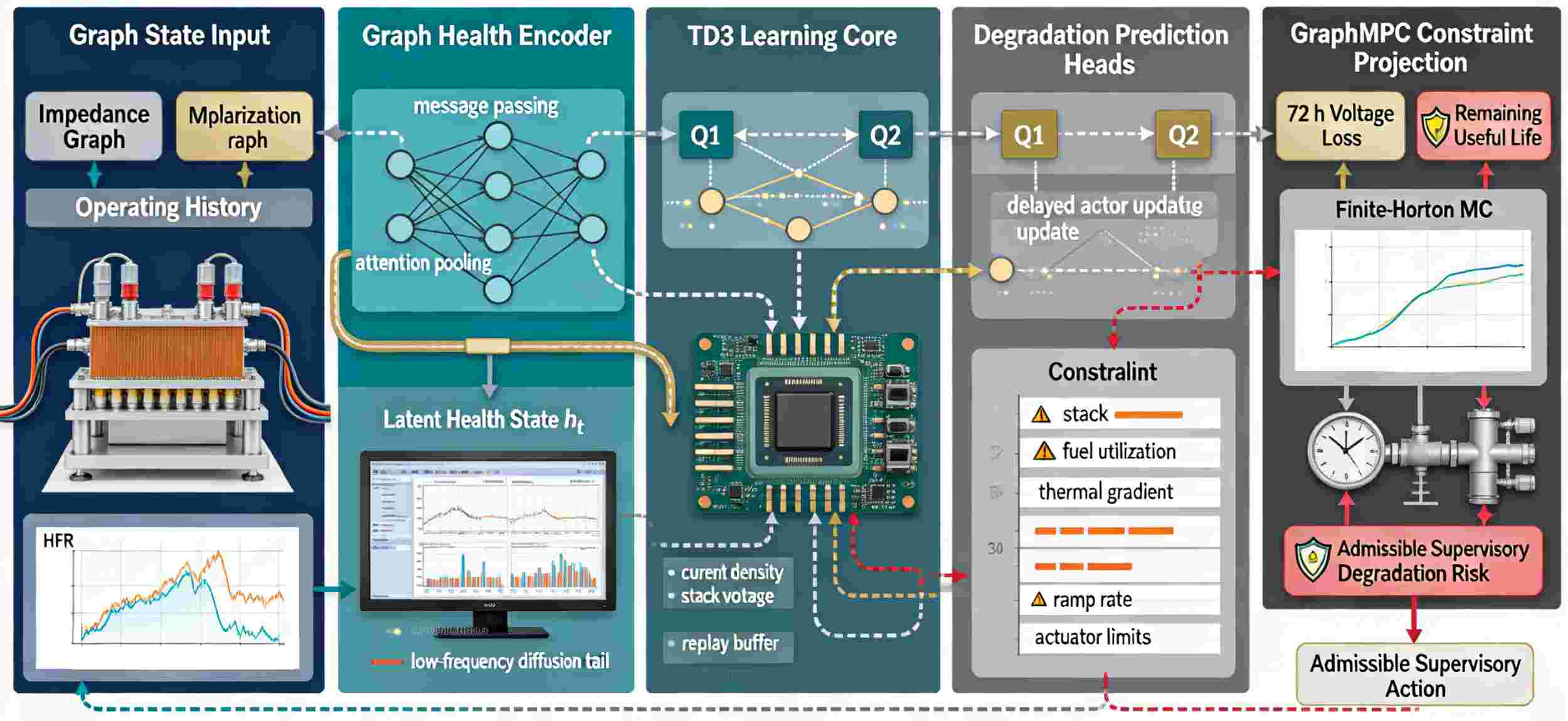
Solid oxide fuel cell systems degrade via combined electrochemical, thermal and mechanical paths that cannot be separated from the regular operating log. A TD3 GraphMPC model is developed in this paper to integrate electrochemical impedance spectroscopy and operating history for short-horizon degradation prediction and health-aware control. Impedance arcs, ohmic resistance, polarization resistance, gas conversion descriptors, thermal gradients, current density history and load-transition statistics are encoded in a dynamic graph, and its edges represent electrochemical coupling and operational adjacency. A twin delayed deep deterministic policy gradient module learns degradation-sensitive control actions, and a model predictive control layer enforces stack voltage, fuel utilization and temperature constraints over the prediction horizon. On a synthesized but engineering-consistent benchmark of 42 stack trajectories, 1,260 impedance sweeps and 18,900 hourly operating records, the proposed model reduced the mean absolute error of 72 h voltage degradation from 8.7 mV for a temporal convolution baseline to 4.9 mV. The mean absolute percentage error of the remaining useful life estimation was 6.8%, and constraint violations during load-following tests dropped by 41.3% compared with unconstrained TD3. Ablation experiments show that, together, impedance graph edges and delayed actor updates improve calibration under transient thermal stress. Based on the above results, impedance-aware graph reinforcement learning can convert intermittent diagnostic spectra and dense operation logs into practical degradation forecasts for SOFC maintenance scheduling and supervisory control.
Details
License
Copyright (c) 2026 Žan Vidmar, Matej Kranjc

This work is licensed under a Creative Commons Attribution-NonCommercial-ShareAlike 4.0 International License.