Multi-Source Structural Monitoring Data-Driven Mechanism Discovery of Dam Deformation Using a Neural Hawkes Transformer Model
Authors
Ricardo Ferreira, Sofia Almeida, João PereiraFiles
Key Information
Journal
Published in Vol. 6 No. 1 (2026) of Journal of Smart Operations and Management Engineering.
Journal of Smart Operations and Management Engineering (JSOME) eISSN: 3136-7666 is an international, peer-reviewed forum dedicated to publishing cutting-edge research at the intersection of process systems engineering, advanced operations research, and intelligent management. The journal bridges the gap between technical system design and executive decision-making, focusing on how data-driven algorithms, automation frameworks, and intelligent computing transform modern industrial operations.
JSOME welcomes original research articles, rigorous reviews, and methodological contributions addressing complex industrial systems, supply chain networks, energy systems, and process industries.
About the JournalAbstract
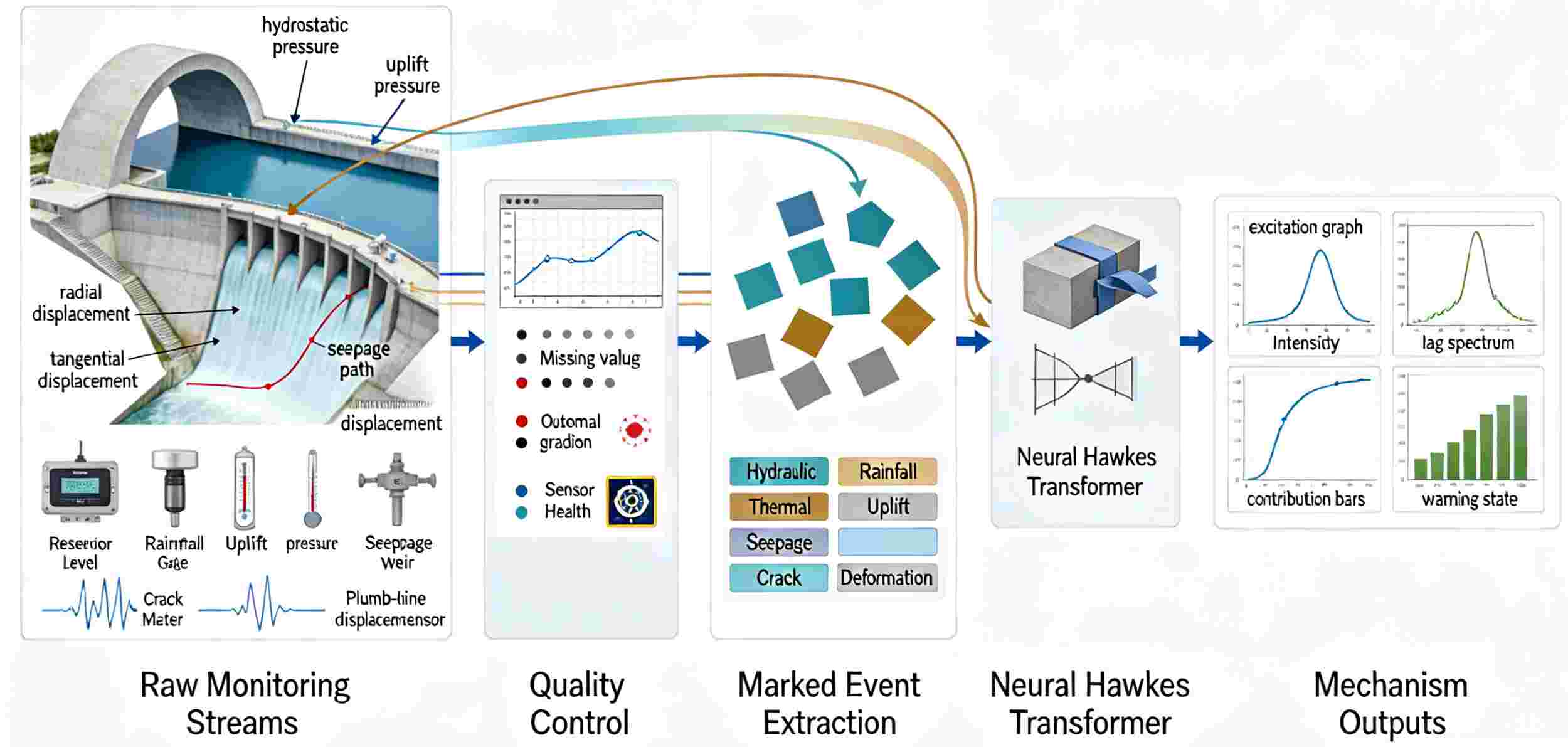
Deformation behavior in high concrete dams is governed by coupled hydraulic, thermal, seasonal, and structural processes, yet routine monitoring records are often asynchronous, incomplete, and event driven. This study develops a Neural Hawkes Transformer model for discovering deformation mechanisms from multi-source structural monitoring data, including reservoir level, rainfall, air temperature, uplift pressure, seepage, crack aperture, and plumb-line displacement. The model converts heterogeneous observations into marked event streams, learns excitation and inhibition among events through a Hawkes intensity layer, and uses temporal self-attention to recover delayed cross-source influence without forcing all sensors onto a rigid sampling grid. A controlled case dataset containing 49,680 hourly records and 2,914 irregular events was constructed from a 214 m arch dam monitoring system. Compared with LSTM, temporal convolution, and a standard Transformer, the proposed model reduced one-step displacement error to 0.842 mm, improved flood-season anomaly F1-score to 0.914, and identified a median hydraulic-to-deformation lag of 37 h. Mechanism attribution showed that reservoir-level rise explained 43.6% of short-term radial displacement variance, while thermal contraction accounted for 28.4% of winter-stage drift. Counterfactual masking further indicated a 5.9 mm peak displacement reduction when reservoir events were removed. The results indicate that event intensity and attention attribution can jointly expose interpretable deformation pathways while retaining engineering prediction accuracy and supporting traceable dam safety assessment.
Details
License
Copyright (c) 2026 Ricardo Ferreira, Sofia Almeida, João Pereira

This work is licensed under a Creative Commons Attribution-NonCommercial-ShareAlike 4.0 International License.