Koopman Neural Operator Model for Trajectory Correction in Batch Reactors Based on Recipe and Spectral Measurements
Authors
Marta Fernández, Laura GómezFiles
Key Information
Journal

Published in Vol. 6 No. 1 (2026) of Journal of Smart Operations and Management Engineering.
Journal of Smart Operations and Management Engineering (JSOME) eISSN: 3136-7666 is an international, peer-reviewed forum dedicated to publishing cutting-edge research at the intersection of process systems engineering, advanced operations research, and intelligent management. The journal bridges the gap between technical system design and executive decision-making, focusing on how data-driven algorithms, automation frameworks, and intelligent computing transform modern industrial operations.
JSOME welcomes original research articles, rigorous reviews, and methodological contributions addressing complex industrial systems, supply chain networks, energy systems, and process industries.
About the JournalAbstract
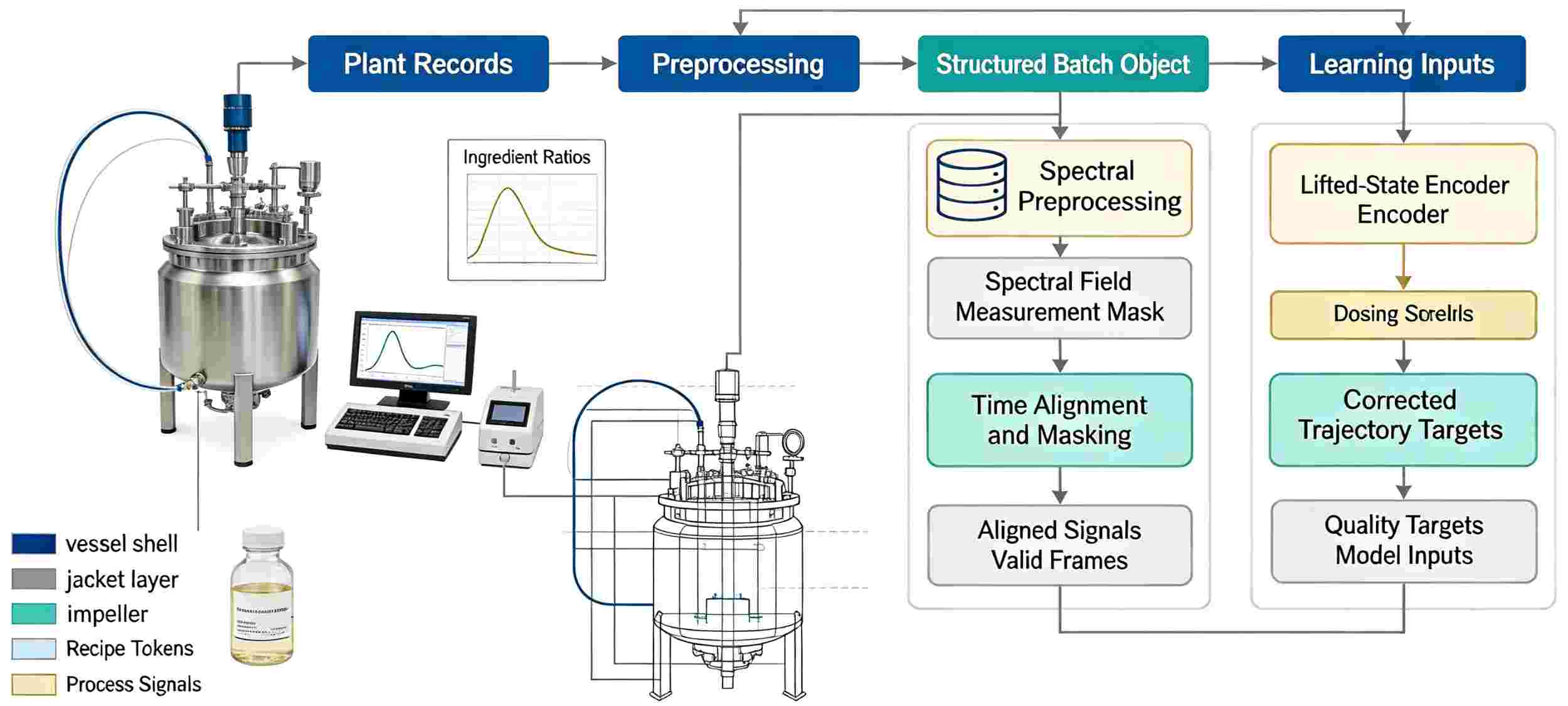
Batch reactors used for specialty chemicals and formulated materials often operate under recipe changes, drifting raw materials, incomplete online quality information, and delayed laboratory assays, making online trajectory correction different from conventional end-point soft sensing. This paper proposes a recipe-spectral Koopman neural operator for trajectory correction in such systems. The model encodes feed ratios, dosing schedules, thermal policies, agitation settings, and time-resolved Raman/NIR spectra into a lifted operator space, where linear Koopman evolution is combined with a measurement-gated correction term. A multi-grade reaction benchmark with 420 historical batches, 32 recipe descriptors, and 1,024 spectral channels was used to evaluate the method under campaign-block validation. Compared with recurrent, transformer, and neural ordinary differential equation baselines, the proposed model reduced 30 min ahead concentration RMSE from 0.184 to 0.067 mol L-1, decreased end-point viscosity error by 48.9%, and improved off-trajectory warning F1 score from 0.812 to 0.936. Ablation analysis showed that removing recipe conditioning increased correction error by 29.4%, while removing spectral gating increased end-point deviation by 36.1%. The median online update required 41 ms on a CPU workstation, which is well below typical spectroscopy sampling intervals. The results indicate that explicit coupling of recipe context and spectral evidence can correct batch trajectories before final quality measurements become available, while retaining a compact operator form suitable for engineering deployment.
Details
License
Copyright (c) 2026 Marta Fernández, Laura Gómez

This work is licensed under a Creative Commons Attribution-NonCommercial-ShareAlike 4.0 International License.
