Few-Shot DLinear-GAT Model for Airport Surface Operation Conflict Prediction
Authors
Seungmin Choi, Yuna JungFiles
Key Information
Journal

Published in Vol. 3 No. 1 (2023) of Journal of Smart Operations and Management Engineering.
Journal of Smart Operations and Management Engineering (JSOME) eISSN: 3136-7666 is an international, peer-reviewed forum dedicated to publishing cutting-edge research at the intersection of process systems engineering, advanced operations research, and intelligent management. The journal bridges the gap between technical system design and executive decision-making, focusing on how data-driven algorithms, automation frameworks, and intelligent computing transform modern industrial operations.
JSOME welcomes original research articles, rigorous reviews, and methodological contributions addressing complex industrial systems, supply chain networks, energy systems, and process industries.
About the JournalAbstract
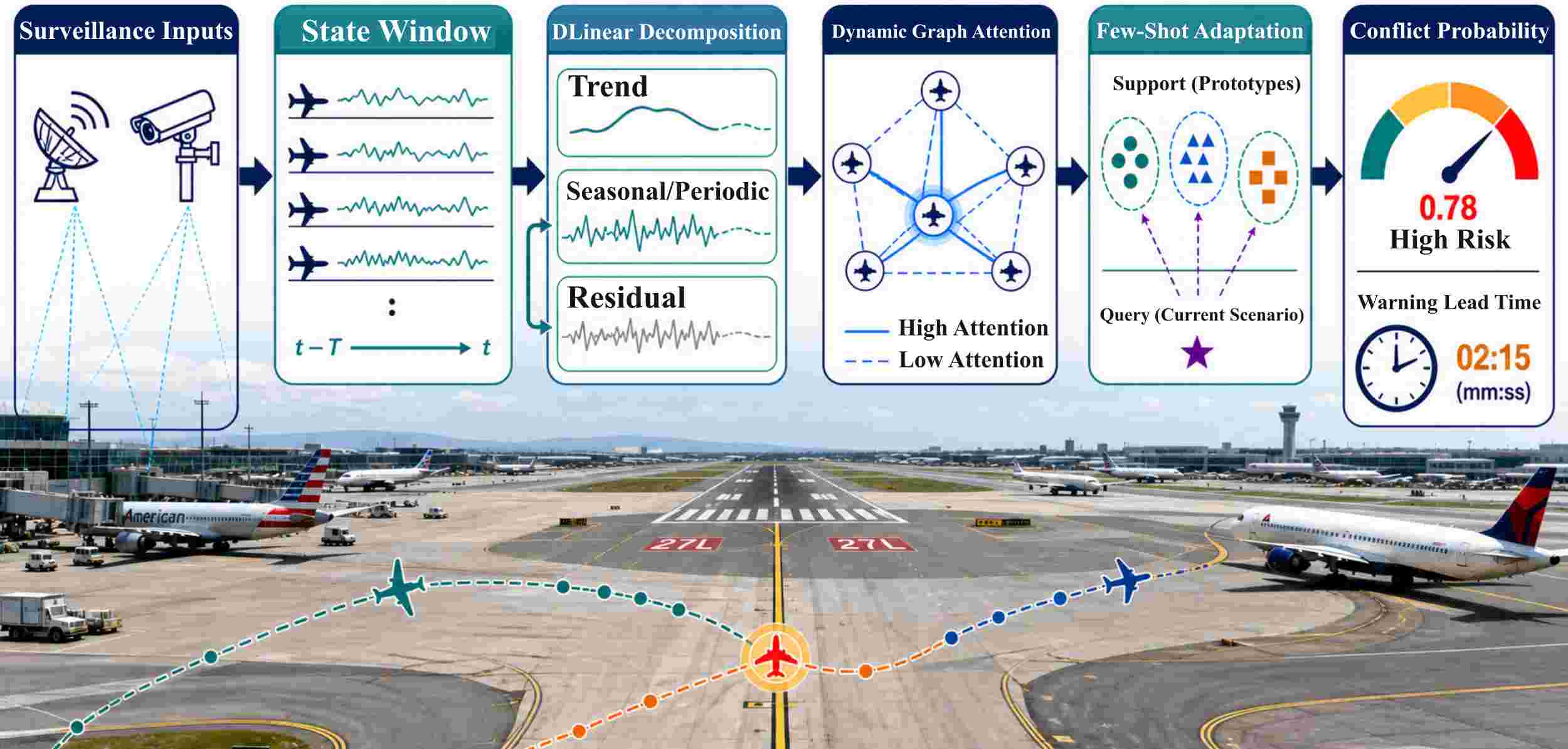
Airport surface conflict prediction remains difficult because conflict events are rare, operating patterns change with runway configuration, and labeled near-miss samples require expert review. This paper proposes a few-shot DLinear-GAT model for predicting aircraft-pair conflicts in airport surface operations under limited labeled data. First, DLinear decomposition extracts trend and residual features from short surveillance-state windows, including position, speed, heading, route segment and occupancy indicators. A dynamic aircraft-interaction graph is then constructed from proximity, route convergence, relative velocity and time to closest approach, allowing graph attention to model operationally meaningful neighbors. To improve adaptation under scarce conflict labels, a prototype-balanced loss is introduced to stabilize the minority conflict class and calibrate warning probabilities. A constructed airport surface movement dataset with 62,400 aircraft states, 1,860 labelled conflict windows and four runway-taxiway operating scenarios is used for experiments. Only 32 labelled conflict samples were available in the target condition, and the proposed model achieved an F1-score of 0.842, an AUC of 0.941 and a mean warning lead time of 43.7 s. F1 is 7.6 percentage points higher than that of the temporal convolution baseline, and false alarms are 18.4% lower than those of a standard GAT. These results indicate that compact temporal decomposition and attention-based interaction reasoning can support reliable small-sample warning for airport surface safety management.
Details
License
Copyright (c) 2023 Journal of Smart Operations and Management Engineering

This work is licensed under a Creative Commons Attribution-NonCommercial-ShareAlike 4.0 International License.