Uncertainty Updating AutoGluon-Tabular Model for a Chemical Reactor Twin Based on Hybrid CFD and Device Measurement Data
Authors
Sophie Visse, Thomas van Dijk, Lisa BakkerFiles
Key Information
Journal
Published in Vol. 3 No. 1 (2023) of Journal of Smart Operations and Management Engineering.
Journal of Smart Operations and Management Engineering (JSOME) eISSN: 3136-7666 is an international, peer-reviewed forum dedicated to publishing cutting-edge research at the intersection of process systems engineering, advanced operations research, and intelligent management. The journal bridges the gap between technical system design and executive decision-making, focusing on how data-driven algorithms, automation frameworks, and intelligent computing transform modern industrial operations.
JSOME welcomes original research articles, rigorous reviews, and methodological contributions addressing complex industrial systems, supply chain networks, energy systems, and process industries.
About the JournalAbstract
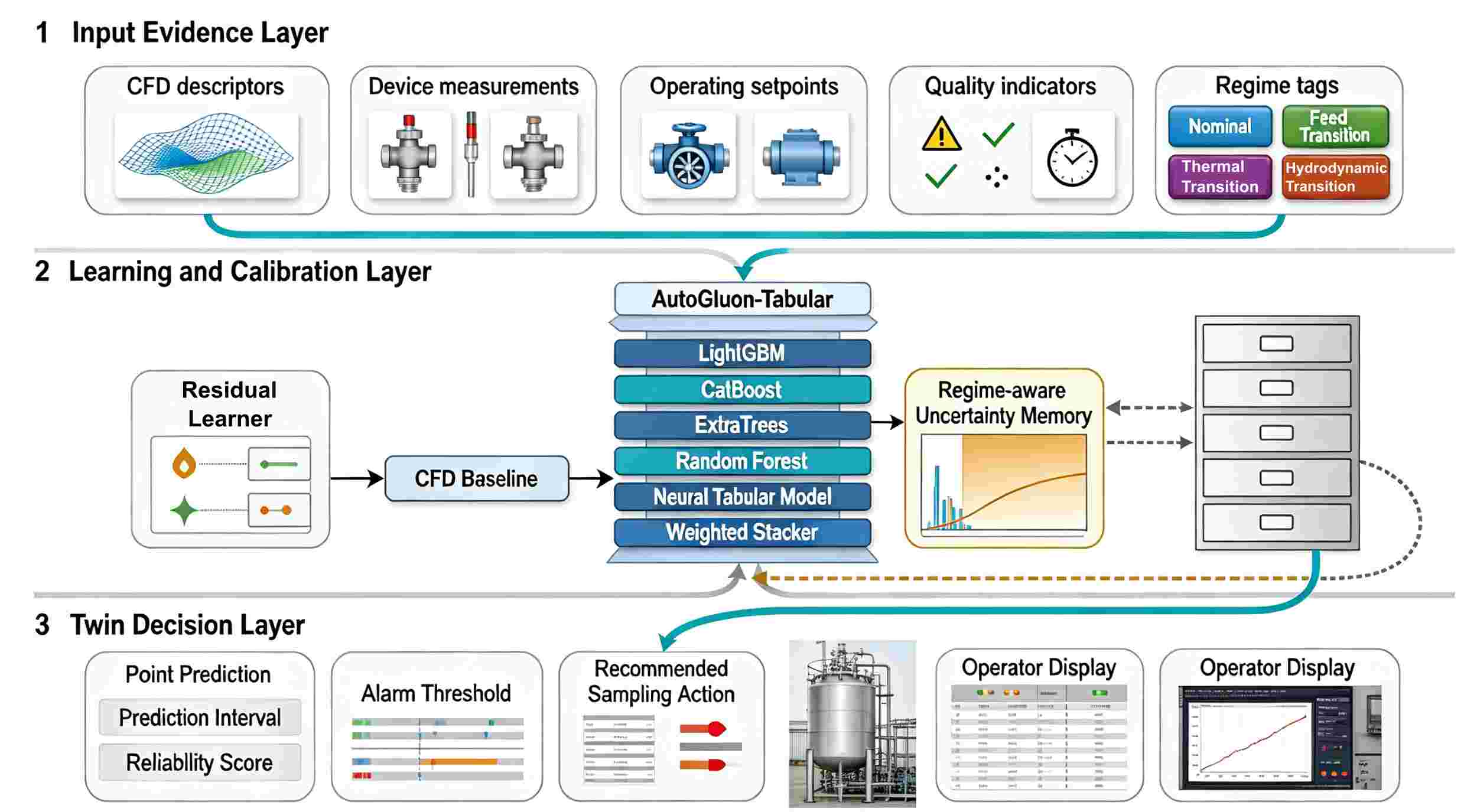
Chemical reactor twins must reconcile high-resolution CFD evidence with device measurements that are sparse, delayed, and affected by drift. To make the study boundary explicit, the present work focuses on a jacketed stirred reactor with delay-corrected online measurements and CFD-derived transport descriptors. This study develops an uncertainty-updating AutoGluon-Tabular model for a jacketed stirred reactor by fusing 18,240 hybrid samples from CFD snapshots, temperature and pressure probes, shaft torque, feed-flow records, jacket data, and product analyzer measurements. The method converts CFD fields into regime-aware transport descriptors, aligns device signals through delay-corrected windows, learns CFD-measurement residuals with stacked tabular ensembles, and updates prediction intervals through recent calibration evidence. In the held-out campaigns, conversion mean absolute error decreased from 3.86 percentage points for the CFD baseline to 1.14 percentage points, hot-spot temperature error decreased from 6.72 K to 2.05 K, and product-concentration RMSE decreased from 0.084 to 0.031 mol L-1. The empirical coverage of the 90% prediction interval improved from 81.3% to 90.8%, while the average conversion interval width narrowed by 22.6%. The largest gains appeared during feed-ratio disturbances and impeller-speed transitions, where measurement-only learning lacked spatial transport evidence and uncorrected CFD retained systematic bias. The resulting workflow supports transparent monitoring decisions without replacing established CFD practice. The results show that AutoGluon-Tabular can serve as a practical uncertainty updater when CFD features, device evidence, quality indicators, and operating regimes are treated as coupled engineering information rather than independent inputs.