Temperature Field Driven Thermal Management Fault Detection in Battery Cabinets Using a CausalFormer Model
Authors
Anna Becker, Jonas HoffmannFiles
Key Information
Journal
Published in Vol. 6 No. 1 (2026) of Journal of Smart Operations and Management Engineering.
Journal of Smart Operations and Management Engineering (JSOME) eISSN: 3136-7666 is an international, peer-reviewed forum dedicated to publishing cutting-edge research at the intersection of process systems engineering, advanced operations research, and intelligent management. The journal bridges the gap between technical system design and executive decision-making, focusing on how data-driven algorithms, automation frameworks, and intelligent computing transform modern industrial operations.
JSOME welcomes original research articles, rigorous reviews, and methodological contributions addressing complex industrial systems, supply chain networks, energy systems, and process industries.
About the JournalAbstract
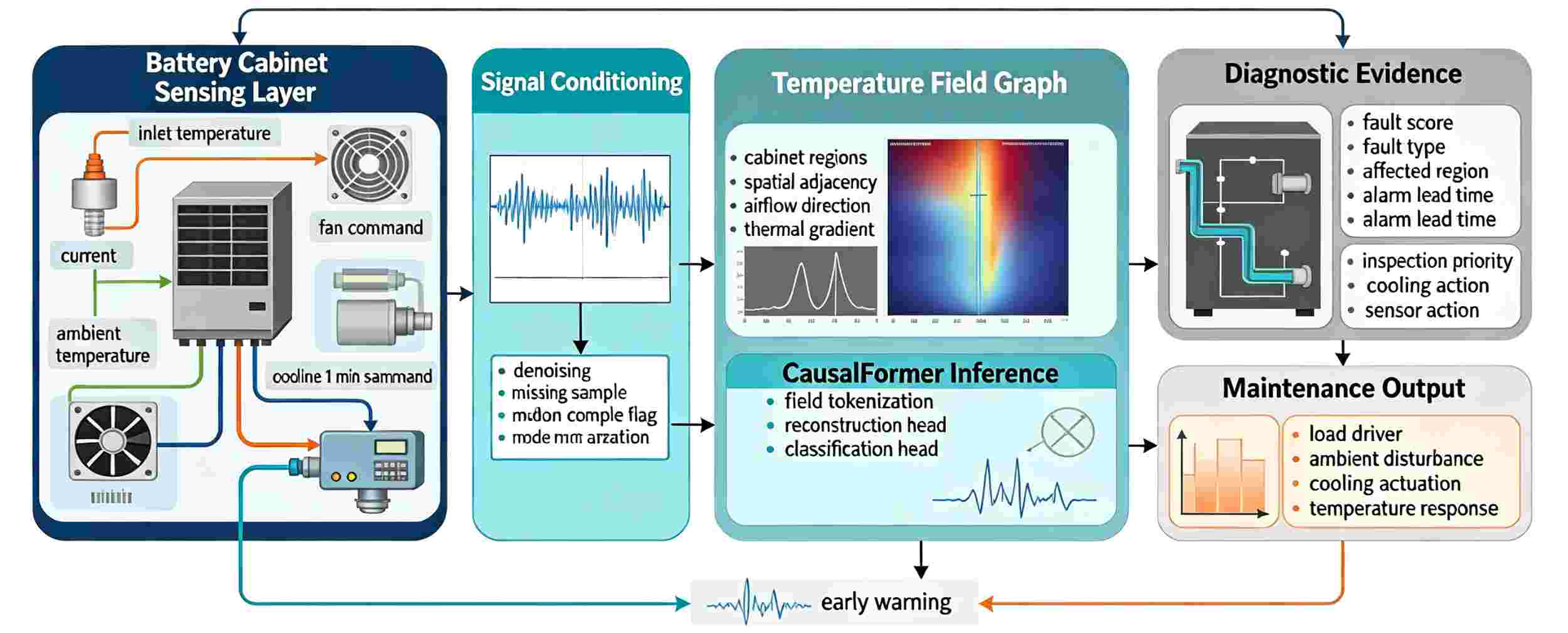
Battery energy storage cabinets work in a dense electrothermal coupling manner, and a local fault in the fans, ducts, sensors or cooling loops can alter the temperature field before reaching the protection limit. Early identification of such abnormal field evolution is important for cabinet maintenance because weak cooling degradation may remain hidden behind normal load induced heating. This paper proposes a temperature field driven CausalFormer model for thermal management fault detection in battery cabinets. The method models cabinet sensors as geometry-aware thermal nodes, reconstructs a short-horizon temperature field, and separates load-induced heating from actuation-related cooling via a causal attention mask and a calibrated fault score. A 42-day cabinet data set containing normal operation, fan degradation, inlet blockage, coolant underperformance and sensor drift was used for validation under charging, discharging and standby profiles. The proposed model achieved 96.8% macro F1, 0.971 AUC and 92.4% localization accuracy, and reduced the mean alarm delay from 18.7 min for a rule-based baseline to 4.9 min. Ablation experiments showed that without a causal mask, the false alarm rate increased from 3.8% to 7.1%, and removing thermal adjacency reduced weak fault recall by 5.6 percentage points. The calibrated score also improved the separation between normal and fault windows from 0.27 to 0.41. The results indicate that fault evidence extracted from evolving temperature fields can support earlier, more stable and more interpretable diagnosis of cabinet-scale battery thermal management faults.