Cross-Domain Reformer-XL Model for Battery-Swapping Demand Forecasting in Electric Vehicles
Authors
Jun Li, Wei Zhang, Haoran LiuFiles
Key Information
Journal
Published in Vol. 4 No. 1 (2024) of Journal of Smart Operations and Management Engineering.
Journal of Smart Operations and Management Engineering (JSOME) eISSN: 3136-7666 is an international, peer-reviewed forum dedicated to publishing cutting-edge research at the intersection of process systems engineering, advanced operations research, and intelligent management. The journal bridges the gap between technical system design and executive decision-making, focusing on how data-driven algorithms, automation frameworks, and intelligent computing transform modern industrial operations.
JSOME welcomes original research articles, rigorous reviews, and methodological contributions addressing complex industrial systems, supply chain networks, energy systems, and process industries.
About the JournalAbstract
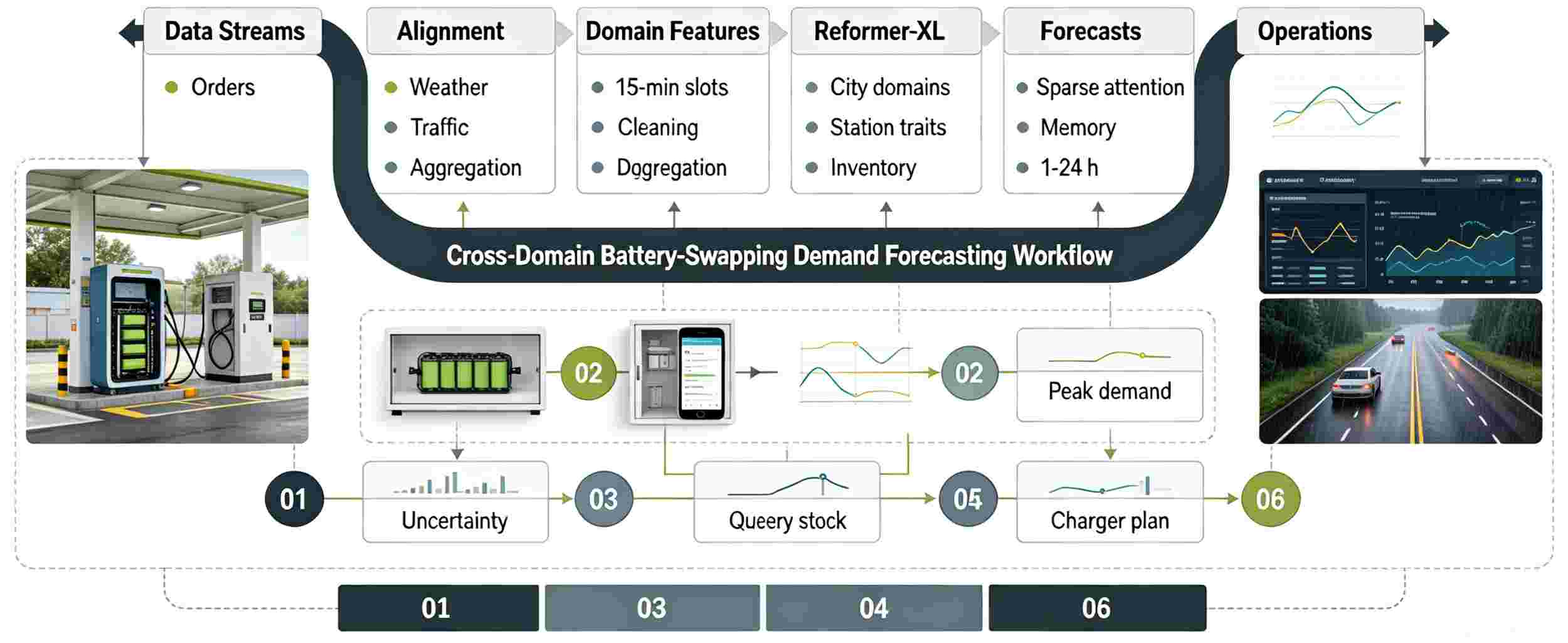
Battery-swapping networks for electric vehicles need short-term, station-level demand forecasts that are still reliable after transferring a model from a mature service area to a new city, where historical reservations are sparse and station behavior changes rapidly. This paper introduces a cross-domain Reformer-XL model that integrates locality-sensitive hashing attention, segment-level recurrence, domain-conditioned normalization, and a station-context gate for multi-horizon battery-swapping demand forecasting. The model is tested on a constructed engineering dataset that contains 18.7 million swapping orders from 214 stations across four urban areas, and meteorological, calendar, traffic, tariff and station-inventory covariates have been aligned at 15-minute intervals. Compared with LSTM, temporal convolution, standard Transformer, Informer and non-transfer Reformer baselines, the proposed model reduces the average MAE to 10.96 swaps per station-hour and lowers the weighted RMSE by 11.7% on the target-domain test set. With only 14 days of target data in cold-start transfer, the model still reached 92.3% of the full-data accuracy and increased peak-hour recall from 0.781 to 0.846. Ablation experiments show that recurrent memory provides a relatively large improvement for a long horizon, and domain-conditioned normalization mainly stabilizes the weekend and rainfall scenarios. As shown in the above results, sparse recurrent attention can support scalable and transferable demand forecasting for battery-swapping infrastructure planning and real-time station operation.