CoAtNet-EMA Model for Stall-Onset Prediction of Airfoils Using Unsteady Surface Pressure Data
Authors
Files
Key Information
Journal
Published in Vol. 4 No. 1 (2026) of Journal of Data‑Centric Engineering Science.
Journal of Data‑Centric Engineering Science eISSN 3136-814X is an international, peer‑reviewed open‑access journal. It publishes high‑quality original research, methodological advances, comprehensive reviews, dataset papers and short communications concerning fundamental theories, scientific methodologies and cross‑domain engineering applications under the data‑centric paradigm. This journal focuses on underlying scientific problems of data‑driven engineering, promotes the integration of data science and physical‑mechanism‑based engineering science, and builds an interdisciplinary platform for academic researchers and industrial scientists.
About the JournalAbstract
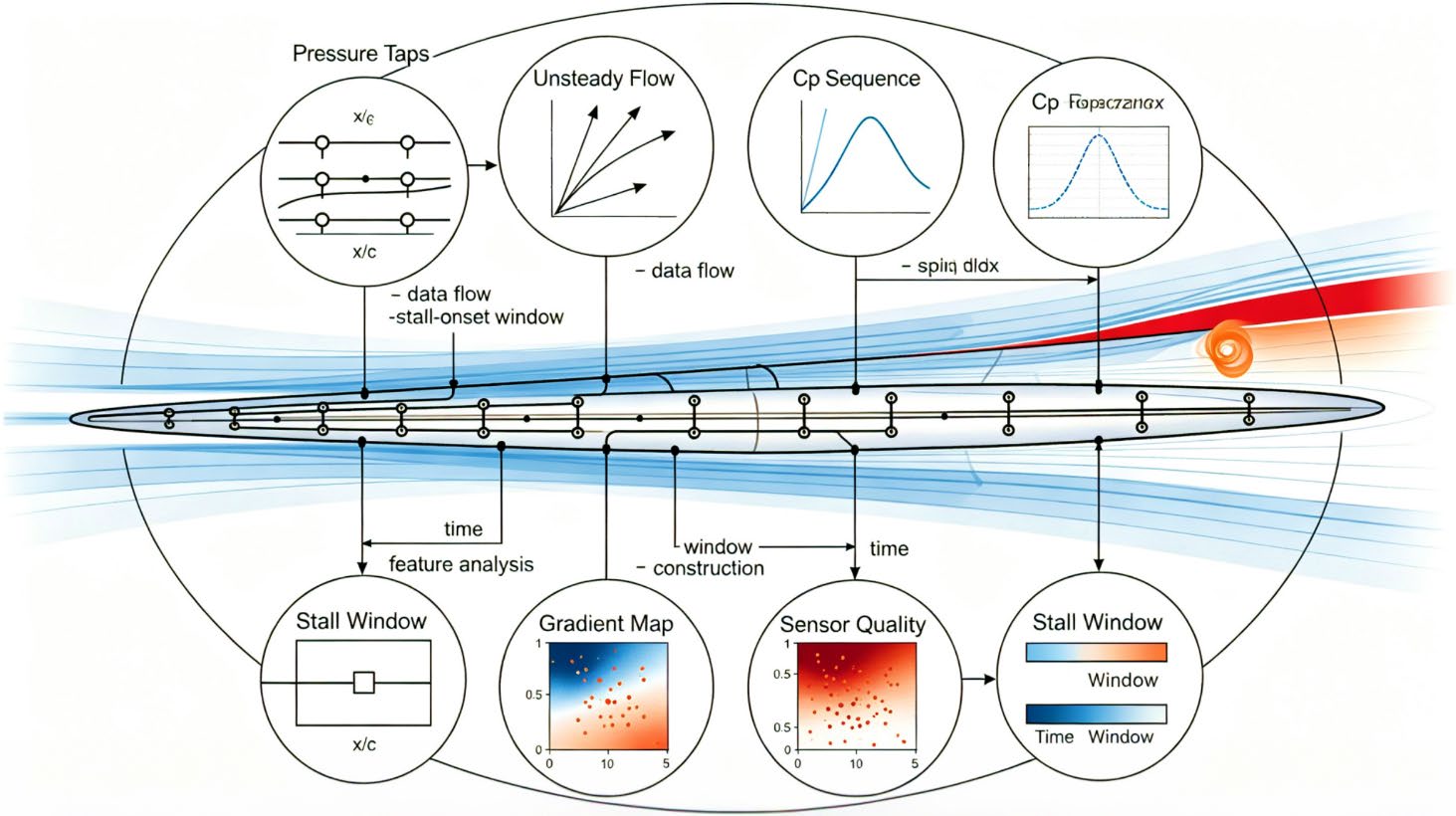
Airfoil stall onset is an unsteady aerodynamic transition caused by pressure redistribution, boundary-layer separation and vortex growth, and it can produce a rapid loss of lift before a conventional force-based alarm becomes decisive. This paper introduces a CoAtNet-EMA model for stall-onset prediction from unsteady surface pressure data. Pressure taps on the suction and pressure sides are organized into short pressure windows together with angle-of-attack information, Reynolds-number bands, pitching-rate tags and sensor-quality flags. Convolutional blocks extract local pressure-gradient changes in leading-edge and mid-chord regions, while attention blocks connect early pressure-recovery loss with subsequent fluctuation growth along the airfoil surface. An efficient multi-scale attention module recalibrates pressure channels according to the strength and reliability of stall evidence. A simulated multi-airfoil dataset containing 18,600 pressure windows is constructed under static-ramp, dynamic-pitching and noisy-sensing conditions. The proposed model achieves a stall-onset classification accuracy of 93.4%, increases early-warning lead time by 18.7% relative to the temporal convolution baseline and reduces false alarms under unseen Reynolds-number conditions from 10.8% to 6.1%. The output includes stall probability, confidence, risk level, dominant pressure region and suggested aerodynamic review action. These results indicate that pressure-window learning can provide earlier stall-onset warning than threshold-based lift monitoring while preserving interpretable evidence for wind-tunnel analysis, flight-test review and control-system evaluation.
Details
License
Copyright (c) 2026 Musab Al-Hammadi, Waleed Al-Mulla, Khamis Al-Zahrani

This work is licensed under a Creative Commons Attribution-NonCommercial-ShareAlike 4.0 International License.