Improved FNO-GraphNet Model for Curing-State Assessment of High-Rise Concrete under Temperature-Humidity and Thermal-Imaging Data
Authors
Files
Key Information
Journal

Published in Vol. 4 No. 1 (2026) of Journal of Data‑Centric Engineering Science.
Journal of Data‑Centric Engineering Science eISSN 3136-814X is an international, peer‑reviewed open‑access journal. It publishes high‑quality original research, methodological advances, comprehensive reviews, dataset papers and short communications concerning fundamental theories, scientific methodologies and cross‑domain engineering applications under the data‑centric paradigm. This journal focuses on underlying scientific problems of data‑driven engineering, promotes the integration of data science and physical‑mechanism‑based engineering science, and builds an interdisciplinary platform for academic researchers and industrial scientists.
About the JournalAbstract
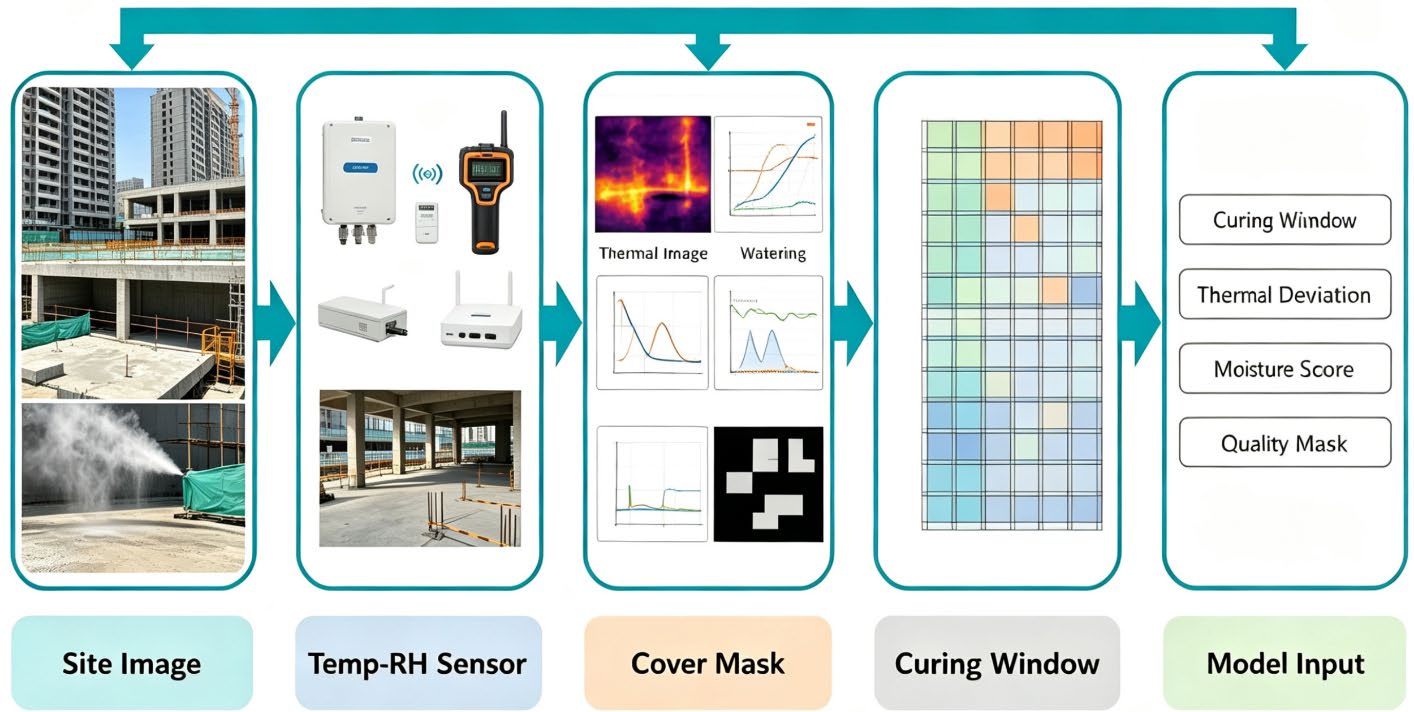
High-rise concrete curing is influenced by vertical temperature gradients, wind exposure, solar radiation, formwork covering, pumping schedules, delayed moisture transport and sensor reliability, so a single humidity sensor or manual surface inspection cannot reliably detect early-stage curing defects. This paper presents an improved FNO-GraphNet model for curing-state assessment based on synchronous temperature-humidity records and thermal-imaging data. Sensor points, floors, member zones and inspection windows are modelled as a structured construction graph; Fourier Neural Operator blocks learn the continuous thermal-humidity field response, and GraphNet layers retain the spatial dependence of adjacent floors and connected members. A simulated multi-floor curing dataset of 18,600 assessment windows is generated, covering slab, shear-wall, column and core-tube members under normal curing, insufficient moisture retention, surface overheating, delayed covering and sensor-disturbance conditions. Training, validation and test sets are 70%, 15% and 15% of the data, respectively, and an unseen-floor test is added to evaluate transferability. Compared with CNN- LSTM, ST-GCN and vanilla FNO baselines, the proposed model improves curing-state classification accuracy to 93.1%, reduces the mean absolute error of moisture risk to 0.071, and increases high-risk zone recall to 90.8%. The output includes curing status, shortage risk, confidence, main evidence and review priority, supporting practical curing management for high-rise concrete structures.
Details
License
Copyright (c) 2026 Adem Dalkıran, Cengiz Fidan

This work is licensed under a Creative Commons Attribution-NonCommercial-ShareAlike 4.0 International License.