Constraint-Aware PPO-Lagrangian Early Warning Model for Thermal Barrier Coating Spallation Using Acoustic Emission and Thermal Cycling Data
Authors
Files
Key Information
Journal
Published in Vol. 4 No. 1 (2026) of Journal of Data‑Centric Engineering Science.
Journal of Data‑Centric Engineering Science eISSN 3136-814X is an international, peer‑reviewed open‑access journal. It publishes high‑quality original research, methodological advances, comprehensive reviews, dataset papers and short communications concerning fundamental theories, scientific methodologies and cross‑domain engineering applications under the data‑centric paradigm. This journal focuses on underlying scientific problems of data‑driven engineering, promotes the integration of data science and physical‑mechanism‑based engineering science, and builds an interdisciplinary platform for academic researchers and industrial scientists.
About the JournalAbstract
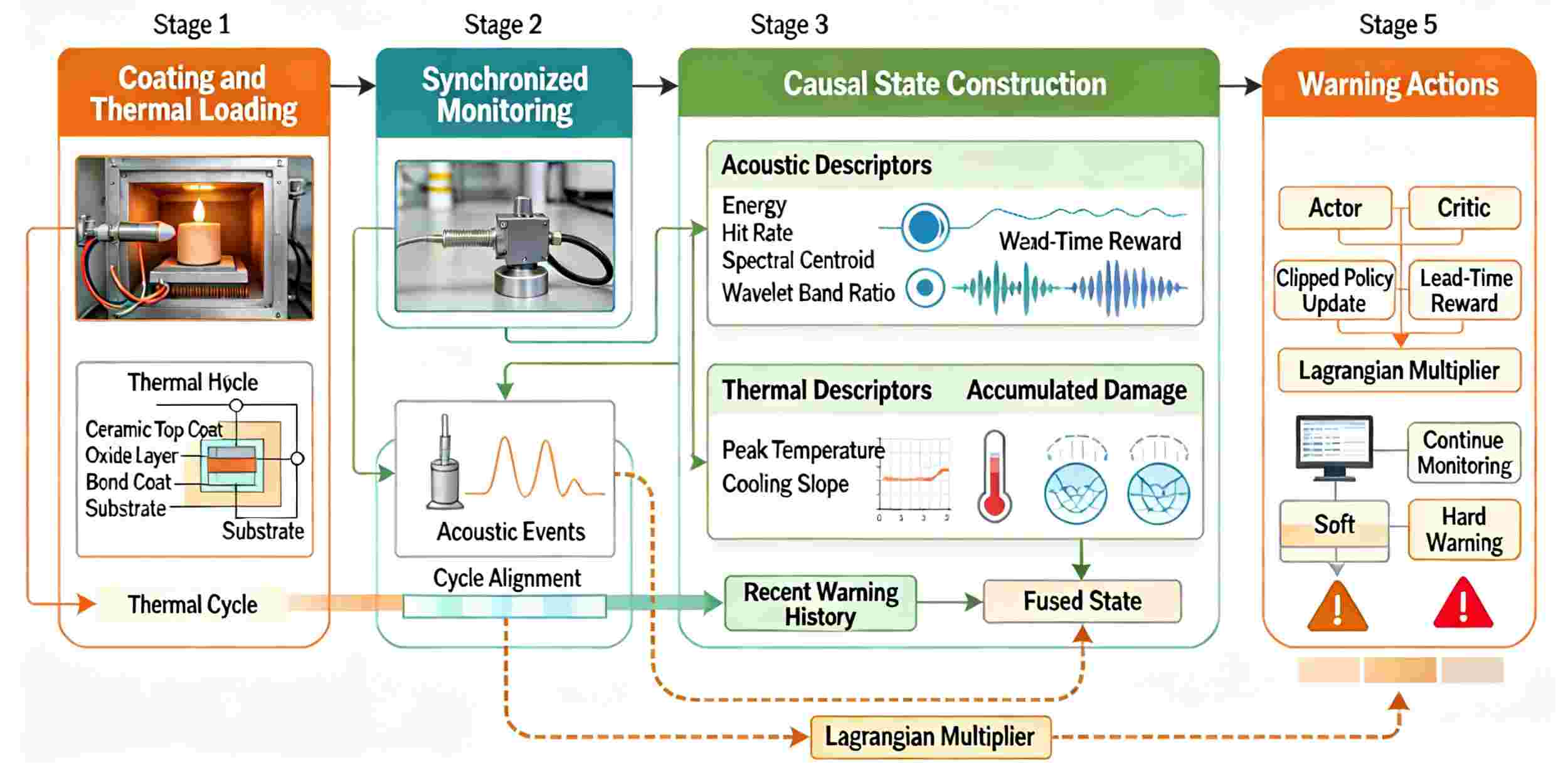
Thermal barrier coating spallation in gas-turbine hot-section components is driven by the coupled evolution of acoustic-emission activity, thermally grown oxide growth, and cyclic strain accumulation. Conventional field-warning strategies still rely mainly on fixed thresholds, cumulative acoustic counts, or supervised classifiers, which are difficult to calibrate when temperature histories, sensor response, and coating degradation rates vary among specimens. This study proposes a constraint-aware PPO-Lagrangian early-warning model that treats each thermal cycle as a causal decision state and combines acoustic energy, hit rate, spectral centroid, wavelet-band ratio, peak dwell temperature, cooling slope, accumulated thermal damage, and recent warning history. The policy selects normal, soft-warning, or hard-warning actions while a Lagrangian penalty controls false alarms, missed alarms, and late alarms under a predefined maintenance cost tolerance. In a specimen-separated dataset containing 1,260 cycle sequences from 120 specimens, the proposed model achieved an AUC of 0.963, an F1 score of 0.884, a false-alarm rate of 4.8%, a mean lead time of 38.6 cycles, and only three late alarms, outperforming fixed-threshold, random-forest, support-vector-machine, LSTM, and GRU baselines. Ablation and response-surface analyses indicate that accumulated thermal damage, frequency migration, and constrained policy optimization jointly improve warning stability. The results suggest that constrained sequential learning can provide a practical bridge between laboratory coating diagnostics and cost-aware maintenance warning, although additional field validation under vibration, combustion noise, sensor drift, and variable duty cycles remains necessary.
Details
License
Copyright (c) 2026 Dunja Radojičić,, Matica Sokolović

This work is licensed under a Creative Commons Attribution-NonCommercial-ShareAlike 4.0 International License.