Causally Constrained Temporal Fusion Framework for Recycled Plastic Quality Grading with Near-Infrared Spectra and Process Data
Authors
Files
Key Information
Journal

Published in Vol. 4 No. 1 (2026) of Journal of Data‑Centric Engineering Science.
Journal of Data‑Centric Engineering Science eISSN 3136-814X is an international, peer‑reviewed open‑access journal. It publishes high‑quality original research, methodological advances, comprehensive reviews, dataset papers and short communications concerning fundamental theories, scientific methodologies and cross‑domain engineering applications under the data‑centric paradigm. This journal focuses on underlying scientific problems of data‑driven engineering, promotes the integration of data science and physical‑mechanism‑based engineering science, and builds an interdisciplinary platform for academic researchers and industrial scientists.
About the JournalAbstract
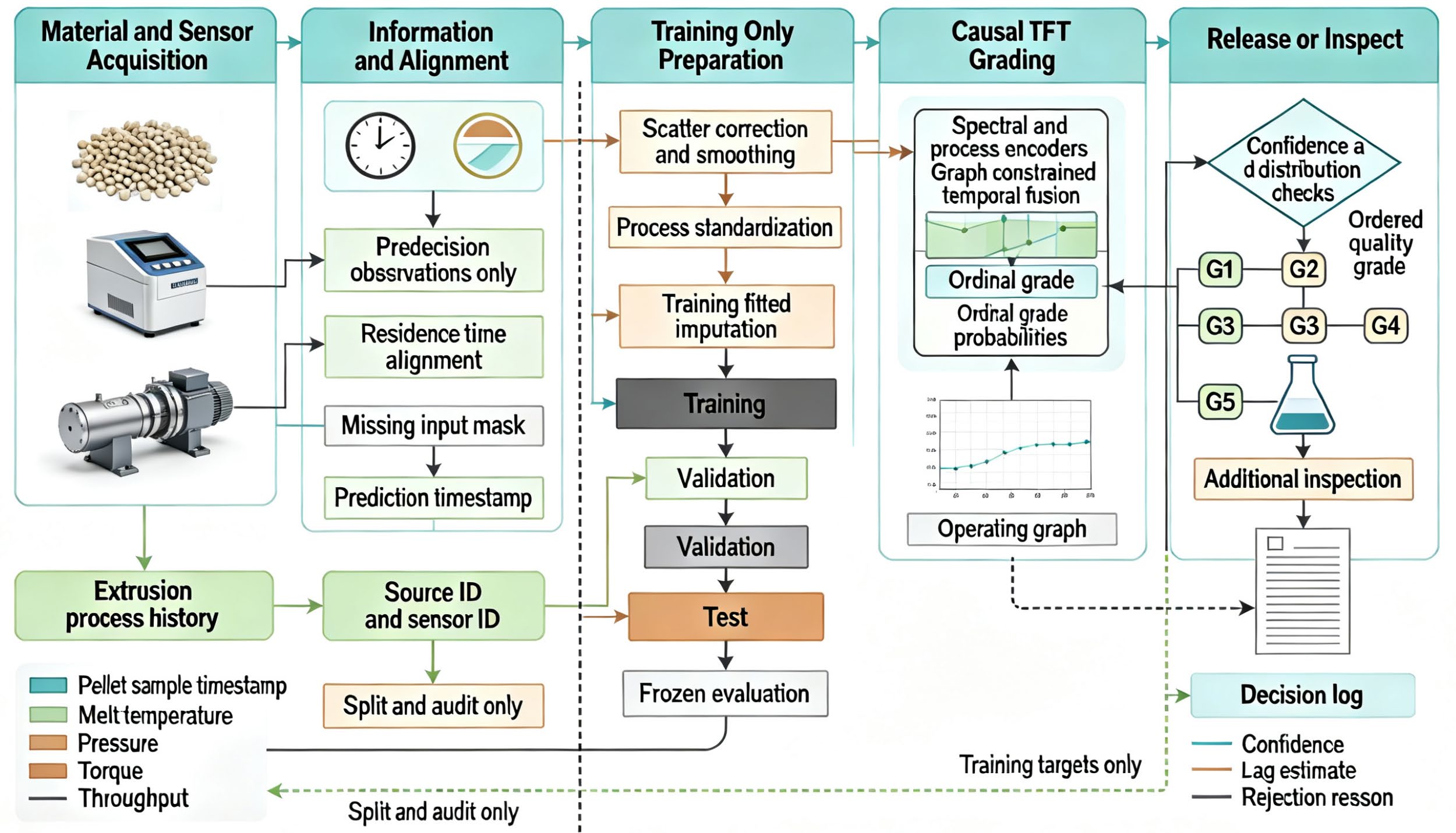
Recycled plastic quality grading requires material-composition evidence and processing histories that differ in sampling frequency, transport delay, and measurement availability. This paper proposes a causally constrained temporal fusion framework that combines near-infrared spectra with extrusion process sequences while excluding information unavailable at the grading decision. The architecture comprises spectral compression, residence-time alignment, graph-constrained variable selection, historical attention, and an ordinal output head. A consistency objective compares material-matched observations from different presumed nuisance environments, while an order-preserving calibration procedure and confidence threshold provide a route to additional inspection. Evaluation is illustrated with 2,400 constructed batch records covering five ordered grades, including 600 test cases; no industrial measurements or completed model-training results are reported. The specified confusion matrix yields 92.0% accuracy, approximately 92.0% macro-averaged F1, and a mean absolute grade error of 0.083. Separate comparison scenarios specify 88.0% accuracy for conventional temporal fusion and 89.0% after removal of the admissibility mask. Prescribed missing-input and operating-shift scenarios assign accuracies of 88.0% at 20% missing inputs and 87.2% under sensor drift, respectively. These values demonstrate an auditable reporting structure rather than empirical superiority. Calibration curves and inspection costs are independently specified examples and cannot be reconstructed from the confusion counts alone. The framework makes explicit the measurement, graph, and label-policy assumptions needed for subsequent implementation. Its industrial utility and any intervention interpretation require validation using laboratory-qualified batches, synchronized acquisition records, and independently operated production lines.
Details
License
Copyright (c) 2026 Aleksandar Ilić, Saša Milenković, Bogdan Kostić

This work is licensed under a Creative Commons Attribution-NonCommercial-ShareAlike 4.0 International License.