FNO GraphNet Model for Salt Spray Corrosion Prediction of Offshore Transformers Based on Marine Climate and Inspection Data
Authors
Files
Key Information
Journal
Published in Vol. 4 No. 1 (2026) of Journal of Data‑Centric Engineering Science.
Journal of Data‑Centric Engineering Science eISSN 3136-814X is an international, peer‑reviewed open‑access journal. It publishes high‑quality original research, methodological advances, comprehensive reviews, dataset papers and short communications concerning fundamental theories, scientific methodologies and cross‑domain engineering applications under the data‑centric paradigm. This journal focuses on underlying scientific problems of data‑driven engineering, promotes the integration of data science and physical‑mechanism‑based engineering science, and builds an interdisciplinary platform for academic researchers and industrial scientists.
About the JournalAbstract
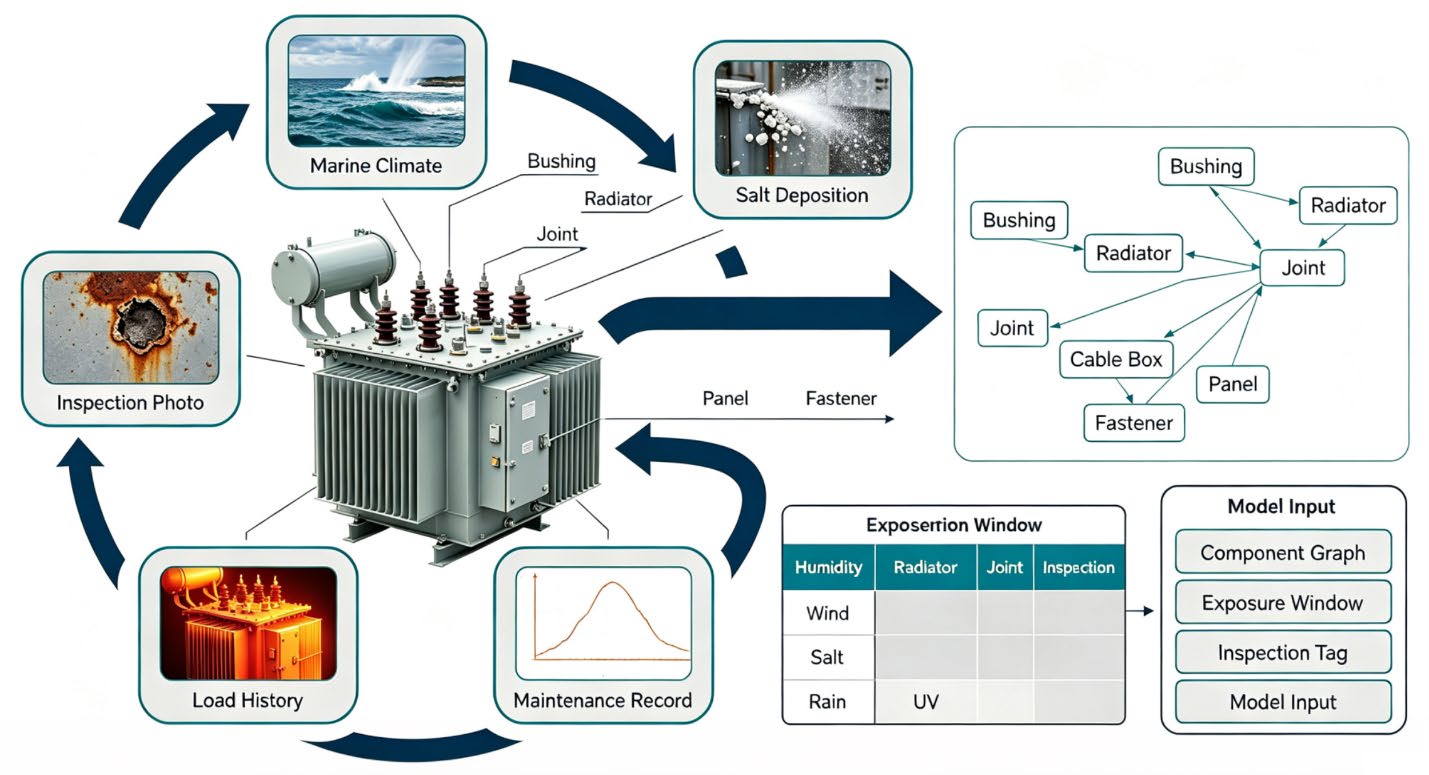
Offshore transformers operate under persistent humidity, wind-driven salt aerosol, chloride deposition, rainfall wash-off, ultraviolet exposure, thermal cycling and repeated maintenance disturbance. These coupled conditions accelerate coating degradation, bushing contamination, cabinet-joint leakage, fastener corrosion, cable-terminal deterioration and radiator surface damage, yet the deterioration process is difficult to predict because marine climate records and inspection images are collected at different temporal intervals. This paper introduces an FNO-GraphNet model for salt-spray corrosion prediction of offshore transformers based on marine climate, operating state, inspection evidence and component metadata. Wind speed, wind direction, relative humidity, sea-salt deposition, wetting duration, rainfall, temperature, ultraviolet level, operating temperature, load rate, component material, coating age, image quality tag, visible rust grade and maintenance history are aligned into component exposure windows. A transformer component graph represents the enclosure, bushing, radiator, junction box, cable terminal, cabinet joint and fastener regions as connected structural nodes. The Fourier Neural Operator branch learns continuous marine exposure fields and long-range climate effects, while the GraphNet branch propagates corrosion evidence among physically adjacent and functionally related components. Experiments use a simulated offshore transformer dataset with unseen seasons, unseen platforms and missing-inspection cases. The model outputs corrosion score, risk level, confidence, dominant evidence, vulnerable component and suggested inspection priority. The framework is designed to support preventive maintenance planning by linking environmental stress, structural vulnerability and reviewable risk evidence rather than producing an isolated hidden prediction.
Details
License
Copyright (c) 2026 Andrea Conti, Davide Lombardi

This work is licensed under a Creative Commons Attribution-NonCommercial-ShareAlike 4.0 International License.