
Causal Temporal Fusion for Twin Temperature Prediction in Cold-Chain Logistics under Vehicle Sensing and Route Data Conditions
Authors
Files
Key Information
Journal
Published in Vol. 4 No. 1 (2026) of Journal of Data‑Centric Engineering Science.
Journal of Data‑Centric Engineering Science eISSN 3136-814X is an international, peer‑reviewed open‑access journal. It publishes high‑quality original research, methodological advances, comprehensive reviews, dataset papers and short communications concerning fundamental theories, scientific methodologies and cross‑domain engineering applications under the data‑centric paradigm. This journal focuses on underlying scientific problems of data‑driven engineering, promotes the integration of data science and physical‑mechanism‑based engineering science, and builds an interdisciplinary platform for academic researchers and industrial scientists.
About the JournalAbstract
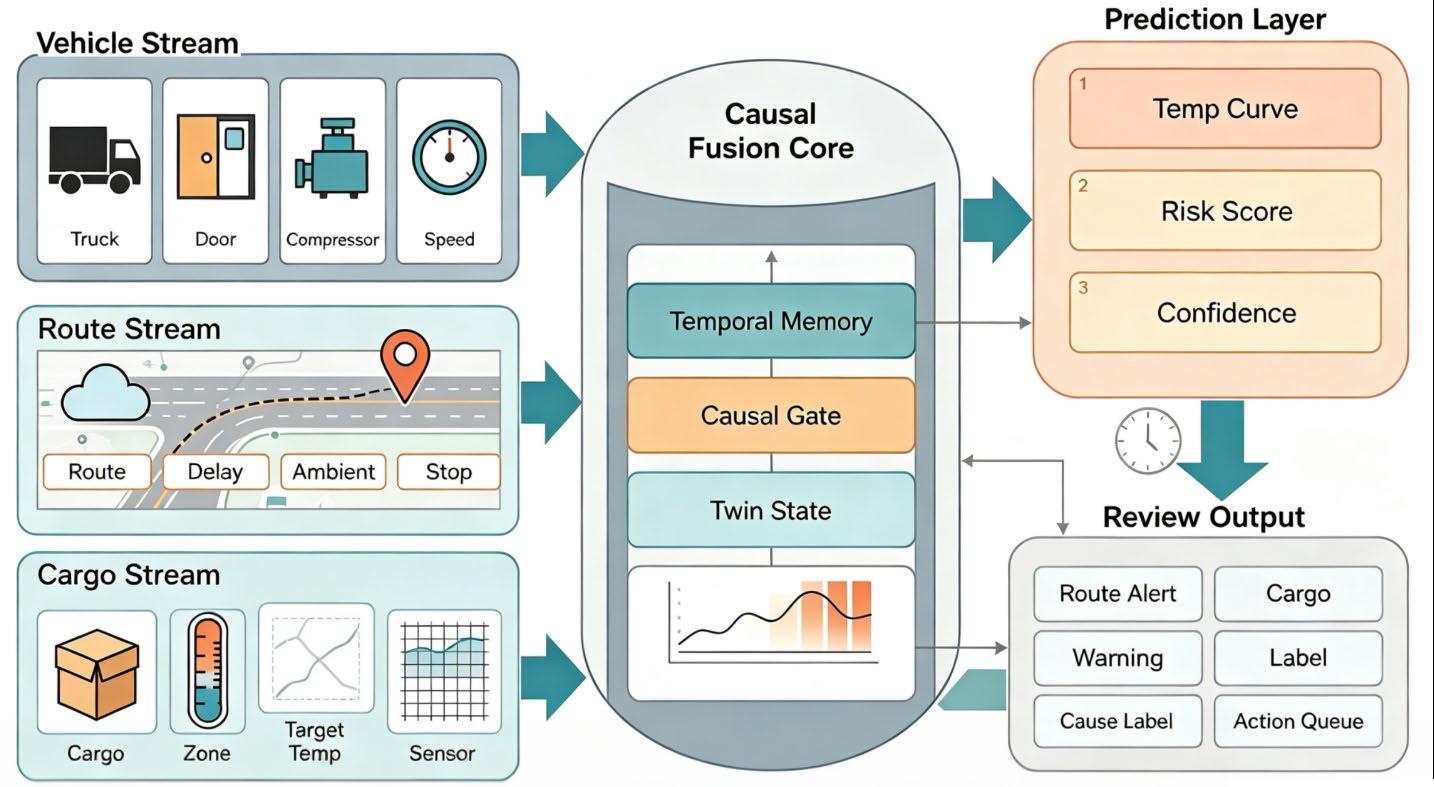
This paper proposes a Causal Temporal Fusion model for temperature prediction of digital twins in cold chain logistics under vehicle-sensing and route-data conditions. The aim is to forecast a short-term temperature excursion risk that may harm cargo quality in advance, and the warning results need to be simple enough for dispatchers, warehouse operators and quality managers to understand. The method builds a chronological route-state sequence from chamber temperature, cargo-zone readings, refrigeration-unit status, GPS segments, door-opening events, traffic delay, road grade, ambient exposure, cargo attributes and route-domain information. A causal screening branch reduces misleading correlations caused by repeated depots, local route habits, cargo mix, vehicle age, or loading routines, and a temporal fusion backbone preserves delayed thermal responses after unloading, waiting, traffic congestion, and cooling recovery. The digital-twin head predicts the next-window temperature change and alerts to a risk warning. Experiments are conducted on a simulated multi-enterprise cold-chain dataset of 214 refrigerated trucks, 42,600 route segments, 27 sensor channels, five cargo classes and four warning labels. Compared with LSTM, temporal convolution, route-only graph scoring and Transformer-only forecasting, the proposed model reduced the temperature MAE from 0.66 degrees Celsius to 0.41 degrees Celsius, improved high-excursion recall from 0.792 to 0.884, and reduced cross-route error growth by 23.1%. Ablation studies show that the causal screening branch and route-state encoder improve the transfer stability for unseen route domains. The output is a route-linked review card that reports the predicted temperature, confidence, dominant evidence and suggested inspection action. Therefore, the model will serve as a decision-support tool for dispatchers and quality managers rather than an autonomous refrigeration-control system.
Details
License
Copyright (c) 2026 Mishaal Al-Tunaiji, Fatima Al-Maktoum, Najeeb Al-Amer

This work is licensed under a Creative Commons Attribution-NonCommercial-ShareAlike 4.0 International License.
