An Improved PointNeXt Mixture of Experts Model for Compressed Air Energy Storage Cavern Pressure Prediction Using Injection and Production Histories and Geological Monitoring Data
Authors
Files
Key Information
Journal

Published in Vol. 4 No. 4 (2026) of Journal of Data‑Centric Engineering Science.
Journal of Data‑Centric Engineering Science eISSN 3136-814X is an international, peer‑reviewed open‑access journal. It publishes high‑quality original research, methodological advances, comprehensive reviews, dataset papers and short communications concerning fundamental theories, scientific methodologies and cross‑domain engineering applications under the data‑centric paradigm. This journal focuses on underlying scientific problems of data‑driven engineering, promotes the integration of data science and physical‑mechanism‑based engineering science, and builds an interdisciplinary platform for academic researchers and industrial scientists.
About the JournalAbstract
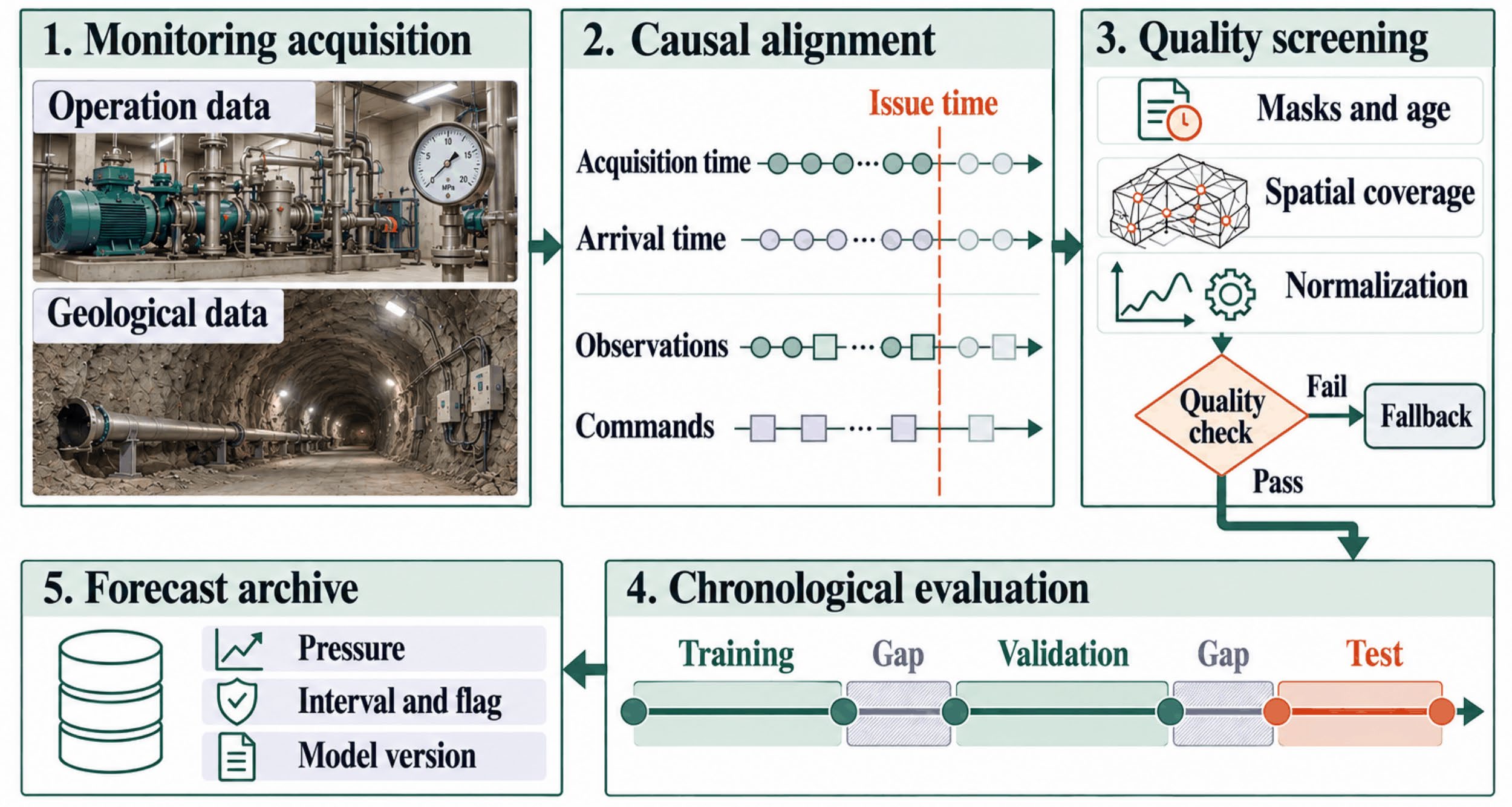
Pressure forecasting for compressed air energy storage caverns requires a consistent treatment of changing air throughput, delayed thermal response, and spatially uneven geological observations. This paper proposes a PointNeXt mixture of expert’s architecture that combines a causal operation encoder with a hierarchical point representation of monitoring locations. Observation quality indicators accompany every measurement, while a sparse gate allocates the fused representation to operating condition specialists. A thermodynamic reference supplies the pressure trend, and a constrained residual head represents departures associated with monitored conditions. The evaluation examines pressure trajectories and forecast errors across operating conditions. Across 1,200 forecast origins and six regimes, the proposed prediction series has a root mean square error of 0.043 MPa, compared with 0.064 MPa for the PointNeXt comparison and 0.056 MPa for the unguided expert comparison. The difference relative to the PointNeXt comparison is 32.8%, providing a quantitative basis for the component sensitivity assessment. Missing observation scenarios increase the error from 0.043 to 0.072 MPa as removal rises from zero to 40%. The analysis specifies leakage resistant partitioning, interval assessment, component removal tests, and operational rejection criteria needed for subsequent empirical evaluation. The contribution is an implementable forecasting design and an auditable evaluation framework with explicit criteria for subsequent independent validation.
Details
License
Copyright (c) 2026 Pietro De Luca, Riccardo Amato

This work is licensed under a Creative Commons Attribution-NonCommercial-ShareAlike 4.0 International License.