Mamba2 UNet Multisource Fusion Model for Aircraft Fuel System Leak Detection
Authors
Files
Key Information
Journal
Published in Vol. 4 No. 4 (2026) of Journal of Data‑Centric Engineering Science.
Journal of Data‑Centric Engineering Science eISSN 3136-814X is an international, peer‑reviewed open‑access journal. It publishes high‑quality original research, methodological advances, comprehensive reviews, dataset papers and short communications concerning fundamental theories, scientific methodologies and cross‑domain engineering applications under the data‑centric paradigm. This journal focuses on underlying scientific problems of data‑driven engineering, promotes the integration of data science and physical‑mechanism‑based engineering science, and builds an interdisciplinary platform for academic researchers and industrial scientists.
About the JournalAbstract
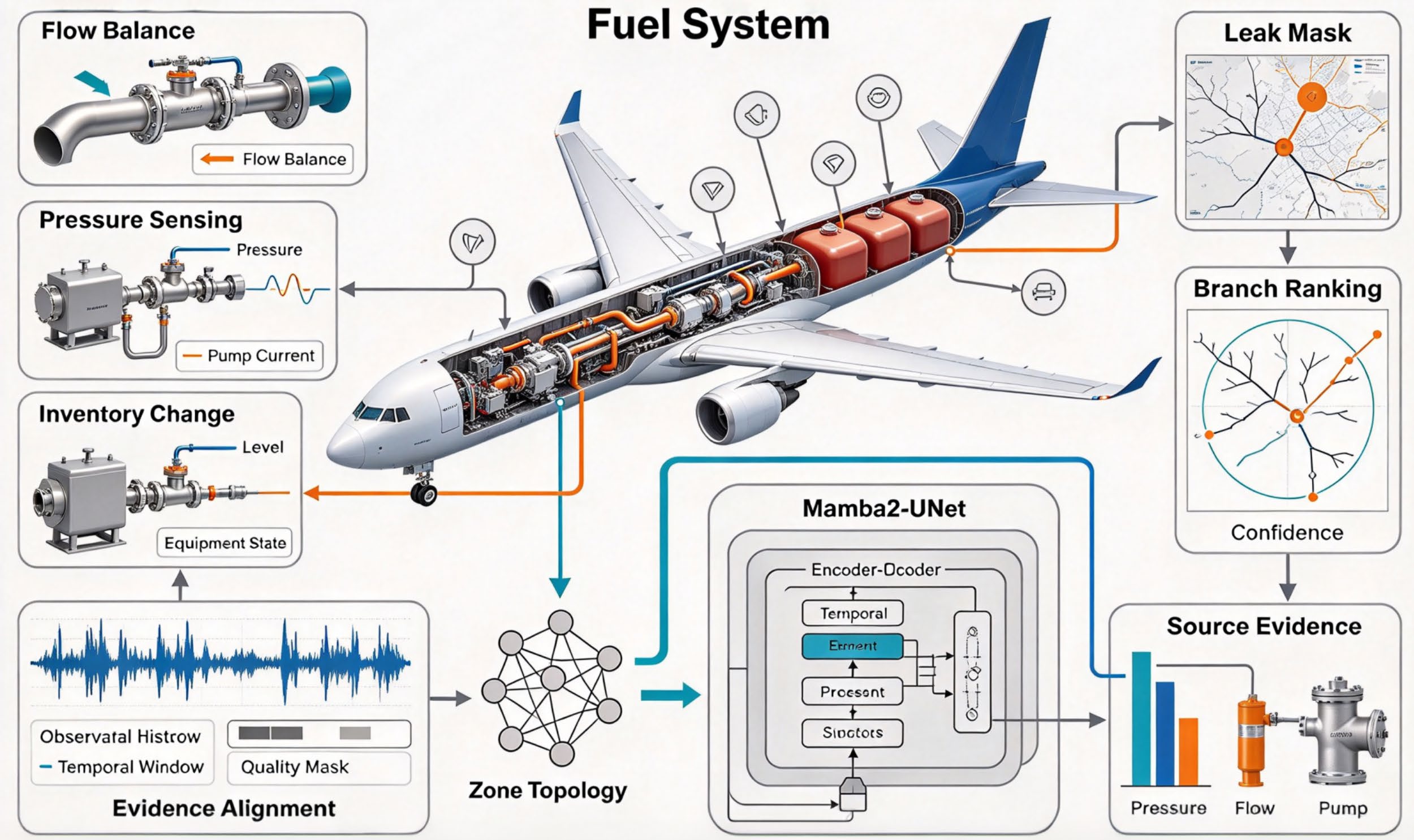
Aircraft fuel-system leak detection requires a diagnosis that combines conservation evidence, operating context and sensor quality while preserving the time and zone of a suspected event. This study evaluates a topology-conditioned Mamba2- UNet for retrospective component-time leak segmentation and branch-level diagnosis. Ten input channels encode local flow imbalance, pressure, pump current, inventory-rate response, outlet flow, valve state, pump context and temperature together with observation validity and adjacent-zone balance. A hierarchical convolutional encoder compresses the eight- zone, 64-epoch map; a four-head selective state-space block processes its temporal bottleneck; and skip-connected decoding restores cell-level probabilities. The evaluation uses 240 generated eight-zone mass-balance cases, partitioned by complete case for fitting, selection, calibration and final testing. The full model has 26,485 trainable parameters and attains test mask intersection over union of 0.7810, Dice coefficient of 0.8770 and event F1 of 0.9643. It identifies all 27 test leak events, with two false alarms among 21 healthy cases. The matched UNet achieves higher nominal mask intersection over union of 0.8708, establishing a stronger segmentation result for the simpler architecture in this benchmark. For five events at leak zones absent from positive fitting examples, full-model mask intersection over union declines to 0.2040, indicating a substantial transfer weakness. Independent temperature scaling reduces pixel calibration error from 0.1959 to 0.0632; the matched UNet retains lower calibrated error. Conditional source-group occlusion produces the largest recent-score effect for pressure under the specified replacement procedure. These findings distinguish event recognition, dense localisation, transfer and probability reliability, and define a controlled basis for further tests of component ordering, network connectivity and observation uncertainty.
Details
License
Copyright (c) 2026 Lakhwinder Brar, Aparna Menon, Sneha Sharma

This work is licensed under a Creative Commons Attribution-NonCommercial-ShareAlike 4.0 International License.