
Multi-Source MegaCRN Model for Container Escape Behaviour Recognition
Authors
Files
Key Information
Journal

Published in Vol. 4 No. 4 (2026) of Journal of Data‑Centric Engineering Science.
Journal of Data‑Centric Engineering Science eISSN 3136-814X is an international, peer‑reviewed open‑access journal. It publishes high‑quality original research, methodological advances, comprehensive reviews, dataset papers and short communications concerning fundamental theories, scientific methodologies and cross‑domain engineering applications under the data‑centric paradigm. This journal focuses on underlying scientific problems of data‑driven engineering, promotes the integration of data science and physical‑mechanism‑based engineering science, and builds an interdisciplinary platform for academic researchers and industrial scientists.
About the JournalAbstract
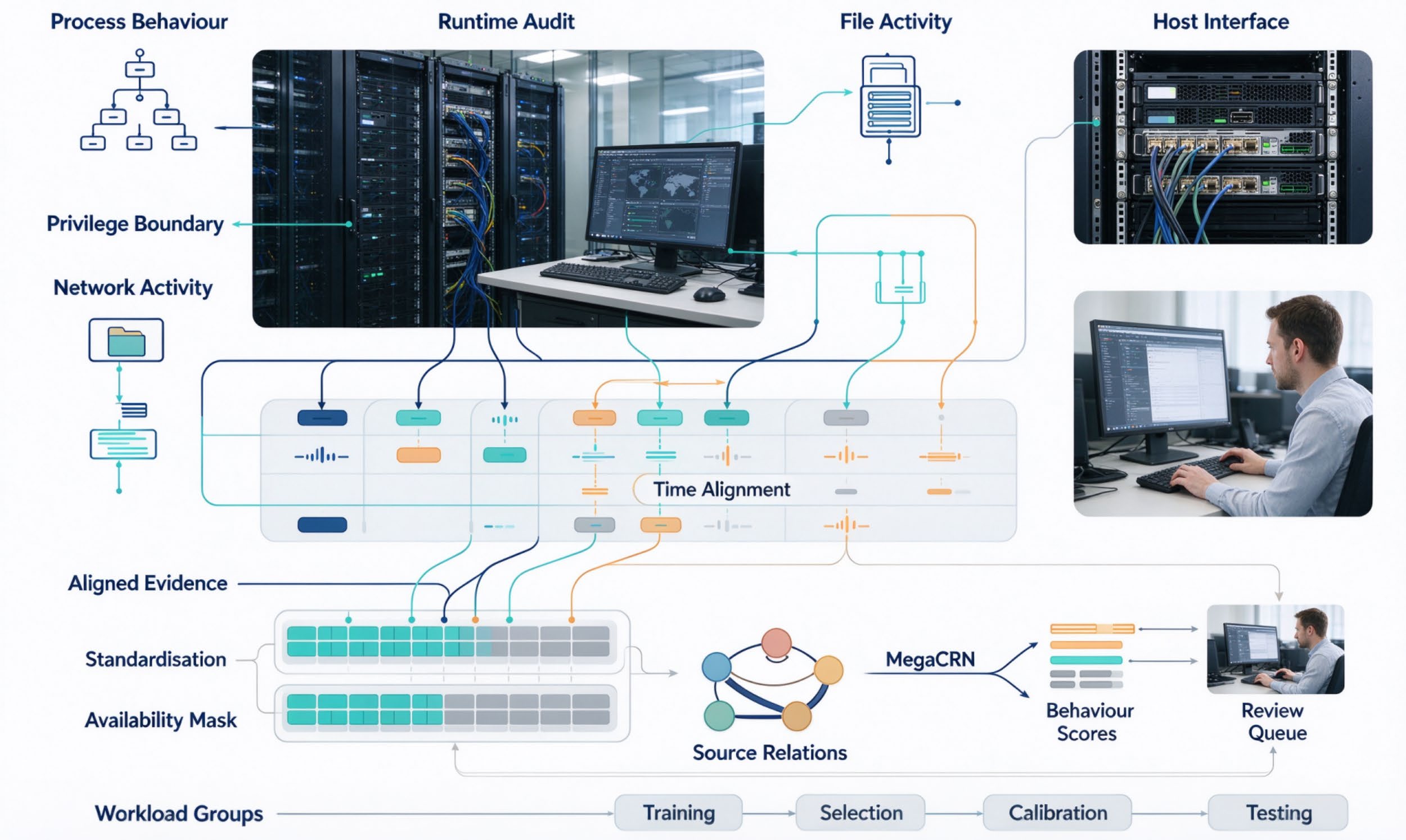
Container escape recognition requires combining intermittent runtime observations across telemetry roles while retaining the distinction between low measured activity and unavailable evidence. This study evaluates a multi-source MegaCRN classifier for normal, deviation and escape-pattern reference windows. Each observation contains twelve ordered records from six roles: process behaviour, runtime audit, filesystem activity, privilege-boundary observations, network activity and host-interface evidence. Every role-time position supplies three response descriptors and a binary availability indicator. A six-vector trainable meta-node bank generates two directed graph supports for an eight-channel graph-recurrent encoder, while hidden-state queries retrieve complementary memory context for three-class scoring. The controlled assessment contains 1,440 windows in 72 workload groups of twenty. Group-disjoint partitions allocate 840 windows to training, 140 to checkpoint selection, 160 to temperature calibration and 300 to final testing. On fifteen held-out test groups, the complete model reaches accuracy 94.33%, macro-F1 0.9466, escape-pattern recall 96.15% and escape precision 0.9615; the escape false-positive rate is 0.0081. The classifier identifies 50 of 52 escape-pattern windows and assigns two non-escape windows to that class. Memory-readout removal gives macro-F1 0.9353, whereas fixed graph supports give 0.9007. Under host- interface source loss, macro-F1 falls to 0.8192 and escape recall to 55.77%; a two-record cross-source shift gives 0.9131 and 80.77%, respectively. Calibration selects temperature 1.0 for the complete model, with held-out Brier score 0.0845. An entropy-ranked review allocation of 75 windows, 25% of the test set, contains all seventeen observed misclassifications and 58 correctly classified windows. These results characterize recognition, evidence dependence, probability quality and retrospective review coverage within a controlled group-separated evaluation; independent operational traces and prospective review remain future validation targets.
Details
License
Copyright (c) 2026 Woosung Han, Donghyun Kang, Seungmin Lim

This work is licensed under a Creative Commons Attribution-NonCommercial-ShareAlike 4.0 International License.
