Random-Feature DeepONet–FNO Surrogate for Bus Bunching Recovery under Variable Boarding Demand
Authors
Files
Key Information
Journal

Published in Vol. 4 No. 3 (2026) of Journal of Data‑Centric Engineering Science.
Journal of Data‑Centric Engineering Science eISSN 3136-814X is an international, peer‑reviewed open‑access journal. It publishes high‑quality original research, methodological advances, comprehensive reviews, dataset papers and short communications concerning fundamental theories, scientific methodologies and cross‑domain engineering applications under the data‑centric paradigm. This journal focuses on underlying scientific problems of data‑driven engineering, promotes the integration of data science and physical‑mechanism‑based engineering science, and builds an interdisciplinary platform for academic researchers and industrial scientists.
About the JournalAbstract
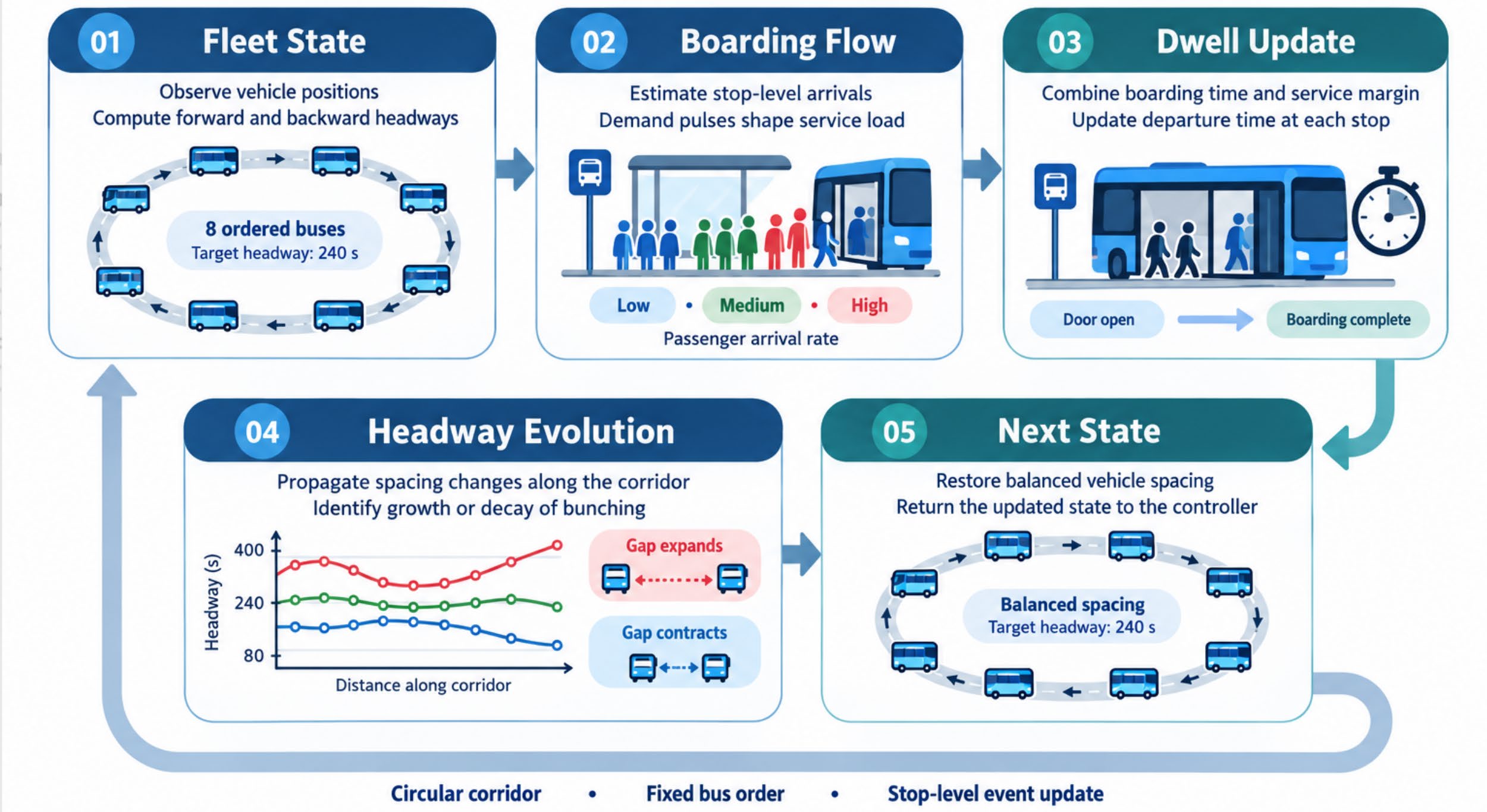
Passenger boarding can amplify irregular headways and propagate delays through a bus fleet. This study develops a boarding-conditioned random-feature surrogate and a bounded holding controller for a simplified circular corridor. A DeepONet-inspired branch–trunk bank and fixed Fourier reconstructions represent local boarding nonlinearities and interactions across the ordered fleet. Ridge fitting determines the common linear readout, and fleet centering enforces a zero-sum predicted increment. The experiment uses eight buses, five demand levels, thirty paired disturbance seeds, and forty-eight control transitions per episode. Independent training, validation, and test sets contain 1200, 200, and 400 fleet fields, respectively. The hybrid test increment root mean square error is 3.47 seconds, compared with 26.30 seconds for the branch model and 20.10 seconds for the spectral model. Under nominal demand, the hybrid controller achieves a mean episode root mean square headway coefficient of variation of 0.073. The headway-derived random-arrival waiting indicators are 120.63 seconds for hybrid control and 197.38 seconds for feedback holding. Prediction errors and closed- loop intervention outcomes are evaluated separately under a shared action bound. The results support the combined representation within the evaluated corridor, with interpretation conditioned on unequal feature counts, a capped boarding response, and exact demand observations. Capacity-matched comparisons and explicit passenger queues remain requirements for assessing broader operational transfer.
Details
License
Copyright (c) 2026 Rodríguez González, Álvarez Torres, Marcos Rubio

This work is licensed under a Creative Commons Attribution-NonCommercial-ShareAlike 4.0 International License.