
Improved ConvNeXtV2 CBAM Model for Formwork Collapse Risk Prediction Using Load Sensing and Construction Progress Data
Authors
Files
Key Information
Journal

Published in Vol. 4 No. 3 (2026) of Journal of Data‑Centric Engineering Science.
Journal of Data‑Centric Engineering Science eISSN 3136-814X is an international, peer‑reviewed open‑access journal. It publishes high‑quality original research, methodological advances, comprehensive reviews, dataset papers and short communications concerning fundamental theories, scientific methodologies and cross‑domain engineering applications under the data‑centric paradigm. This journal focuses on underlying scientific problems of data‑driven engineering, promotes the integration of data science and physical‑mechanism‑based engineering science, and builds an interdisciplinary platform for academic researchers and industrial scientists.
About the JournalAbstract
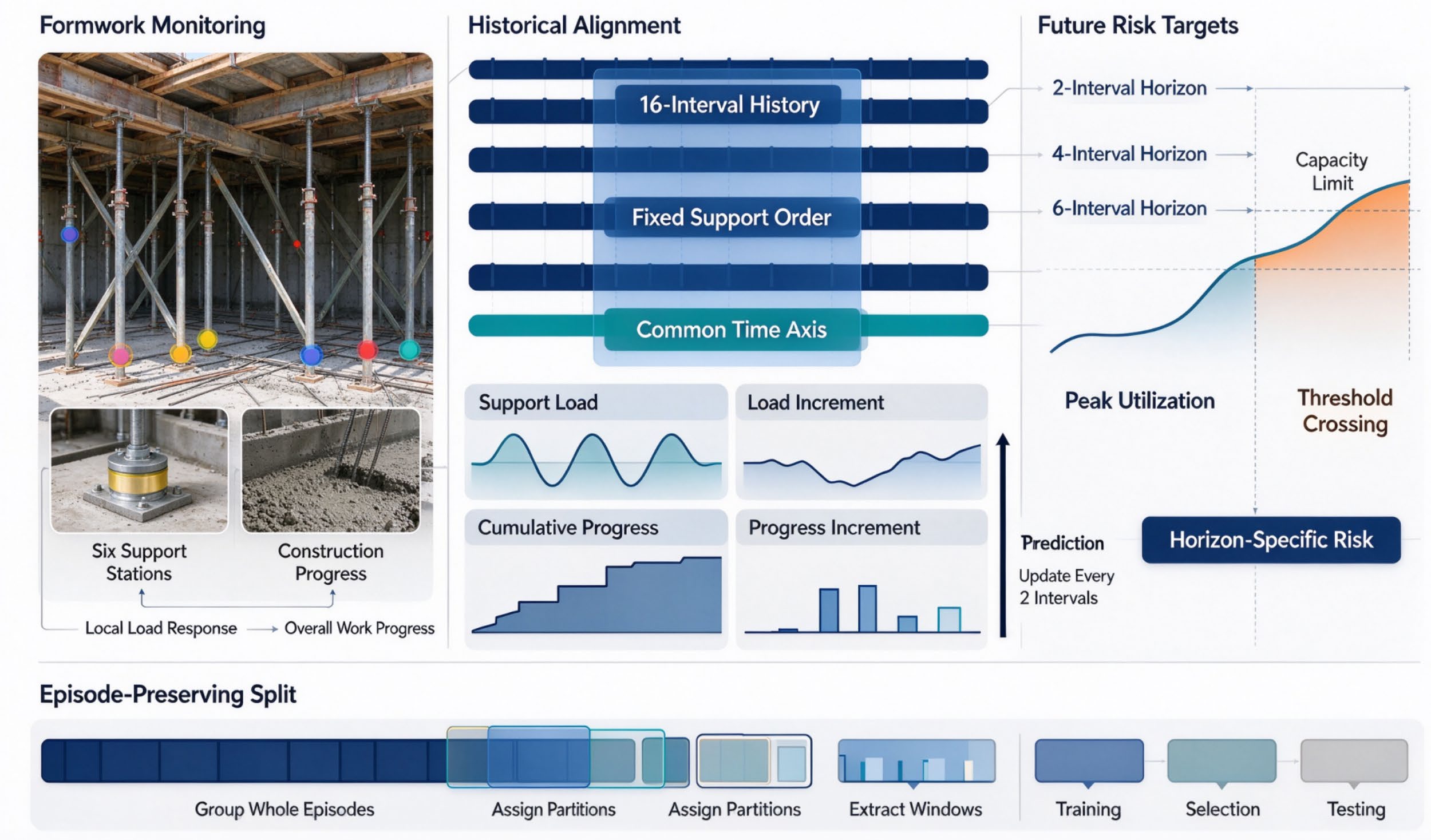
Formwork collapse-risk forecasting requires alignment of changing support loads with construction progress and an explicit future capacity-reference target. This study evaluates a compact progress-aware ConvNeXtV2-CBAM encoder on a numerical construction-sequence reference. Six support-load measurements, their increments, cumulative progress and recent progress increments form a four-channel, six-support, sixteen-interval historical map at each prediction endpoint. A ConvNeXtV2-style convolutional representation with global response normalization is refined by sequential channel and spatial attention. Shared features generate binary probabilities for capacity-reference crossings within the next two, four and six intervals, alongside auxiliary estimates of maximum future utilization. The reference contains 180 independent construction episodes and 3,960 historical windows; complete episodes are assigned to training, model selection or testing. The combined familiar-rate and withheld-rate test partitions contain 1,848 windows. Positive-class F1 reaches 0.8993, 0.9010 and 0.8808 at the respective horizons, with corresponding accuracies of 96.86%, 96.16% and 94.48%. Under a six- interval warning region, threshold 0.50 and two-endpoint persistence, the model detects 50 of 61 eligible reference crossings, or 81.97%, with a conditional mean advance of 4.34 intervals among detected events. The median network- forward time is 1.075 ms for 8,441 trainable parameters. Component comparisons show that an eight-interval history obtains six-interval F1 0.9011 and progress-channel removal obtains 0.8861, both above the full configuration's 0.8808, whereas removal of auxiliary utilization supervision yields 0.8604. These results characterize forecast, warning and efficiency trade-offs for the declared numerical load–capacity process and motivate validation on independently monitored formwork operations.
Details
License
Copyright (c) 2026 Zulfikar Osman, Priyanka Gandhi, Syafiq Abdullah

This work is licensed under a Creative Commons Attribution-NonCommercial-ShareAlike 4.0 International License.
