Hypergraph Transformer Model for Masonry Quality Defect Recognition from Close-Range Wall Images
Authors
Files
Key Information
Journal

Published in Vol. 4 No. 3 (2026) of Journal of Data‑Centric Engineering Science.
Journal of Data‑Centric Engineering Science eISSN 3136-814X is an international, peer‑reviewed open‑access journal. It publishes high‑quality original research, methodological advances, comprehensive reviews, dataset papers and short communications concerning fundamental theories, scientific methodologies and cross‑domain engineering applications under the data‑centric paradigm. This journal focuses on underlying scientific problems of data‑driven engineering, promotes the integration of data science and physical‑mechanism‑based engineering science, and builds an interdisciplinary platform for academic researchers and industrial scientists.
About the JournalAbstract
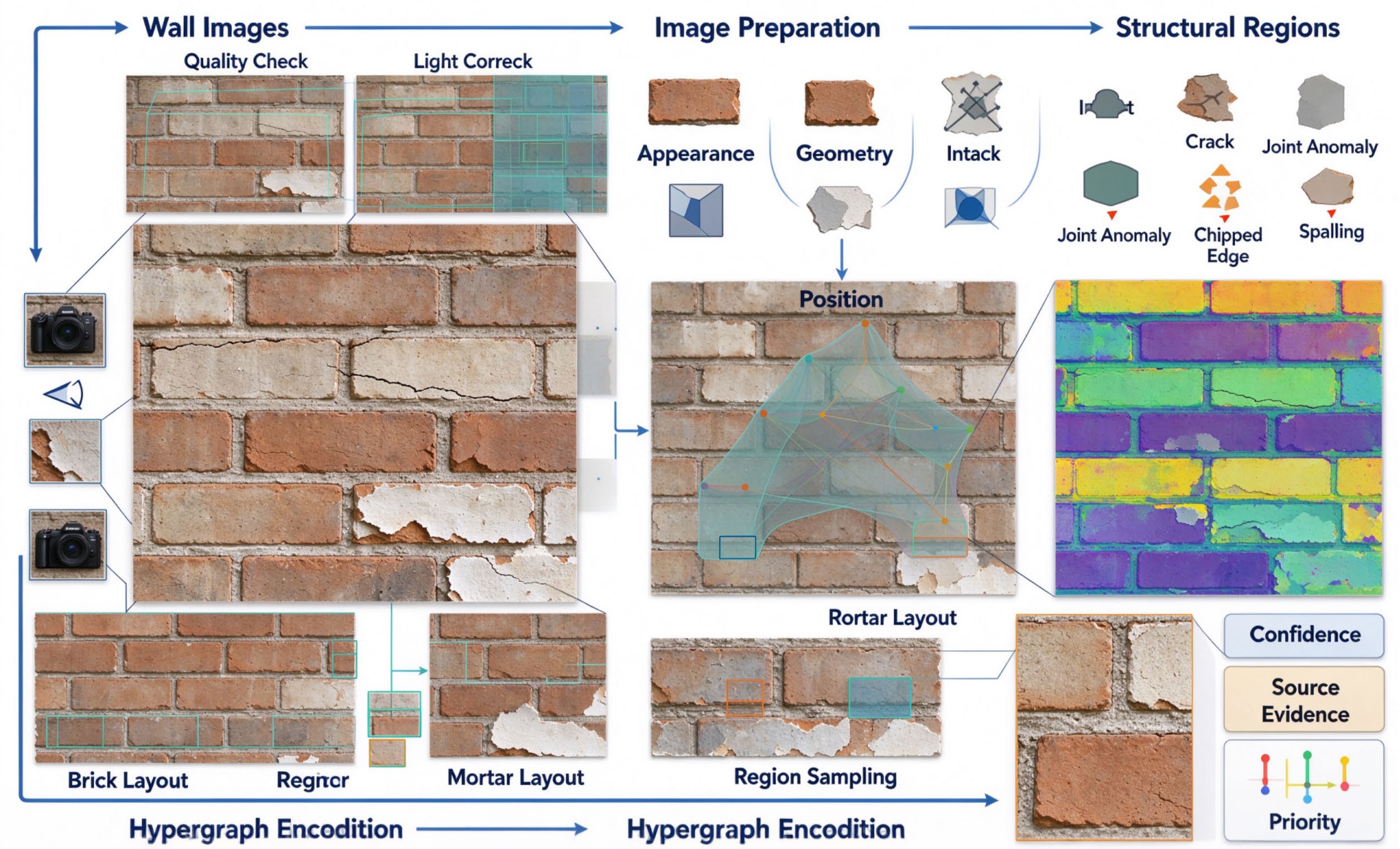
Close-range masonry inspection requires recognition of local damage while retaining the relation between brick texture, mortar continuity and visible wall geometry. This study specifies a structure-guided Hypergraph Transformer for region- level classification of intact surface, cracks, joint anomalies, chipped edges and surface spalling. Colour photographs are padded to a 1024 by 1024 reference input while preserving aspect ratio, and larger images are processed through overlapping tiles linked to their parent coordinates. A feature pyramid and a layout branch support regional sampling with a maximum of 256 nodes per tile. Each region combines appearance, normalized geometry and observation-quality descriptors in a 384-dimensional embedding. Local, mortar-joint and texture hyperedges encode complementary spatial and structural associations. Three hypergraph blocks use four attention heads to aggregate region states within typed relations and redistribute relation-conditioned evidence before classification. Boundary supervision and matched-region augmentation consistency supplement class-weighted learning, with initial auxiliary coefficients of 0.3 and 0.1. The evaluation protocol assigns independent wall groups in planned proportions of 70% training, 15% validation and 15% testing. Half of the validation pool, or 7.5% of total groups, serves checkpoint selection; the other half serves probability- temperature calibration. Planned comparisons include regional MLP, convolutional, pairwise graph-attention and dense Transformer alternatives under matched wall assignments, alongside relation-family and supervision ablations. Class- specific recall, macro-F1, balanced accuracy, wall-level uncertainty, computational cost and controlled imaging disturbances define the intended assessment. A confidence-based review policy is specified at candidate-region budgets of 5%, 10%, 15%, 20% and 30%. The manuscript establishes a traceable computational and evaluation design; realized wall- group counts, recognition scores and prospective inspection yield remain subjects for empirical validation.
Details
License
Copyright (c) 2026 Vesna Erjavec, Julija Rozman

This work is licensed under a Creative Commons Attribution-NonCommercial-ShareAlike 4.0 International License.